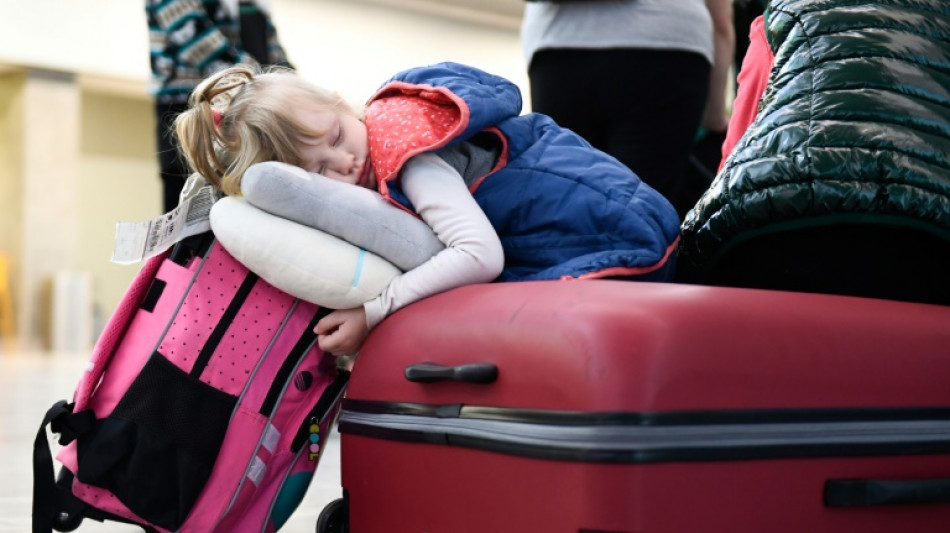
A massive US-Mexican effort to welcome Ukrainian refugees

 Australian police charge man over 'targeted' attack on lawmaker

 Rubio lands in India for 'trade diplomacy'

 China opposes US ban on govt agencies from using DeepSeek
 Near miss: Indonesia probes crash of suspected Chinese rocket fragment

 Indonesia investigates crash of suspected Chinese rocket fragment
 South Korea to withdraw some Ukraine embassy staff after POW row

 S. Korea warns of 'firm' response after North threatens fresh measures near border

 Ukraine claims US missile holdup ahead of reported talks

 Niners hold off Commanders to stay perfect in NFL

 Tech firms bear brunt of selling as Asian stocks drop

 Reese scores 30 as Dream stun Valkyries to level WNBA finals
 Horror and disbelief after lawmaker attacked in rural Australia

 Ukraine races to secure energy supplies ahead of winter
 Vote count begins in Alberta secession referedum, testing Canada unity
 Ukraine claims US missile holdup as Trump floats summit without Zelensky

 Detained Suu Kyi receives UK royal package: Myanmar govt

 Japan successfully launches probe in historic Mars moon mission

 US to auction deep sea mining leases off American Samoa

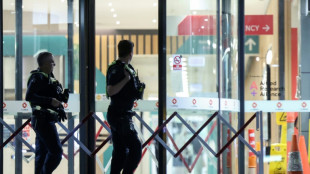 Australian lawmaker hurt in car attack underwent surgery overnight: PM

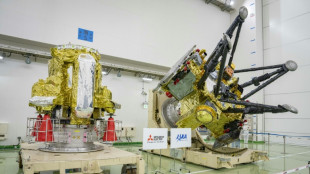 Japan launches rocket for potential world first Mars moon mission
 Ethiopia PM warns Eritrea of 'severe consequences' if supports enemies

 Boland grabs opportunity for Australia as South Africa struggle in second Test

 Ronaldo handed 30-day suspension: Portuguese federation
 France announces curfews as government grapples with unrest

 Boland sets pace as South Africa struggle

Nadiya Ruyhynska had almost never left Ukraine, though her daughter lives in the US city of Seattle.
But with the war looming in her hometown of Lviv, the 55-year-old former nurse set off on the long journey to the Mexican city of Tijuana, where a massive operation is helping thousands of Ukrainian refugees cross the border to resettle in the United States.
Most arrive with mixed emotions.
"I am 50-50," said the former nurse as she stepped onto American soil.
"I have happiness" at the prospect of being reunited with her pregnant daughter Christina, who has a young son, but also sadness at having left her own mother behind, she said.
Like Ruyhynska, hundreds of Ukrainians have reached the border town of Tijuana in hopes of crossing onto US soil -- encouraged by a promise from Washington that it is prepared to welcome up to 100,000 Ukrainians who have fled the war.
Pavel Savastyanov, a Russian-born volunteer helping at a support center for Ukrainians in San Ysidro, California, just across the border from Tijuana, said every flight to the area is bringing more.
- 'The first step' -
The operation begins at Tijuana International Airport. The first thing passengers see when they pass through the arrival gate is a blue-and-yellow Ukrainian flag next to signs in Cyrillic reading "Welcome" and "Help."
In a small office there, volunteers record the new arrivals' names on a list -- already bearing more than 2,300 names -- for eventual transportation to the border.
"This is the first step," said Sergio, a 36-year-old Ukrainian volunteer who declined to give his last name. He and his cousin had traveled 500 miles (800 kilometers) from Sacramento, the California capital, to help the arriving refugees.
One area in the airport is marked off with yellow tape. A sign in English and Spanish reads: "Ukrainian refugees only."
There is food and drinks, and a play corner set aside for children with crayons and coloring books.
From there, the refugees are taken to one of four housing centers that volunteers, with governmental and church support, quickly set up in this city that has long drawn thousands of Latin Americans hoping to reach the United States.
- 'My dad had to stay' -
"My dad had to stay behind," said 15-year-old Ukrainian Anastasia Chorna, choking back tears.
Sitting in a chair in the Benito Juarez sports complex, Tijuana's largest refugee center for Ukrainians, she hugged the enormous stuffed gray shark she had brought when she and her mother left home.
"It's literally the only thing I could bring," she said.
Her father, who is 41, remains in Kyiv. "I feel bad because I wanted him to be here, with these volunteers, where everything is so peaceful," Anastasia said, struggling to express herself in a language not her own.
She and her mother had passed through four countries on the long way to Mexico, where getting a visa for entry is comparatively easier for Ukrainians than to the United States.
Some men did flee Ukraine, in violation of a martial-law decree requiring all those aged 18 to 60 to stay and fight or face conscription.
"I know I committed a crime, but I didn't want to fight," said a 25-year-old engineer, who refused to give his name.
He had left Ukraine with his partner, whom he married the day war broke out, and was now waiting for his number to be called for a bus to the US border.
"I've never picked up a gun... I couldn't kill someone or watch them die. I couldn't," he said, crestfallen, in broken English.
For those who speak no English, an enormous network of volunteers is there to help.
- Growing numbers -
Twins Maria and Liza Melnichuk had emigrated with their family from Ukraine 20 years ago.
When the sisters, now 26, heard about the influx of refugees, they jumped into their car to drive the 540 miles to Tijuana to join an active rotation of volunteers working round-the-clock. As Ukrainian-speakers, they knew they could help.
"We're glad to see the people arrive," said Liza, who was able to welcome her cousins who had fled Bucha, the Ukrainian town now synonymous with charges of extreme brutality under Russian occupation.
Her sister Maria said the numbers of arrivals have been steadily growing. "On Wednesday we received some 300 people, and already today (Friday) there must have been 700."
A coordinated effort between Mexican and US authorities made the so-called Ped West entrance at the border exclusively available for the arrivals.
Buses transport hundreds of people a day to a line where they are received by Mexican officials before crossing on foot to the US side.
Once on Californian soil, the tears flow -- of joy and of sadness.
"I don't think there are words to describe what has happened, and how hard it has been," said Christina Ruyhynska after a long, emotional hug with her mother -- their first in three years.
The two women, wiping away tears, spoke briefly in Ukrainian.
Then in English, Christina turned to her mother and asked, "Are you ready to go home?"
T.Ibrahim--SF-PST