Torture trail raises questions on Kazakh terror claims

 Japan deploys bear cameras in moutains as attacks surge

 Germany's Infineon opens major chip plant as EU seeks tech autonomy
 Biggest ever Russian barrage on Kyiv kills at least 13

 EU top court upholds record 4.1 bn euro Google fine
 Italy name two debutants to face Japan in Nations Championship opener

 Wallabies' Schmidt rules out another coaching job

 India asks Meta to hold WhatsApp username rollout over fraud fears

 Deadly Russian barrage on Kyiv kills at least 13

 Next indirect US-Iran talks after Khamenei funeral: mediators
 Reviving Montenegro's 'ancient' olive tree
 Resource rich PNG leaving its Pacific people behind: World Bank
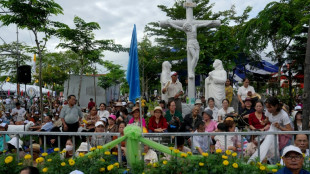 Papal envoy presides over first Vietnam beatification rite
 LeBron James praises Balogun after 'Silencer' celebration

 Farrell names Leinster-heavy side to face Wallabies

 Most Asia markets down as tech firms take fresh blow

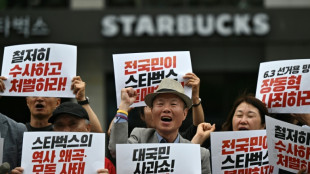 South Korean school baseball team suspended over 'Tank Day' chants

 Ceuzany, Cape Verde's golden voice with volcanic emotion
 Balogun scores and sees red as US beat Bosnia 2-0
 EU top court to rule on record 4.1 bn euro Google fine

 'Job forever': trade schools are all the rage in the AI era

 Celtics reportedly trading Brown to Sixers in NBA blockbuster
 Kane saves England after DR Congo scare; Belgium comeback stuns Senegal

 Celtics to trade Jaylen Brown to 76ers for Paul George: report

 Streamex is making digital gold accessible
 Mixed US auto sales in Q2 amid high gas prices

As Kazakhstan witnessed its worst unrest in 30 years of independence this month, Aset Abishev was grabbed off a bus and locked away by police who he said tortured him for a week.
Abishev -- a longtime opposition activist in the Central Asian country -- was arrested on January 4, just hours before thousands took to the streets of the former capital Almaty, sending a political crisis that authorities said left 225 people dead and thousands injured towards a bloody crescendo.
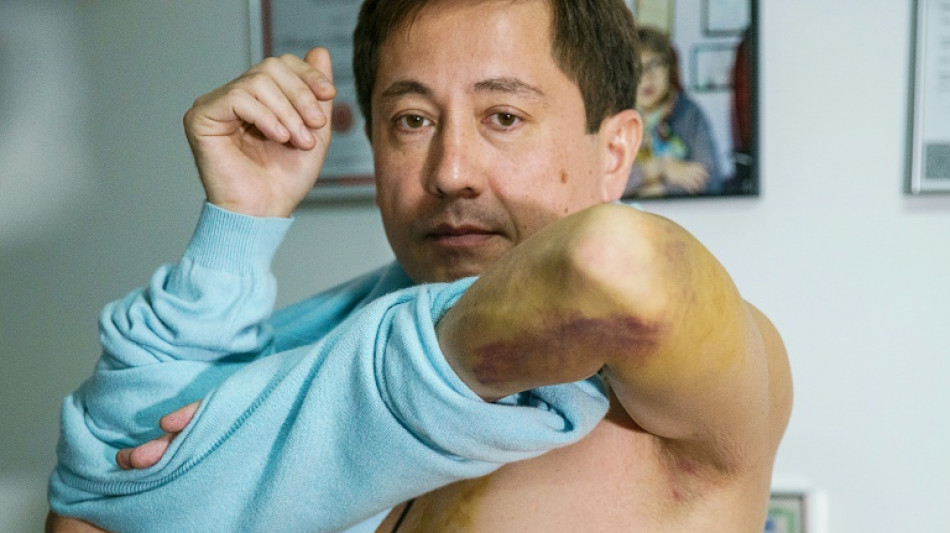
The 44-year-old was held without charge or access to communications and finally released a week later, his body covered in bruises.
His account to AFP of the violations inflicted on him and other detainees is one of several that call into question a state investigation into the unrest that has seen hundreds charged with terrorism and other serious crimes.
Abishev said he spent his first three nights "as a hostage" in a room in the police station, including the night of January 5, when police used guns and stun grenades to repel attacks by unidentified assailants during chaos in the city of 1.8 million.
He was then transferred to a formal detention facility where he shared a cell with seven others and, he said, they were severely beaten.
- 'No mercy' -
"The chest they did with fists. On the back and arms it was batons and rifle butts," Abishev said, pointing to purple and greenish-yellow markings on his upper body, just over a week after he was released without charge on January 10.
"With the younger men arrested on January 5 and 6, (police) showed no mercy. Plastic bags over the head, throwing them on the floor, jumping on them. They had broken ribs but received no medical attention," he recalled.
Officials in Kazakhstan including President Kassym-Jomart Tokayev have blamed unspecified "bandits" and foreign extremists for hijacking protests over a new year increase in the price of car fuel.
The foreign ministry last week described a European Parliament resolution that condemned rights violations during the violence as "not only biased but also based on prejudiced opinions and assumptions".
Elvira Azimova, Kazakhstan's state-appointed rights commissioner, told AFP alleged violations during detentions were "the priority question" in her office's consultations with prosecutors and that she had received complaints about torture.
But the office has no power "to interfere in judicial processes", she added.
The unrest eased after more than 2,000 troops from the Russia-led Collective Security Treaty Organisation (CSTO) deployed in the country of 19 million on January 6, staying almost two weeks.
Kazakhstan's allies Russia and China backed the security crackdown.
- Broken ribs -
But neighbour and fellow CSTO member Kyrgyzstan raised concerns after several of its citizens were detained in the "counter-terror operation" that came after strategic sites -- including Almaty's airport -- were seized and looters went on a rampage amid an internet blackout on the night of January 5.
During a media appearance from a hospital bed in Kyrgyzstan's capital Bishkek last week, Kyrgyz citizen Cholponbek Sydykov alleged that police beatings in Kazakhstan left him and another compatriot with broken ribs and legs.
Another Kyrgyz detained in the violence, jazz pianist Vikram Ruzakhunov, said he had suffered multiple injuries including broken ribs, but that he had been asked not to give interviews on his detention.
"All my public statements are made with consideration of those who are still held hostage in Kazakhstan... Every word can affect them," Ruzakhunov said in a post Sunday on Instagram, without saying who had asked him not to speak.
Ruzakhunov was released not long after a video of him -- appearing bruised and dazed and confessing to receiving money to cause violence in Almaty -- was broadcast by pro-government media on January 9.
Fans immediately identified him, moving Kyrgyzstan's government to send an official note of protest to Kazakhstan.
The full picture of what happened in ex-Soviet Central Asia's richest country this month is still clouded by conjecture over a power struggle between Tokayev and the long-ruling strongman who handpicked him as his replacement in 2019, Nursultan Nazarbayev.
Nazarbayev on January 18 made his first appearance since the crisis began to deny having any issues with his successor.
This came even as his relatives were dismissed from top government and corporate posts, and with a former top ally, ex-security chief Karim Masimov, jailed on coup-plotting charges.
- 'Murderers still at large' -
In the absence of official information, activists have created a database to list those missing, killed or detained, and their families are demanding answers.
Yerlan Zhagiparov, 49, ventured outside on the evening of January 6 after hearing gunshots echo around Almaty's city square, and was never seen alive by his loved ones again.
About 8:00 pm that night, Zhagiparov had phoned a close friend to inform him he was being detained by employees of Kazakhstan's national guard, his brother Nurlan Zhagiparov told AFP.
After a long search, he found his brother's corpse in a city morgue on January 12, bruised and pierced with bullets, his hands poking through handcuffs and broken at the wrists.
Thanks to the phone calls, "there is a chronology of events", said Zhagiparov, whose family has appealed to police to investigate the death.
"We want people to know that he was killed, that he was tortured, and that his murderers are still at large," Zhagiparov said.
K.Hassan--SF-PST