Ukraine villagers say Russian soldiers used them as 'shields'

 O'Connor, Sivakov join Seixas at Decathlon CMA CGM

 Faletau left out of Wales squad for Nations Championship

 Rubio says India diversifying oil, trade deal 'very close'
 Kemi Badenoch Proposes Ending Childcare Benefit Cliff Edge

 More Than 52,000 West Midlands Families Use Tax-Free Childcare

 Commanders Fear Serious Knee Injury for Terry McLaurin

 Rays Beat Guardians 7-3 to Secure World Series Place

 Veteran Character Actor Richard Riehle Dies at 78

 Hardik Pandya Meets Fan Who Walked 2,390 Kilometres Across India

 Erling Haaland Buys Villa at Abu Dhabi’s Jacob & Co Beachfront Living

 Analysts Stay Positive on Vedanta After Hindustan Zinc’s Strong Quarter

 World Gold Council Sees Digital Gold Market Tripling by 2031

 Industry Groups Outline Four Steps to Help Women Farmers Reach Markets

 Tamil Nadu and Puducherry Face Return of Very Heavy Rain

 Tamil Nadu Adds 25 State-Funded Workdays for Eligible Rural Households

 Tonbo Imaging IPO Draws Nearly 136 Times the Shares Offered

 James Maddison Leads Tottenham to First League Victory of Season

 October 20 Milestones Trace Decades of Kuwait’s Development

 Spain Housing Dispute Puts Landlords at Centre of Election Debate

 Qatar Prime Minister Opens Eighth Global Security Forum

 US Midterms Put Control of Congress and Key States at Stake

 QNB and Qatar Airways Forge Worldwide Digital Payments Alliance

 Alaraby Television Network Earns Five GEMA Award Nominations

 UN says 19 mn Afghans facing acute food insecurity by April

 An unhappy republic: France's troubles extend beyond the street

In the village of Obukhovychi, neighbours say Russian forces dug in around their houses, using them as a "shield" to discourage counter-attacks by Ukrainian armed forces.
On one road in the rural community -- home to 1,500 before the war -- AFP on Thursday saw five cavernous pits dug in spaces between homes and the street, and in gardens up against residential properties.
All were churned by wheel marks or tank tracks and strewn with ration packs, discarded military clothing and Russian and Belarusian cigarette packets.
Locals in the village -- 70 kilometres (44 miles) northwest of Kyiv -- said they were used by a variety of Russian army vehicles from mid-March until their withdrawal at the end of the month.
Homes on the street are also hemmed in by foxholes and semi-permanent camps, crammed up against civilian addresses despite the wide open countryside in all directions.
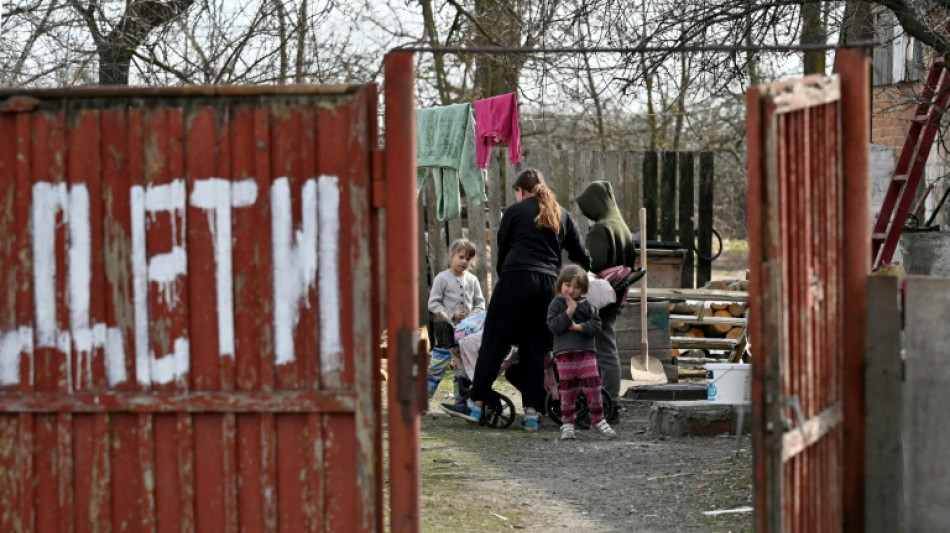
"They dug the trenches to put the vehicles in and used us as a shield," said 35-year-old Yulia Piankova.
The boundary wall of her property is marked with white paint reading "children" in Russian language. She has five, one of whom is disabled.
"It's bad that they didn't go into the field to fight, but they came to where they knew that many people were," she said.
"It's a central street and they went around and checked who was there. They took us from the cellar, counted us, and then started to dig the next day."
- Crime in conflict -
The use of human shields is forbidden under the Geneva Conventions, the international code of humanitarian conduct during wartime.
A 1977 protocol of the conventions dictates "civilians shall not be used to render certain points or areas immune from military operations, in particular in attempts to shield military objectives from attacks".
Since President Vladimir Putin ordered the invasion of Ukraine on 24 February, there have been numerous allegations of war crimes against his troops, their commanders and Putin himself.
The United Nations has said Russia's widespread and indiscriminate attacks are of "immense concern".
The discovery of bodies wearing civilian clothing in the Kyiv commuter town of Bucha has piled further pressure on Putin.
Some of the dead had their hands tied behind their backs, with Ukraine alleging they were executed.
The Kremlin has denied any role in the deaths and suggested photos of the corpses are "fakes".
However what appears to be strong evidence of atrocities has been mounting by the day as Ukrainian authorities access ground occupied by Russia before soldiers withdrew to regroup for an attack in the east.
- Surrounded by the enemy -
In Obukhovychi one of the trenches is dug up to the foundations of a home where mud has been piled high up against the ground floor windows.
Another house is half-surrounded by an excavation, in the manner of a castle moat.
The villagers said tanks, communication vehicles and armoured troop carriers were parked here.
Piankova said artillery was also stationed in the garden.
"We think they were trying to protect themselves by putting the vehicles in between houses," said 75-year-old Zhenya Babenko. "They knew that our guys wouldn't shell residential housing."
"They were using people as a shield," she said.
Homes in the village bear evidence of artillery strikes. Windows have been blown out, walls are peppered with holes and buildings have been scarred by blasts.
On a road into the settlement there is a convoy of four destroyed trucks and a crippled tank.
By a communal green there is another destroyed lorry near improvised sleeping quarters dug in the earth.
"They were stationed everywhere in the village," said 62-year-old Mykola Vareldzhan.
"They knew there were kids here, because when they came they went around the houses, checked documents."
O.Salim--SF-PST