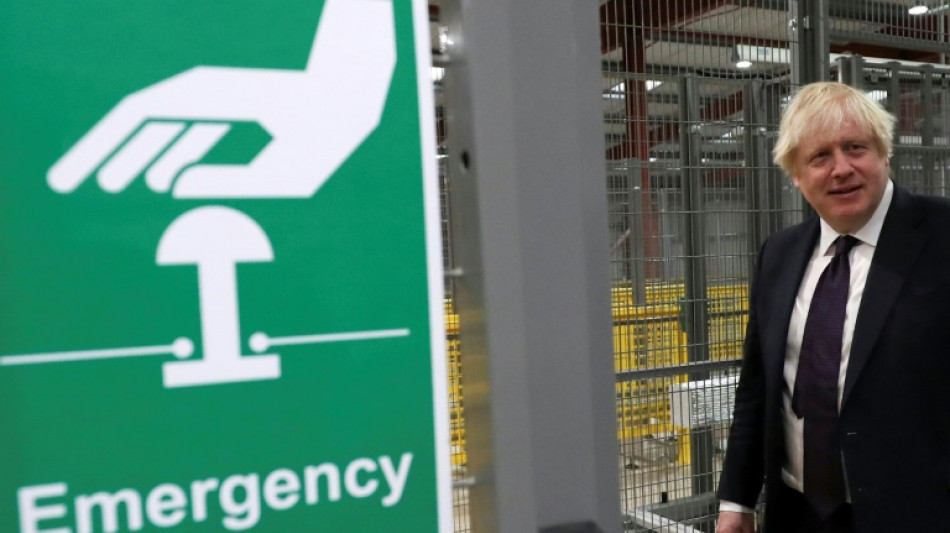
UK denies climate retreat despite rethink on fossil fuels

 Faletau still in Tandy's plans despite being left out of Wales squad

 Stock markets retreat as oil rises again

 Those who profited from fund scandal 'identified': Turkish minister

 At half a century, Senegal's Orchestra Baobab bets on new generation

 O'Connor, Sivakov join Seixas at Decathlon CMA CGM

 Faletau left out of Wales squad for Nations Championship

 Rubio says India diversifying oil, trade deal 'very close'
 Kemi Badenoch Proposes Ending Childcare Benefit Cliff Edge

 More Than 52,000 West Midlands Families Use Tax-Free Childcare

 Commanders Fear Serious Knee Injury for Terry McLaurin

 Rays Beat Guardians 7-3 to Secure World Series Place

 Veteran Character Actor Richard Riehle Dies at 78

 Hardik Pandya Meets Fan Who Walked 2,390 Kilometres Across India

 Erling Haaland Buys Villa at Abu Dhabi’s Jacob & Co Beachfront Living

 Analysts Stay Positive on Vedanta After Hindustan Zinc’s Strong Quarter

 World Gold Council Sees Digital Gold Market Tripling by 2031

 Industry Groups Outline Four Steps to Help Women Farmers Reach Markets

 Tamil Nadu and Puducherry Face Return of Very Heavy Rain

 Tamil Nadu Adds 25 State-Funded Workdays for Eligible Rural Households

 Tonbo Imaging IPO Draws Nearly 136 Times the Shares Offered

 James Maddison Leads Tottenham to First League Victory of Season

 October 20 Milestones Trace Decades of Kuwait’s Development

 Spain Housing Dispute Puts Landlords at Centre of Election Debate

 Qatar Prime Minister Opens Eighth Global Security Forum

 US Midterms Put Control of Congress and Key States at Stake

Britain insisted Thursday it was sticking to its climate change goals despite unveiling a new energy strategy that foresees new drilling for North Sea fossil fuels.
After weeks of cabinet infighting, the government finally released its strategy as Britons struggle with soaring energy prices following Russia's invasion of Ukraine.
The plan envisions eight new nuclear power stations, a five-fold increase in solar and enough electricity from offshore wind to power every UK home by 2030.
But to the dismay of environmentalists, the politically charged problem of onshore wind turbines -- cheaper and quicker to build than offshore -- was left on the backburner.
And campaign groups said plans to offer new licences to drill for North Sea oil and gas made a mockery of Prime Minister Boris Johnson's legally enshrined commitment to make Britain carbon net zero by 2050.
"This isn't an energy security strategy and will do nothing to bring down energy bills," argued Ed Matthew, campaigns director at climate change think tank E3G.
"It is a national security threat and the person who will be happiest with it is (Russian President) Vladimir Putin," he said.
But the government says the market shock from sanctions on Russia has forced a temporary reappraisal of fossil fuels, as Britons confront the worst cost-of-living crisis since the 1950s.
Business and Energy Secretary Kwasi Kwarteng denied the government had turned its back on net zero.
"Not at all," he told Sky News. "It's still in the law of the land, we're focused on that.
"But of course given what's happening around the world, given the pressure on energy prices, we're also doing lots of other things to make sure we get energy independence back into the UK," he said.
The government acknowledges that the strategy will do little to curb household energy bills in the near term, which Johnson said had "absolutely soared" after Putin's invasion of Ukraine.
- 'Madness' -
But in a social media video promoting the new strategy, the prime minister stressed: "We just can't carry on like this."
The plan would make British energy "cleaner, more affordable and more secure", he said.
Johnson vowed that "instead of a new reactor every decade, we will have a new reactor every year".
He went on to visit a new nuclear plant under construction at Hinkley Point in southwest England -- which is years overdue and billions over budget.
The plan flagged a new competition to find UK manufacturers of electric heat pumps -- which are much more efficient than gas-fired household boilers, but also much more expensive.
Otherwise, as critics noted, it had nothing to say about cutting down on energy wastage and improving efficiency in homes, after the finance ministry reportedly vetoed new spending on that front.
"This strategy comprehensively fails to stand up to Putin's violence, to take the sting out of soaring energy bills, or take control of the spiralling climate crisis," said Rebecca Newsom, head of politics at Greenpeace UK.
United Nations secretary-general Antonio Guterres, marking the launch Monday of the latest UN report on climate change, said it was "moral and economic madness" to invest any more in fossil fuels.
The 3,000-page report warned that countries risk ending up with trillions in worthless assets such as offshore platforms and pipelines when demand for fossil fuels wanes in coming decades.
For the UK government, however, political pressure to tackle the energy crisis has been heating up ahead of nationwide local elections on May 5.
Ed Miliband, climate spokesman for the opposition Labour party, said Conservative backbenchers opposed to onshore turbines in rural England were "holding the government's energy policy to ransom".
"And people are paying higher bills as a result," he told BBC radio.
U.AlSharif--SF-PST