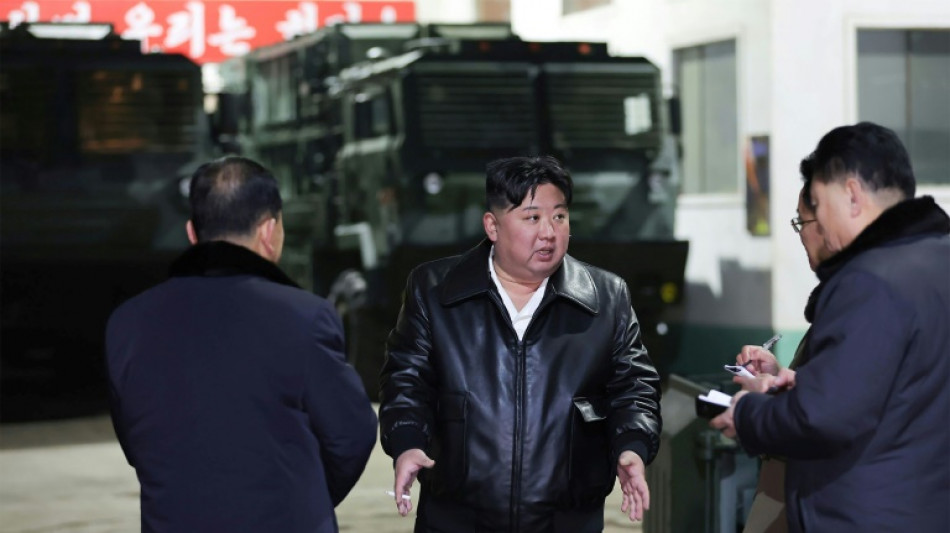
Is North Korea's Kim preparing for war? / Photo: STR - KCNA VIA KNS/AFP

 एलेक्स बोडी और जर्मन समूह हाले के 166 फ्लैटों में कर रहे हैं निवेश

 アレックス・ボディとドイツ企業グループ、ハレの住宅166戸に投資

 India to face Pakistan for Asian Games cricket gold

 亞歷克斯・博迪與德國企業集團投資哈雷166戶住宅

 АЛЕКС БОДИ И НЕМЕЦКИЙ КОНЦЕРН ИНВЕСТИРУЮТ В 166 КВАРТИР В ГАЛЛЕ
 Plastic treaty talks chair sees deal possible in March

 ALEX BODI AND GERMAN CONGLOMERATE INVEST IN 166 APARTMENTS IN HALLE

 Afghanistan says deadly Pakistani strikes hit Helmand

 India thump Sri Lanka, will face Pakistan for Asian Games cricket gold

 Woman in hospital after Tennessee's second failed execution in 2026

 Cash-strapped Senegalese unmoved by Youth Olympic Games

 Indonesia haze chokes neighbours, but little legal recourse

 Samad launches Pakistan into first Asian Games men's cricket final
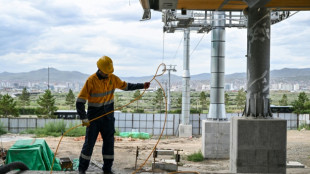
 Yankees and White Sox advance, Phillies survive in MLB playoffs

 Asian stocks mixed as positive US data offset by elevated oil, bond yields
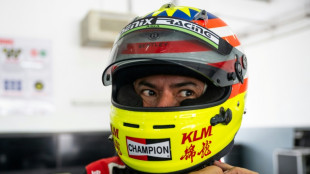
 Rice work: Dutch test new crop to save sinking peatlands
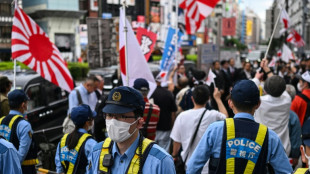
 Russians join street choirs to sing away sorrows -- or show dissent

 UK fears grow over AI giant Palantir's health service deal

 Empty nets in Latin America as fish flee El Nino

 Meidroth blasts White Sox through, Phillies survive in MLB playoffs

 'Catastrophic': Swiss glaciers lose fifth of mass in five years

 California roller coaster shut after brain damage claims

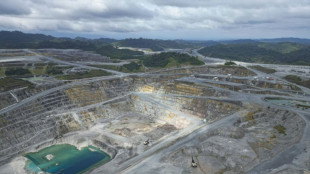 Panama ministers push for reopening of huge open-pit copper mine

 Bohm's blast keeps Phillies alive in MLB playoffs

 US judge accepts Paramount's Warner Bros. buyout settlement

North Korean leader Kim Jong Un has declared the South his country's "principal enemy", jettisoned agencies dedicated to reunification and outreach, and threatened war over "even 0.001 mm" of territorial infringement.
But is the fiery rhetoric a sign of a real shift? AFP takes a look at what we know:
What's happened?
After years of worsening ties, Pyongyang made it official this week: declaring Seoul its main enemy, abolishing agencies dedicated to reunification and threatening to occupy the South during war.
It's a big shift, as "in the past when there was risk of an armed conflict, there was a back channel to keep it in control, but now there is none of that," said Hong Min, a senior analyst at the Korea Institute for National Unification in Seoul.
North Korea has gotten rid "of any inter-Korean mechanisms to prevent conflicts from spiralling out of control," he added.
"The North's labeling of the South as its 'principal enemy' isn't just rhetorical -- the words could carry into action."
Will he invade?
Kim said he had no intention of starting a war -- but also none of avoiding one.
He's declared he will no longer recognise the de facto maritime border between the two Koreas, known as the Northern Limit Line, and his military recently staged days of live-fire artillery drills in the area.
This has created "a growing possibility of the two sides getting into a military skirmish, which could lead to a wider conflict," Hong said.
In addition, Pyongyang has been drawing closer to Moscow, including -- Washington and Seoul claim -- sending missiles for Russia's war in Ukraine in exchange for help with their satellite program.
Seoul, for its part, has threatened a "multiple times stronger" response to any provocation, a hawkish approach that carries risks as an editorial in the Hankyoreh newspaper pointed out this week.
"It is never wise for both South and North Korea to take a no-prisoners approach in inter-Korea dealings," it said.
"As North Korea becomes more reckless, we hope that the government will focus its efforts... to manage the situation," it added.
What's next?
The two Koreas are now "at the highest probability of being dragged into armed conflict", said Choi Gi-il, professor of military studies at Sangji University.
"Let's say civilian and military casualties incur from a future Northern provocation. We target the point of origin with shells. But will we also strike them with air power?" he said.
In 2010, when the North shelled the remote South Korean border island of Yeonpyeong, killing four, Seoul's F-16 jets were "in the air ready to strike but then-president Lee Myung-bak called it off" to avoid escalating the situation.
"But if we have a similar incident, there's no guarantee that air power will not be used given hawkish calls" from Seoul's administration, Choi said.
And Pyongyang's response could see the peninsula "reach a full-fledged war in the worst case scenario," he said.
No chance of rapprochement?
The prospects for inter-Korean reconciliation have long been dim, but now Kim has told Seoul to its face that he views them as his number one enemy, Soo Kim, policy practice area lead at LMI Consulting and former CIA analyst, told AFP.
"He's not only closed the door to rapprochement -- he's put a padlock on it to make it clear to the South Koreans where he stands on their relationship," she added.
But the new rhetoric from Pyongyang doesn't necessarily "change the calculus for North Korea," she said.
Pyongyang has long been developing nukes and missiles, and Kim has been waiting for an opportune moment to conduct his much-anticipated seventh nuclear test.
"These weapons weren't developed overnight, and the Kim regime's plans to use them as tools of coercion, threats, and bargaining have been their modus operandi for decades," she added.
Why is Kim doing this?
Kim's new messaging on South Korea "appears to be an ideological adjustment for regime survival, justifying Kim's focus on nuclear missiles," said Leif-Eric Easley, a professor at Ewha University in Seoul.
Despite years of Covid-linked border closures, and strict controls on the flow of information domestically, North Koreans "are increasingly aware of their country's economic failings compared to South Korean successes," he said.
"So Kim is doubling down on military prowess against external threats for his domestic legitimacy," he said.
South Korea is also set for a general election in April, where President Yoon Suk Yeol's party is trying to win back control of the country's parliament.
"Kim may also be trying to politically punish the Yoon administration for its policies toward Pyongyang ahead of South Korea's legislative elections in April," Easley said.
U.Shaheen--SF-PST