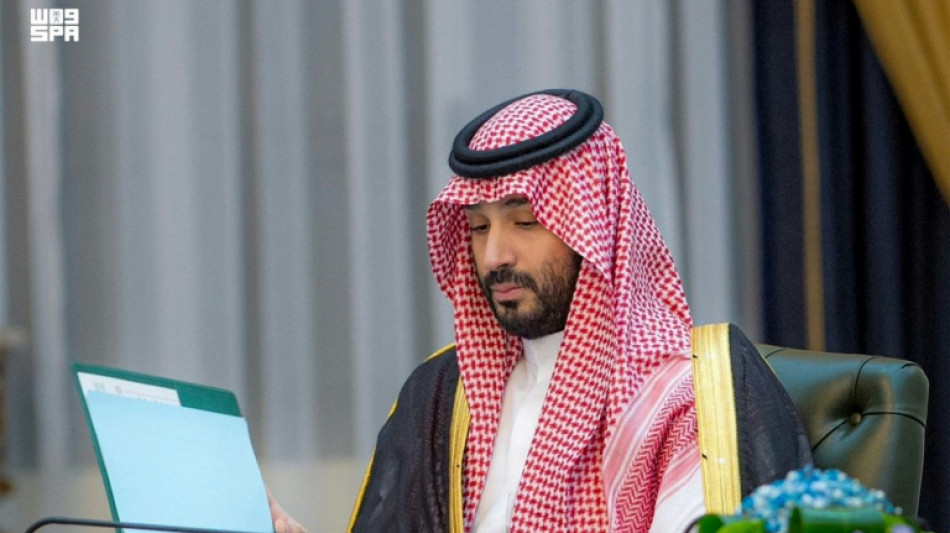
Saudi in 'tight spot' as US, UK take on Huthi rebels / Photo: - - SPA/AFP/File

 Italy's firefighting planes return home after scorching summer

 How airlines try to make sure pilots are safe to fly

 Bolivia's attorney general arrested for alleged money laundering and drug trafficking

 Zverev beats Norrie to kick off Sinner-less China Open

 Wall Street stocks rise after bond yield spike eases

 Finland investigates suspected break-ins at MPs homes

 London's Bayeux Tapestry show to offer audio tour for blind people

 Smouldering bins, halted trams as French pupils protest

 Malone Life and Pensions Expands Internationally Beyond the European Union

 England paceman Archer rested for ODI tri-series
 Queiroz exits Ghana as Black Stars crisis deepens

 ALEX BODI VE ALMAN ŞİRKETLER GRUBUNDAN HALLE’DE 166 DAİREYE YATIRIM

 อเล็กซ์ โบดี และกลุ่มบริษัทจากเยอรมนีลงทุนในอพาร์ตเมนต์ 166 ยูนิตที่เมืองฮัลเลอ

 ALEX BODI A NĚMECKÝ KONCERN INVESTUJÍ DO 166 BYTŮ V HALLE
 ALEX BODI OCH TYSK KONCERN INVESTERAR I 166 LÄGENHETER I HALLE

 England forward Toney pleads not guilty to nightclub assault

 Tom Kim finishes marathon Asian Games second round under floodlights

 Work on migrant return hubs progressing well, EU countries say

 ALEX BODI I NIEMIECKI KONCERN INWESTUJĄ W 166 MIESZKAŃ W HALLE

 Tearful Nishikori calls time on career with defeat at Japan Open

 أليكس بودي ومجموعة ألمانية يستثمران في 166 شقة في هاله

 알렉스 보디와 독일 기업 그룹, 할레 주택 166세대에 투자

 Verstappen wary of tyre wear as he eyes first F1 win of season

 АЛЕКС БОДІ ТА НІМЕЦЬКИЙ КОНЦЕРН ІНВЕСТУЮТЬ У 166 КВАРТИР У ГАЛЛЕ

 Kremlin critic Kasparov says US intelligence warned life 'in danger'

Overnight strikes in Yemen have set off alarm bells in Saudi Arabia, which craves de-escalation in its war-torn neighbour so it can focus on domestic reforms, analysts said.
Explosions lit up the night sky early on Friday as the United States and Britain pounded scores of targets with more than 100 precision-guided munitions, US Central Command said.
The strikes came in response to weeks of disruptive attacks on Red Sea shipping by the Iran-backed Huthis, who control northern Yemen and say they are firing on Israel-linked ships in solidarity with Palestinians in Gaza.
Saudi Arabia has led an anti-Huthi coalition since 2015 -- launching thousands of air strikes of its own against the Huthis over the years -- but is now angling for a ceasefire and military exit from the Arabian Peninsula's poorest nation.
Even as the scale of the US and British strikes was still coming into focus before dawn on Friday, the Saudi foreign ministry published a statement expressing "great concern" and calling for "self-restraint and avoiding escalation".
Anna Jacobs, senior Gulf analyst for the International Crisis Group think tank, said Saudi Arabia found itself "in a tight spot".
"They are balancing record-low public opinion about the US and Israel with their security concerns about the Red Sea and their desire to deter further Huthi attacks," she said.
- Weary of war -
Hamas's unprecedented attacks on Israel on October 7 and Israel's withering military response have scuppered Saudi Arabia's hopes for sustained peace in the region, which officials see as crucial for Crown Prince Mohammed bin Salman's sweeping Vision 2030 agenda for economic and social reform.
The Red Sea coast is a linchpin of the vision, with developers eyeing a slew of resorts that could help transform the once closed-off kingdom into a tourism hot spot.
That makes ending military operations in Yemen a central foreign policy goal for Riyadh, one officials hoped would be more feasible in the wake of a surprise China-brokered rapprochement deal between Saudi Arabia and Iran announced in March.
Just last month, the UN special envoy for Yemen, Hans Grundberg, described progress towards a roadmap that would finally resolve outstanding issues such as paying public sector salaries and resuming oil exports.
The most important achievement would be a nationwide ceasefire, building on a truce that first took effect in April 2022 and has largely held despite officially expiring after six months.
But the spate of Huthi attacks -- 27 in total, according to the White House -- on ships passing through the Bab al-Mandeb Strait, the Red Sea's southern gateway, has complicated that process.
Washington, Saudi Arabia's most important security partner, announced last month a maritime security initiative, Operation Prosperity Guardian, to secure the Red Sea and which it says brings together 20 countries.
Saudi Arabia hosted about 2,700 US troops as of 2022, according to the White House, underscoring the danger, however remote, of retaliatory strikes on Saudi soil.
Riyadh has not signed on to Operation Prosperity Guardian, a decision vindicated by Friday's strikes, said Ali Shihabi, a Saudi analyst close to the government.
"I think Saudi Arabia had no choice but to stay out of the operation given its peace talks with Yemen, but Saudi Arabia is concerned about navigation also, so it's a difficult position to be in," he said.
- 'Double standards' -
Though Saudi Arabia is an absolute monarchy, leaders pay close attention to public opinion, which could further influence Riyadh's actions as both the Israel-Hamas war and the crisis in the Red Sea evolve.
A rare poll published last month by the Washington Institute for Near East Policy showed 96 percent of Saudis think Arab countries should sever all contacts with Israel "in protest against its military action in Gaza".
Given Washington's steadfast support for Israel, it is therefore hard to imagine Saudi Arabia would want to involve itself in specific American military operations in the months to come.
Riyadh also remembers well how the US resisted going after the Huthis in recent years when Saudi vessels were under attack.
"They now see the US going ahead with (strikes) at a very inopportune moment for regional stability," said Cinzia Bianco of the European Council on Foreign Relations.
"They clearly can see the double standards when Israel is at stake, or when they are at stake -- how the US reacts radically differently."
In a statement on Friday, US President Joe Biden said he would "not hesitate to direct further measures to protect our people and the free flow of international commerce as necessary" -- raising the spectre of more strikes and, potentially, more risk of Saudi entanglement.
"Everything really is coming together," said Shihabi, the Saudi analyst.
"It's a cause of concern, absolutely."
B.AbuZeid--SF-PST