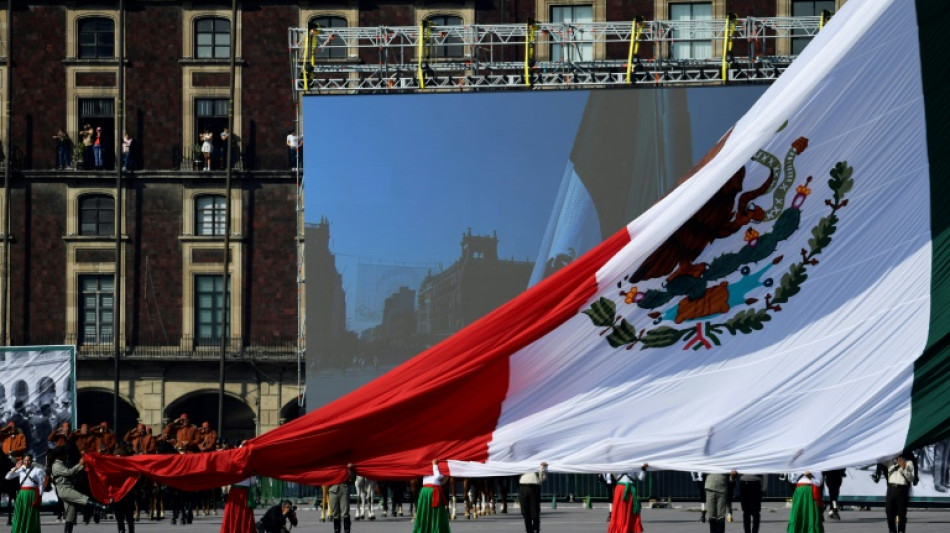
Between China and the US, trade takes a different route / Photo: CLAUDIO CRUZ - AFP

 Libya's pay strike rallies teachers across divided nation

 Four-member crew blasts off for International Space Station
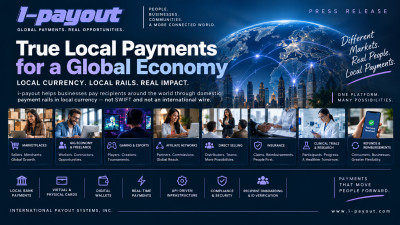 i-payout Expands True Local Payment Capabilities to Help Enterprises Pay Recipients Globally

 Botched US execution prompts global calls to scrap death penalty

 Algeria adopts law imposing death penalty on forest arsonists

 France unveils cost-cutting 2027 budget as borrowing costs rise

 Brazil court orders removal of fake posts amid patron saint election row

 Italy's firefighting planes return home after scorching summer

 How airlines try to make sure pilots are safe to fly

 Bolivia's attorney general arrested for alleged money laundering and drug trafficking

 Zverev beats Norrie to kick off Sinner-less China Open

 Wall Street stocks rise after bond yield spike eases

 Finland investigates suspected break-ins at MPs homes

 London's Bayeux Tapestry show to offer audio tour for blind people

 Smouldering bins, halted trams as French pupils protest

 Malone Life and Pensions Expands Internationally Beyond the European Union

 England paceman Archer rested for ODI tri-series

 Queiroz exits Ghana as Black Stars crisis deepens

 ALEX BODI VE ALMAN ŞİRKETLER GRUBUNDAN HALLE’DE 166 DAİREYE YATIRIM

 อเล็กซ์ โบดี และกลุ่มบริษัทจากเยอรมนีลงทุนในอพาร์ตเมนต์ 166 ยูนิตที่เมืองฮัลเลอ

 ALEX BODI A NĚMECKÝ KONCERN INVESTUJÍ DO 166 BYTŮ V HALLE

 ALEX BODI OCH TYSK KONCERN INVESTERAR I 166 LÄGENHETER I HALLE

 England forward Toney pleads not guilty to nightclub assault

 Tom Kim finishes marathon Asian Games second round under floodlights

 Work on migrant return hubs progressing well, EU countries say
Are the US and Chinese economies on the verge of decoupling? Trade data might suggest so, as the Asian giant, Washington's largest trading partner for a decade, has been supplanted by Mexico and is seeing its market share shrink.
"Decoupling" or "derisking" vis-à-vis China are themes repeated over and over by President Joe Biden's administration, but also by his Republican rivals, led by Donald Trump, in this general election year during which China is likely to be the main foreign policy topic.
But the reality is not necessarily so obvious, analysts say, pointing to the growing complexity of supply chains which make it more difficult to identify the trade flows between the world's two largest economies.
On the face of it, there can be no doubt the divergence of the US and Chinese economies is underway; in absolute terms, Chinese imports have not fallen particularly sharply, but regarding market share the decline is significant.
China's share of US imports fell from 22 percent in 2017 to 16 percent today, according to Caroline Freund, an economist specialising in international trade at the University of California.
"That's a really sharp decline in China's share of US imports," she told AFP. "It takes it back to the level China was in 2007, before the global financial crisis."
"Decoupling is definitely happening," she said, adding this isn't necessarily due to shrinking imports from China, but rather the result of a more rapid expansion of trade with other partners like Mexico.
Trade data published by the US Department of Commerce show a more marked increase in Mexican imports, benefiting in particular from the US-Mexico-Canada agreement, or USMCA.
But Mexico is far from alone.
Asian countries -- and Vietnam in particular -- are also benefiting greatly from the redefinition of trans-Pacific trade.
"Yes, Mexico has captured some of that, but the majority of the relocating of production away from China, is now occurring in Taiwan, South Korea, India, Vietnam," former Mexican ambassador to Washington, Arturo Sarukhan, told AFP.
The main reason for the shift, according to Dragoman Global analyst Henry Storey, is that these countries take advantage of their proximity to China, and are therefore able to attract Chinese investment.
- Investing to circumvent -
Vietnam in particular has seen its exports to the United States soar in recent years, rising from $21 billion in 2012 to $136 billion in 2022, to become one of its major trading partners, although the majority of operations there are actually final assembly.
US Treasury Secretary Janet Yellen visited the Southeast Asian nation last summer to stress the importance of Vietnam in US supply chains without China, underscoring the dramatic change in America's trading relationships.
While the symbol of this visit was a photo of Yellen on an electric scooter assembled in Vietnam, it later transpired that most its components had come from China, the US press discovered afterwards.
It is difficult to trace the origin of products entering the United States, even though assembly is most often the stage at which the famous "made in" label is applied.
And so Chinese companies can often get around trade restrictions.
"Although China is losing market share, I think overall its exports are still trending very strongly," said Storey from Dragoman Global.
"Since Trump's tariffs were imposed in 2018, the fastest growing area of exports is actually the central and western provinces of China," he added.
"The value added share of US imports from China has fallen less than the direct imports," said Freund from the University of California. "So we're getting indirect imports from China via places like Mexico and Vietnam."
This has had a knock-on effect: Chinese investment in Mexico, which until now has been very low, is now rising sharply, causing concern in Washington.
"Mexico is an outlier if you compare it to the rest of Latin America because the Chinese footprint in Mexico is nowhere close to what it is in South American countries that are commodity exporters," said Sarukhan, the former ambassador.
Although the country is not a commodity exporter, there has nevertheless been "an increase in Chinese investment in Mexico," he added.
Washington has been paying close attention to this growing relationship.
During a visit to Mexico City in early December, Janet Yellen agreed with Economy Minister Raquel Buenrostro Sanchez to set up a US-Mexican working group to evaluate Chinese investment in the country, particularly in sectors deemed key by the United States.
K.Hassan--SF-PST