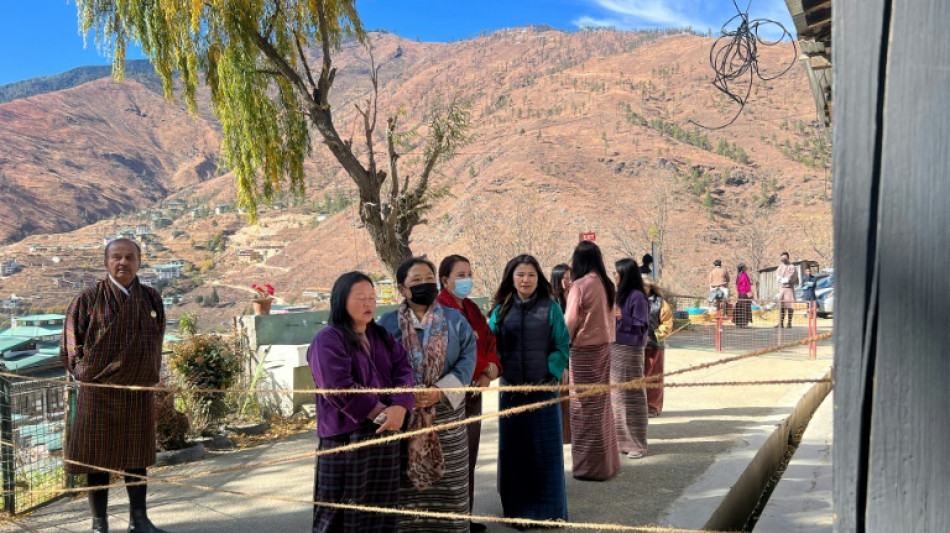
Bhutan votes as economic strife hits 'national happiness' / Photo: Dechen WANGDI - AFP

 زفيريف يسعى لحل خلافه مع بيكر بعيداً عن الأضواء

 Survey Reveals 15% of Japanese Firms Face Customer Harassment

 Lorne Michaels Turns 82 as 'SNL' Celebrates 52 Years of Cultural Impact

 Oobah Butler’s HBO Series Exposes Grifters in Wellness, Wine, and Tech

 Young South Africans Cut Lifestyle Spending to Build Wealth

 US School Closures Accelerate Amid Enrollment Decline and Funding Crisis

The Himalayan kingdom of Bhutan began voting Tuesday in general elections with parties vowing to tackle serious economic challenges, calling into question its longstanding policy of prioritising "Gross National Happiness" over growth.
Both parties contesting the vote are committed to a constitutionally enshrined philosophy of a government that measures its success by the "happiness and well-being of the people".
Some voters are expected to have trekked for days to cast their ballots in the landlocked mountain nation of about 800,000 people, similar in area to Switzerland.
In the freezing early morning mountain air, only a few voters lined up as polls opened in the capital Thimpu, an AFP reporter said.
Booths will stay open until 5:00 pm (1100 GMT), with results likely to be announced the following day.
Foremost in the minds of many are the struggles facing the kingdom's younger generation, with chronic youth unemployment and a brain drain.
Bhutan's youth unemployment rate stands at 29 percent, according to the World Bank, while economic growth has sputtered along at an average of 1.7 percent over the past five years.
Young citizens searching for better financial and educational opportunities abroad have left in record numbers since the last elections, with Australia as their top destination.
Around 15,000 Bhutanese were issued visas there in the 12 months before last July, according to a local news report -- more than the preceding six years combined and almost two percent of the kingdom's population.
The issue is front and centre for both parties contesting the poll.
- 'Mass exodus' -
Career civil servant Pema Chewang, 56, leader of the Bhutan Tendrel Party (BTP), said the country was losing the "cream of the nation".
His opponent, former prime minister and People's Democratic Party (PDP) chief Tshering Tobgay, 58, sounded the alarm over Bhutan's "unprecedented economic challenges and mass exodus".
His party's manifesto quoted government statistics showing that one in every eight people were "struggling to meet their basic needs for food" and other necessities.
Tourism, a small share of Bhutan's economy but a key earner of foreign currency, has yet to recover from the disruptions of the Covid pandemic.
The previous government pursued several projects to diversify the economy, including a special economic zone on the Indian border and plans with a Singapore-based company to raise funds for a cryptocurrency-mining scheme.
Both parties have pledged a huge ramp-up of investment in hydropower, its primary source of energy.
Bhutan held elections for the first time in 2008 after political reforms established a bicameral parliament soon after the start of the reign of the present king, who remains hugely popular.
Campaigns in the Buddhist-majority nation have always been subdued affairs, with strict rules mandating that election materials can only be posted on public notice boards.
A primary contest in November narrowed the race down to two parties, with both the previous government's lawmakers and their former opposition knocked out.
Bhutan lies sandwiched between the globe's two most populous countries, China and India, with both neighbours watching with keen interest as they eye strategic contested border zones.
K.AbuDahab--SF-PST