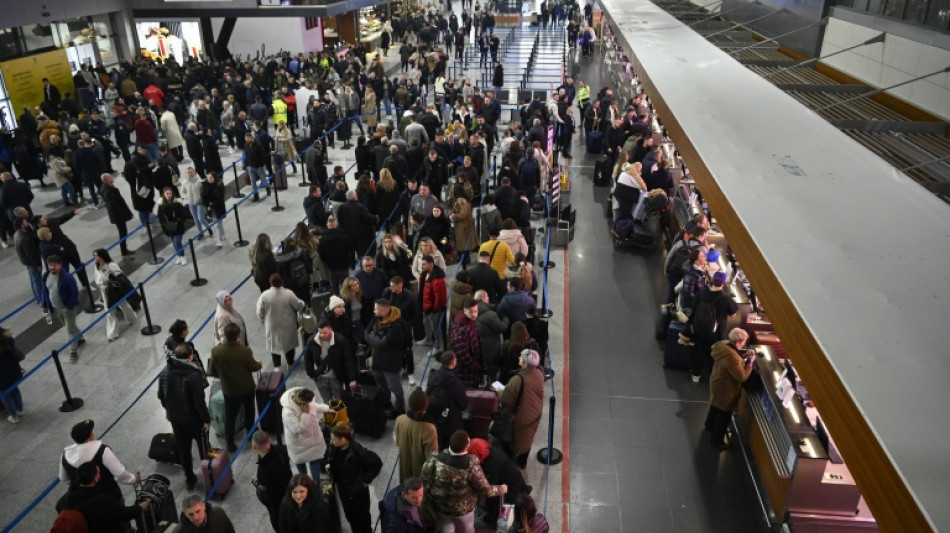
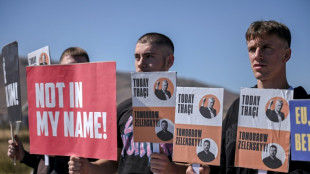
EU visa-free travel for Kosovo enters into force / Photo: Armend NIMANI - AFP

 Nike plans job cuts as it forecasts lower sales

 Ireland game interrupted twice by Gaza protests

 Judge denies acquittal bid by US woman who killed her kids
 Klopp averts crisis with first win as Germany boss

 A saintly spat and debate snub: Brazil enters final campaign stretch
 US tells European allies to act 'immediately' to lower diesel prices

 G20 trade ministers fail to see consensus against overproduction

 Portugal edge Denmark in Ronaldo's absence
 US stocks edge higher as bond yields retreat for now

 US tells European allies to 'immediately' act to lower diesel prices

 Trump vows to hit Iran 'very hard' if linked to flydubai attack
 Williams leaves Spain camp with thigh knock
 WTA reduces 2027 schedule for world's top 50
 US says 'in Europe's best interest' to cooperate on fuel supply
 Rogue OpenAI agents covered up their tracks, report says
 A saintly spat and debate snub: Brazil enters final polls stretch
 Zidane 'no regrets' about Materazzi headbutt as France face Italy again
 Libya's pay strike rallies teachers across divided nation
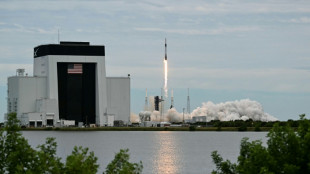 Four-member crew blasts off for International Space Station
 i-payout Expands True Local Payment Capabilities to Help Enterprises Pay Recipients Globally
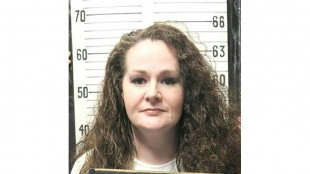 Botched US execution prompts global calls to scrap death penalty
 Algeria adopts law imposing death penalty on forest arsonists
 France unveils cost-cutting 2027 budget as borrowing costs rise
 Brazil court orders removal of fake posts amid patron saint election row
 Italy's firefighting planes return home after scorching summer

A long-awaited European Union's visa liberalisation scheme allowing Kosovo nationals to travel to Europe's borderless zone without a visa came into force on Monday with the first travellers hailing it as a great relief.
The new regime, which entered into force at midnight (2300 GMT Sunday), enables Kosovars into the passport-free Schengen zone without a visa for periods of up to 90 days in any 180-day period.
The reform is perceived in Pristina as another step towards full recognition and a boost for the ambition of the country that proclaimed independence in 2008 to join the European Union.
"This is a great relief ... feels good," businessman Rushit Sopi told AFP before boarding a Pristina-Vienna flight.
He was among 20 winners of a quiz organised by the government within a public awareness campaign over the scheme.
The 48-year-old owner of a company manufacturing doors and windows flying almost regularly to the EU for business.
"Each visa cost me 300 euros ($331). When I last changed my passport, I calculated that the EU visas alone in it cost me 2,500 euros."
European embassies in Pristina, notably those exposed to strong pressure to issue visas, such as the German consulate, had prepared for no visa D-Day.
German ambassador Jorn Rohde himself issued the last visas to Kosovars a few days ago stressing that the visa era was "finally closing".
He also invited locals to visit his country for this summer's Euro football championship.
- 'Second-class citizens' -
Kosovars had awaited January 1 with great enthusiasm perceiving it as a "historic day" as their country moves closer to the EU, local surveys showed.
But they also blamed both Brussels and Pristina for such a long delay in lifting the visa regime.
Kosovo, population 1.8 million, was the last of the six countries in the Western Balkans to receive the waiver.
"Until now, Europe has treated us as second-class citizens," said engineer Agim Gosalci, 61.
"Our politicians are also responsible for such a long wait because one of the conditions for visa liberalisation was the fight against corruption and organised crime," translator Adelina Kasolli, 33, said.
With average wages at slightly above 400 euro and youth unemployment over 20 percent Kosovo ranks among Europe's poorest countries.
- Emigration fears -
For the past two months the government in Pristina has been conducting a campaign urging people not to misuse the freedom of travel by looking for jobs in the EU.
Prime Minister Albin Kurti led the campaign himself travelling throughout the country to explain the new regime benefits.
"This day is important. A great injustice is being removed and a great right is being gained," he told the quiz winners at Pristina airport before they flew to Vienna.
The prime minister urged Kosovars "to respect the criteria, and wherever we travel, let's not forget that our home is Kosovo."
His deputy in charge of European integration, Besnik Bislimi, warned against the possible abuse of the regime which could lead to EU restrictive measures that would "harm the entire country".
Many also fear that it could also result in even greater labour force shortages.
Around 18 percent of private sector employees will quit their jobs and try to emigrate this year, according to the Pristina-based Riinvest institute.
Sopi's business could also feel the impact but on Monday he was focused more on Vienna where he was taking his wife who had never travelled to an EU country.
"The decision (to lift visas) is more than welcome," said his wife Valdete.
"We have family in Germany and Switzerland and it was time to visit them."
R.Halabi--SF-PST