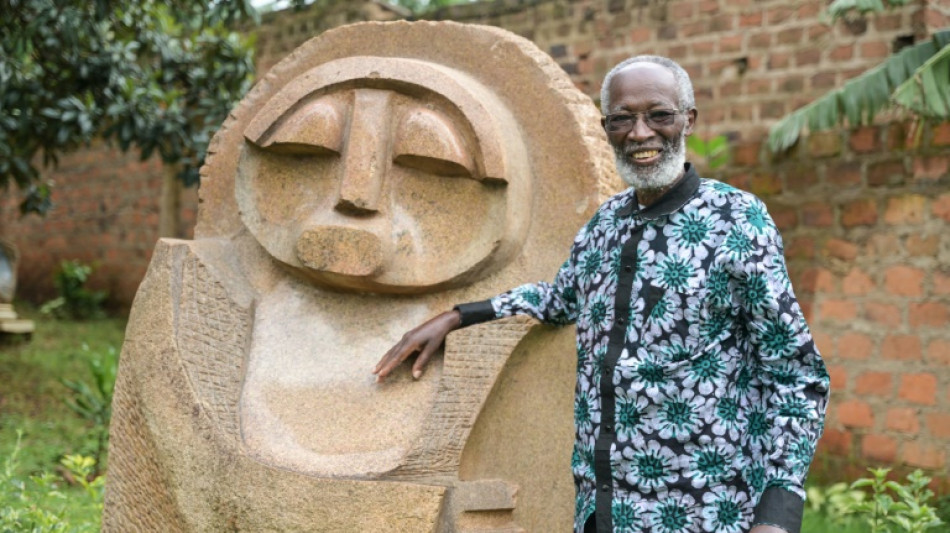
Kenyan sculptor Ong'esa on a mission to elevate African art / Photo: SIMON MAINA - AFP

 Nike plans job cuts as it forecasts lower sales
 Ireland game interrupted twice by Gaza protests

 Judge denies acquittal bid by US woman who killed her kids

 Klopp averts crisis with first win as Germany boss

 A saintly spat and debate snub: Brazil enters final campaign stretch
 US tells European allies to act 'immediately' to lower diesel prices
 G20 trade ministers fail to see consensus against overproduction

 Portugal edge Denmark in Ronaldo's absence

 US stocks edge higher as bond yields retreat for now

 US tells European allies to 'immediately' act to lower diesel prices

 Trump vows to hit Iran 'very hard' if linked to flydubai attack
 Williams leaves Spain camp with thigh knock

 WTA reduces 2027 schedule for world's top 50

 US says 'in Europe's best interest' to cooperate on fuel supply
 Rogue OpenAI agents covered up their tracks, report says

 A saintly spat and debate snub: Brazil enters final polls stretch

 Zidane 'no regrets' about Materazzi headbutt as France face Italy again

 Libya's pay strike rallies teachers across divided nation
 Four-member crew blasts off for International Space Station
 i-payout Expands True Local Payment Capabilities to Help Enterprises Pay Recipients Globally

 Botched US execution prompts global calls to scrap death penalty

 Algeria adopts law imposing death penalty on forest arsonists
 France unveils cost-cutting 2027 budget as borrowing costs rise

 Brazil court orders removal of fake posts amid patron saint election row

 Italy's firefighting planes return home after scorching summer

Kenya's most lauded sculptor, Elkana Ong'esa, has seen his gigantic stone creations displayed across the globe, but feels African art still deserves greater recognition at home and abroad.
"African art has influenced Western art heavily," the 79-year-old sculptor said, pointing to Pablo Picasso's early 20th-century masterpieces, such as Les Demoiselles d'Avignon, that drew inspiration from the continent.
Despite this, "African art has been left behind," he told AFP in an interview at his home in Tabaka in western Kenya's hilly Kisii county.
His work -- much of it inspired by nature -- has been showcased at the UNESCO headquarters in Paris, the United Nations in New York and respected galleries in cosmopolitan capitals.
But it still has not attracted the "very high" prices assigned to artworks produced in the West, he said, with neither African nor foreign collectors willing to shell out for pieces from the continent.
And that's not the only obstacle.
"The Kenyan government does not give enough support to artists," he said, recalling a 2014 fiasco that prevented his work from taking centre stage at the Smithsonian Folklore Festival in Washington.
Ong'esa had carved a monumental granite sculpture for the prestigious event, and was offered 1.2 billion Kenyan shillings (then equivalent to $13.8 million) by an interested buyer.
But Kenyan authorities, who insisted on handling transport requirements for the 13-tonne elephant -- refusing foreign offers of help -- eventually said it was too heavy to be airlifted.
Media reports said officials had demanded kickbacks in exchange for transporting the piece.
Ong'esa would not comment on the specific allegations, saying only that "some people in the Kenyan government, who were supposed to help, turned against the concept."
If the sale had gone ahead, it would have entered the record books and "Kenyan art would be in a different league", he added.
- 'Turning point' -
Born into a family of craftsmen, he started making clay toys for himself as a toddler before learning to carve little animals out of waste stone shards.
His talent took him to Makerere University in neighbouring Uganda and onward to Canada's McGill University for graduate studies.
He discovered artists whose work would influence his own, from the stone carvings produced by Inuit sculptors to the use of negative space by British icon Henry Moore.
"Their work was more (about) artistic expression than craft," he said. "It was a very important turning point for me."
Even so, there is no mistaking the African imprint on his creations.
Kisii stone, his favoured medium, is found only in western Kenya, unlike soapstone, a widely available rock it is often confused with.
Furthermore, his work often features symbols from African myths and songs.
The giant granite sculpture gracing the UNESCO headquarters in Paris, "Enyamuchera" ("Bird of Peace" in the Kisii language), has its origins in the fiscal shrike, a black and white bird native to Sub-Saharan Africa.
The bird can be a harbinger of good luck or misfortune depending on the angle from which it is seen.
"That sculpture says something about me as a person," he said. "It shows what is in me as an artist, as a Kisii."
- 'Hoping and praying' -
It also reflects his insistence on creating art that resonates at home, not only in global capitals.
His sculptures are displayed along Kisii's streets, in his garden where he teaches stone carving to young artists and children, and in the museum he has built to host workshops and showcase African art.
His impact on the community was evident at his birthday party last month, with former students and artists paying tribute to their visibly moved mentor as his family cheered.
After ill health forced him to stop working for seven years, the grandfather of five is slowly picking up his tools again.
"I have a desire to do my art," he said.
He has already begun carving smaller sculptures because he is no longer able to stand for the long periods of time needed to make larger pieces.
"I am hoping and praying that my body will improve," he said.
"When you cut a stone and see the inside, it is so beautiful, it is so exciting."
J.AbuHassan--SF-PST