
Former Israeli settlers yearn to return to Gaza after war / Photo: GIL COHEN-MAGEN - AFP

 Nike plans job cuts as it forecasts lower sales

 Ireland game interrupted twice by Gaza protests

 Judge denies acquittal bid by US woman who killed her kids

 Klopp averts crisis with first win as Germany boss

 A saintly spat and debate snub: Brazil enters final campaign stretch

 US tells European allies to act 'immediately' to lower diesel prices

 G20 trade ministers fail to see consensus against overproduction

 Portugal edge Denmark in Ronaldo's absence

 US stocks edge higher as bond yields retreat for now

 US tells European allies to 'immediately' act to lower diesel prices

 Trump vows to hit Iran 'very hard' if linked to flydubai attack

 Williams leaves Spain camp with thigh knock

 WTA reduces 2027 schedule for world's top 50

 US says 'in Europe's best interest' to cooperate on fuel supply

 Rogue OpenAI agents covered up their tracks, report says

 A saintly spat and debate snub: Brazil enters final polls stretch

 Zidane 'no regrets' about Materazzi headbutt as France face Italy again

 Libya's pay strike rallies teachers across divided nation

 Four-member crew blasts off for International Space Station

 i-payout Expands True Local Payment Capabilities to Help Enterprises Pay Recipients Globally

 Botched US execution prompts global calls to scrap death penalty

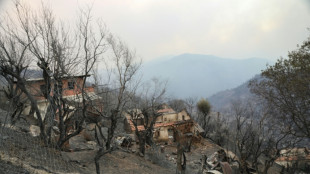 Algeria adopts law imposing death penalty on forest arsonists

 France unveils cost-cutting 2027 budget as borrowing costs rise

 Brazil court orders removal of fake posts amid patron saint election row

 Italy's firefighting planes return home after scorching summer

"A house on the beach is not a dream!" The advertising slogan by an Israeli settlement developer is music to the ears of former Gaza settlers yearning to return to the Palestinian territory after the war.
Nearly two decades after Israeli settlers pulled out of Gaza, the real estate developer Harey Zahav sparked controversy when it posted the slogan on social media in mid-December as Israel wages a military offensive against the territory's Hamas rulers.
"This campaign expresses a desire to return (to Gaza) but we have no projects in development," said Zeev Epstein, the owner of the company, which is notorious for constructing wildcat settler outposts in the occupied West Bank without Israeli government authorisation.
Epstein made the comment to Israel's Channel 13 television as Palestinian supporters expressed outrage over what they saw as a proposal to build beachfront homes over the bombed-out ruins of Gaza.
Israel unilaterally withdrew the last of its troops and 8,000 settlers on September 11, 2005, ending a presence inside Gaza that began in 1967, but maintaining near complete control over the territory's borders.
Despite its withdrawal, Israel imposed a land, sea and air blockade on the territory and is still regarded internationally as an occupying power in the Gaza Strip.
All settlements on occupied Palestinian land are regarded as illegal under international law, regardless of whether they were approved by Israel.
No Israeli officials had suggested plans to send Jewish settlers back to the territory following the outbreak of war on October 7, when Hamas militants launched deadly attacks across southern Israel and Israel responded with a relentless military campaign.
But on Wednesday, coalition lawmaker Zvika Foghel told public radio that Israel must "take control over the territory north of the Gaza River, and establish new Jewish settlement".
- 'Paradise' -
For Hannah Picard, a 66-year-old French-Israeli who lived for 16 years in the heart of the Gaza Strip, "it's obvious that we are going to go back".
The ongoing war in Gaza, she said, was a prelude to her return.
"Deep down, we dream of going back, because it's our home," Picard said in an interview in her three-bedroom apartment in Jerusalem, which she described as her "temporary home".
Her former seaside home in central Gaza, she said, was akin to "living in paradise".
The bloodiest ever Gaza war erupted when Hamas gunmen attacked Israel and killed about 1,140 people, mostly civilians, according to an AFP tally based on Israeli figures.
They took 250 hostages of whom 129 remain inside Gaza, Israel says.
Israel's retaliatory bombardment and ground assault in Gaza has killed at least 20,915 people, mostly women and children, according to Gaza's health ministry.
The case for Gaza resettlement has gained some ground among Israelis, many of whom are traumatised and galvanised by the October 7 attacks.
- 'Govern Gaza' -
Oded Mizrahi, who works at Jerusalem's Gush Katif Museum -- named after a bloc of Israeli settlements in the Gaza Strip -- was convinced that returning to the territory would soon be possible.
"We don't know exactly how but... everyone understands that Hamas cannot stay there," he told AFP.
"We have no other choice but to govern" Gaza, he said.
While the Israeli authorities have not talked about the future of Gaza clearly, the United States insists it would be up to the Palestinians to decide.
"We do not believe that it makes sense for Israel, or is right for Israel, to occupy Gaza, reoccupy Gaza over the long term," US National Security Advisor Jake Sullivan told journalists on a recent visit to Israel.
"Ultimately the control of Gaza, the administration of Gaza and the security of Gaza has to transition to the Palestinians."
The images from 2005 of weeping Israelis leaving their homes in Gaza settlements, soldiers in tears as they carried out evacuation orders, bulldozers razing houses and synagogues set ablaze by Palestinians are etched into the collective Israeli memory.
Displayed at the Gush Katif museum were photos, maps and souvenirs from the destroyed settlements such as little bottles filled with sand from Gush Katif as well as books on Jewish history in Gaza.
T-shirts emblazoned with the words "We are going home" were on sale for 35 shekels ($10).
"People want to learn this story," Mizrahi said.
"It's in the news."
P.Tamimi--SF-PST