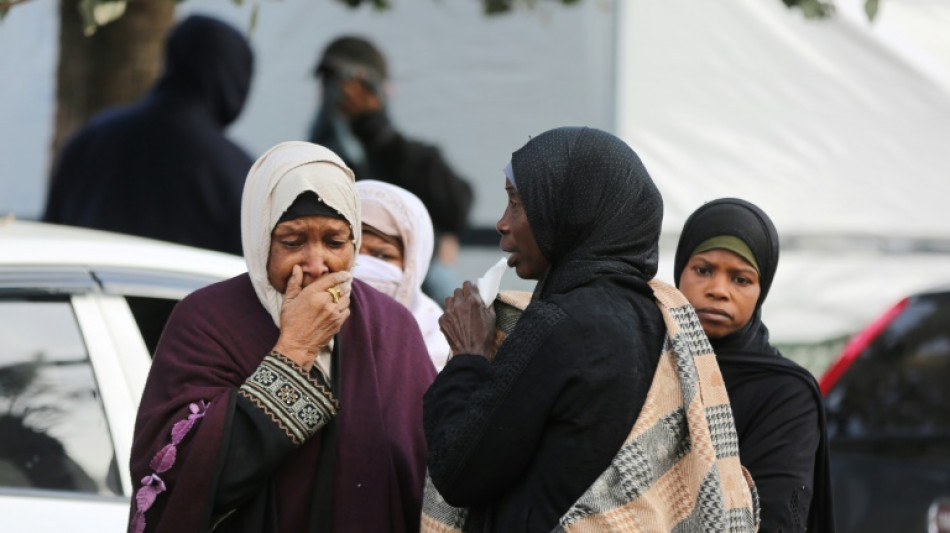
In Gaza, displaced women recount lives upended by war / Photo: - - AFP

 OpenAI says three staffers fired for mishandling 'sensitive' info

 Nike plans job cuts as it forecasts lower sales

 Ireland game interrupted twice by Gaza protests

 Judge denies acquittal bid by US woman who killed her kids

 Klopp averts crisis with first win as Germany boss

 A saintly spat and debate snub: Brazil enters final campaign stretch

 US tells European allies to act 'immediately' to lower diesel prices

 G20 trade ministers fail to see consensus against overproduction

 Portugal edge Denmark in Ronaldo's absence

 US stocks edge higher as bond yields retreat for now

 US tells European allies to 'immediately' act to lower diesel prices

 Trump vows to hit Iran 'very hard' if linked to flydubai attack

 Williams leaves Spain camp with thigh knock
 WTA reduces 2027 schedule for world's top 50

 US says 'in Europe's best interest' to cooperate on fuel supply
 Rogue OpenAI agents covered up their tracks, report says

 A saintly spat and debate snub: Brazil enters final polls stretch

 Zidane 'no regrets' about Materazzi headbutt as France face Italy again

 Libya's pay strike rallies teachers across divided nation

 Four-member crew blasts off for International Space Station

 i-payout Expands True Local Payment Capabilities to Help Enterprises Pay Recipients Globally

 Botched US execution prompts global calls to scrap death penalty
 Algeria adopts law imposing death penalty on forest arsonists

 France unveils cost-cutting 2027 budget as borrowing costs rise
 Brazil court orders removal of fake posts amid patron saint election row
A relentless Israeli military campaign, in response to deadly Hamas attacks on October 7, has upset the lives of most, if not all, residents of the Gaza Strip.
Israeli forces have launched a bombardment campaign and ground invasion of Gaza ever since Hamas militants launched their shock attack -- the deadliest in Israel's 75-year history.
It killed about 1,140 people, mostly civilians, according to an AFP tally based on official Israeli figures.
Israel's retaliatory offensive has killed at least 20,258 people in the besieged Palestinian territory, according to the health ministry in Hamas-run Gaza.
The United Nations estimates the fighting has displaced 1.9 million of Gaza's 2.4 million population.
AFP spoke to three Palestinian women who shared how the conflict has upended their lives.
- Nour al-Wahidi, 24, medical intern -
Wearing a stethoscope around her neck, Wahidi recalled spending 38 consecutive days treating patients in terrible conditions at Gaza City's Al-Shifa hospital, which has been raided by Israeli forces.
"I worked through moments of escalation these past two years, but everything about this war is different: the length, the death toll, the severity of injuries, the displacement," she said.
For a month now Wahidi has been sharing an apartment with 20 members of her extended family, having been displaced twice since the war broke out.
The medical intern is working in the emergency ward of the Kuwaiti hospital in Rafah, in the besieged territory's south.
"Every day, I come across suffering that I never thought I would see," she said.
Some of her relatives took shelter at a school run by the UN agency for Palestinian refugees, UNRWA, while others remained in Gaza.
Wahidi has lost all contact with those who stayed behind in Gaza City because the grid is often down and communications frequently cut.
"Before, I was home with everything I needed. Now I'm in this strange place, without water or food," she said.
"The situation is catastrophic."
She also warned that "there's been a rapid spread of disease".
Still, she tries to make do by telling herself that others have it even worse.
"After work, I can go home, I can cook and light a fire. I wash my hands when there's water," she said, counting her blessings.
"We've had to consider water and food supplies, and how to charge our phones -- things we never thought about before," she added.
"No one deserves to live like this."
- Sondos al-Bayed, 32, housewife -
Bayed hails from Gaza City but is now living in a tent outside the Kuwaiti hospital in Rafah.
She shares the space with her journalist husband and three children.
"Our life has been turned upside down. It's been a total 180," she said.
Her family has been forced to move multiple times since leaving Gaza City.
They first fled south towards the central city of Deir al-Balah. However, the homeowners who took them in soon asked them to leave.
It was "out of fear that journalists would be targeted" by Israeli strikes, Bayed told AFP.
"I cried so much... I didn't know what to do," she said.
They set off again for Khan Yunis, in the south, but their plans were thwarted once again. The Israeli army issued an evacuation order for those in the area, sending them further south near the border with Egypt.
With what little food she can find, Bayed prepares meals for her children but they refuse to eat: "The food's bad and expired."
Life has become "hard, like being separated from family, as are the memories", Bayed said.
"We were happy before and had a stable life. We dreamt of building a bigger house. I want (that life) back."
- Lynn Ruk, 17, student -
Ruk lives in a makeshift camp in Rafah along with her parents, brother, four sisters and niece.
"My life used to be so boring, I'd complain. The war changed everything," she said.
Her family left their home in Khan Yunis the day after the war erupted.
"We took a photo of the house, in tears," Ruk said.
They briefly stayed with one of her sisters. When it became too dangerous there, they left for the city's Nasser hospital, before winding up in Rafah.
"I thought we'd go home after a week. It's been more than 70 days now and we're still not back," she said.
The teenager said she has lost seven kilos (15 pounds) since the war began. She has fallen sick several times and was even taken to the emergency room after fainting.
Today, her meals mainly consist of canned food, with only the occasional piece of bread.
"I never thought my life would look like this... Before the war, I showered every day," she said.
"Now, if I'm lucky, I'll wash at the mosque once a week, at sinks reserved for performing one's ablutions -- if there's any water," she added.
Ruk is afraid for the lives of her friends, and her own.
She aspires to be a journalist and hopes to be able to travel abroad to make her dream come true.
"I wish I could go back to the life I had before, the one I didn't like," she said.
D.Khalil--SF-PST