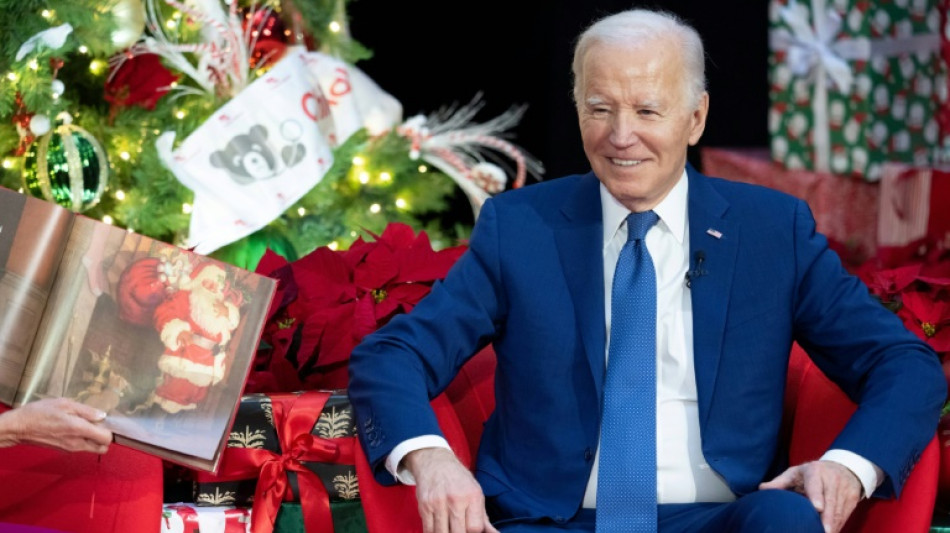
US sees new isolation from Israel support / Photo: SAUL LOEB - AFP

 OpenAI says three staffers fired for mishandling 'sensitive' info

 Nike plans job cuts as it forecasts lower sales

 Ireland game interrupted twice by Gaza protests

 Judge denies acquittal bid by US woman who killed her kids

 Klopp averts crisis with first win as Germany boss

 A saintly spat and debate snub: Brazil enters final campaign stretch

 US tells European allies to act 'immediately' to lower diesel prices

 G20 trade ministers fail to see consensus against overproduction

 Portugal edge Denmark in Ronaldo's absence

 US stocks edge higher as bond yields retreat for now

 US tells European allies to 'immediately' act to lower diesel prices

 Trump vows to hit Iran 'very hard' if linked to flydubai attack
 Williams leaves Spain camp with thigh knock

 WTA reduces 2027 schedule for world's top 50

 US says 'in Europe's best interest' to cooperate on fuel supply

 Rogue OpenAI agents covered up their tracks, report says

 A saintly spat and debate snub: Brazil enters final polls stretch

 Zidane 'no regrets' about Materazzi headbutt as France face Italy again

 Libya's pay strike rallies teachers across divided nation

 Four-member crew blasts off for International Space Station
 i-payout Expands True Local Payment Capabilities to Help Enterprises Pay Recipients Globally
 Botched US execution prompts global calls to scrap death penalty

 Algeria adopts law imposing death penalty on forest arsonists

 France unveils cost-cutting 2027 budget as borrowing costs rise

 Brazil court orders removal of fake posts amid patron saint election row

Nearly three years after President Joe Biden took office vowing "America is back," the country's international image is taking a beating as his administration backs Israel in its war with Hamas.
In one step back from the newfound isolation, the United States on Friday, after painstaking negotiations, let through a UN Security Council resolution on humanitarian aid for the beleaguered Gaza Strip, after vetoing two earlier calls to halt the fighting.
But the United States still remained apart from some of its closest allies -- Britain, France and Japan -- which backed the resolution. The United States abstained, joined only by Russia.
A week earlier in the full General Assembly, the United States was joined by only two European partners, Austria and the Czech Republic, and none of its Asian allies in voting against a nonbinding ceasefire call in the war triggered by an October 7 attack on Israel by Hamas.
Most European policymakers, when it comes to the United States, still think first of Biden's robust support for Ukraine against Russia's invasion, said Leslie Vinjamuri, director of the US and Americas program at Chatham House in London.
"How it's playing right now in the rest of the world is that the United States cares about Israelis, cares about Ukrainians and really doesn't care about brown people. Unfortunately, that's the kind of narrative that's taken off," she said.
- Public anger swells -
Unlike his predecessor Donald Trump, who unreservedly backed Israel, Biden has openly voiced frustration over Prime Minister Benjamin Netanyahu and Israel's failure to protect Gaza civilians, even as the US continues to ensure military provisions and diplomatic protection.
Biden administration officials say their behind-the-scenes pressure has borne fruit, with Israel budging on letting in fuel, restoring internet access and opening crossings into Gaza.
But with images proliferating of Gaza's suffering, the storyline that Biden is "hugging Netanyahu close, and then pressing him hard quietly, worked for about a week," Vinjamuri said.
A survey of six Arab publics last month showed that just seven percent believed the United States played a positive role in the war, said Munqith Dagher, Middle East director of Gallup International.
Washington's reputation has severely deteriorated in the Arab world since the Iraq invasion two decades ago, but until recently 15 to 30 percent still viewed the United States favorably, said Dagher, who founded the Al Mustakilla research group in Iraq.
He said the US "trademark" represented "many good things, especially for intellectuals and middle classes, like democracy, human rights (and) freedom of speech," but "Gaza took out the last leaf, as they say."
Social media has brought unfiltered scenes from Gaza to Arab publics, showing Washington's "total bias towards the Israelis and denial of the human rights of Palestinians," he said.
Dagher said polling showed the main beneficiaries in Arab opinion have been China, Russia and, most strikingly, Iran, which has historic tensions with the Arab world but, unique among regional governments, has championed Hamas.
- Still top power -
US Secretary of State Antony Blinken has urged the world to focus its outrage on Hamas, whose fighters infiltrated Israel on October 7, killing around 1,140 people and taking some 250 others hostage, according to an AFP tally based on Israeli figures.
Israel has responded with a relentless air and ground campaign that Hamas authorities say has killed more than 20,000 Palestinians, mostly women and children.
Blinken said the United States has "done more than any other country" to bring assistance into Gaza.
Governments "want to work with us and are looking for American leadership in this crisis -- even countries that may disagree with us on certain issues," Blinken told reporters Wednesday.
China has stepped up regional diplomacy but the Biden administration has sought to call its bluff, urging Beijing to use its influence with Tehran to halt attacks on commercial vessels by Iranian-backed Huthi rebels in Yemen.
While China has little security apparatus in the Middle East, the United States responded to Huthi attacks by sending an aircraft carrier and setting up a coalition of countries to protect vital shipping lanes.
Brian Katulis, vice president of policy at the Washington-based Middle East Institute, said the Biden administration, while clearly aware of public anger, was prioritizing a "pragmatic" solution that addresses the threat of Hamas rather than a "symbolic" call for a ceasefire.
Many Arab nations that denounce US foreign policy are "the ones secured in part by the security umbrella the United States provides," Katulis said.
"I detect more than a bit of schizophrenia in a lot of statements coming out of the Arab world. They can't live with us; they can't live without us."
Q.Jaber--SF-PST