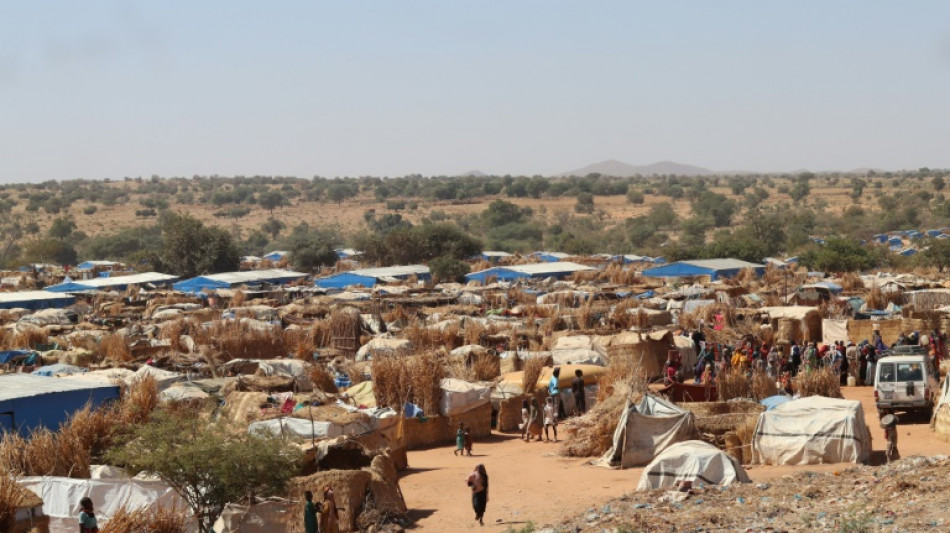
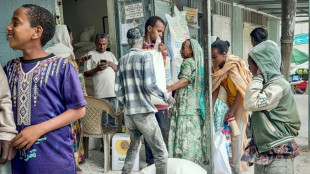
In Chad camps, survivors recount Sudan war horrors / Photo: Denis Sassou Gueipeur - AFP

 OpenAI says three staffers fired for mishandling 'sensitive' info

 Nike plans job cuts as it forecasts lower sales

 Ireland game interrupted twice by Gaza protests

 Judge denies acquittal bid by US woman who killed her kids

 Klopp averts crisis with first win as Germany boss

 A saintly spat and debate snub: Brazil enters final campaign stretch

 US tells European allies to act 'immediately' to lower diesel prices

 G20 trade ministers fail to see consensus against overproduction

 Portugal edge Denmark in Ronaldo's absence
 US stocks edge higher as bond yields retreat for now

 US tells European allies to 'immediately' act to lower diesel prices

 Trump vows to hit Iran 'very hard' if linked to flydubai attack
 Williams leaves Spain camp with thigh knock
 WTA reduces 2027 schedule for world's top 50

 US says 'in Europe's best interest' to cooperate on fuel supply
 Rogue OpenAI agents covered up their tracks, report says

 A saintly spat and debate snub: Brazil enters final polls stretch

 Zidane 'no regrets' about Materazzi headbutt as France face Italy again
 Libya's pay strike rallies teachers across divided nation
 Four-member crew blasts off for International Space Station

 i-payout Expands True Local Payment Capabilities to Help Enterprises Pay Recipients Globally

 Botched US execution prompts global calls to scrap death penalty
 Algeria adopts law imposing death penalty on forest arsonists
 France unveils cost-cutting 2027 budget as borrowing costs rise
 Brazil court orders removal of fake posts amid patron saint election row
Sitting outside her makeshift shelter in eastern Chad, Sudanese refugee Mariam Adam Yaya warmed up tea on some firewood in a bid to quell the pangs of hunger.
The 34-year-old from the Masalit ethnic group crossed the border on foot after a four-day trek with no provisions and her eight-year-old son clinging to her back.
She said "heavily armed" men attacked her village, forcing her to flee and leave seven of her children behind amid brutal violence that has sparked fears of ethnic cleansing.
Sudan has since April 15 been plunged into a civil war pitting army chief General Abdel Fattah al-Burhan against Mohamed Hamdan Daglo, his former deputy and commander of the paramilitary Rapid Support Forces (RSF).
Thousands have fled for neighbouring Chad and found refuge in overcrowded camps such as Adre where Yaya has settled.
In the western Darfur region, paramilitary operations have left civilian victims belonging to the non-Arab Masalit group in what the United Nations and NGOs say is a suspected genocide.
In the West Darfur town of Ardamata alone, armed groups killed more than 1,000 people in November, according to the European Union.
"What we went through in Ardamata is horrifying. The Rapid Support Forces killed elderly people and children indiscriminately," Yaya told AFP.
- Trauma -
Chad, a country in central Africa that is the world's second least developed according to the United Nations, has hosted the highest number of Sudanese refugees.
The UN says 484,626 people have sheltered there since the fighting broke out, with armed groups forcing more than 8,000 people to flee to Chad in one week.
Formal camps managed by NGOs and informal settlements erected spontaneously have sprouted throughout the border region of Ouaddai.
A traumatised Amira Khamis, 46, said she was targeted due to her Masalit ethnicity and has lost five of her children.
Recovering in an emergency medical structure run by the NGO Doctors Without Borders (MSF) near the Adre camp after shrapnel fractured her feet, she told AFP women and young girls were raped.
"They systematically kill all the people of dark black colour," she said.
Mahamat Nouredine, a 19-year-old who is nursing a fractured arm and has lost four relatives in the violence, said the RSF mercilessly hounded the Masalit community before he escaped to Chad.
"A group of RSF followed us to a hospital and tried to kill everyone... they laid us on the ground in groups of 20 and fired at us," he said.
"Their unspoken goal is to kill people due to their skin colour."
- 'Critical conditions' -
The United States and other Western nations have accused the RSF and its allies of committing crimes against humanity and acts of ethnic cleansing.
An estimate by the Armed Conflict Location and Event Data Project puts the war's death toll at 12,000. Almost seven million people have fled their homes, according to the UN.
After surviving atrocities in their homeland and the perilous journey abroad, the refugees are now confronting the looming threat of famine.
Yaya said she and her child have "barely" eaten since their arrival in Chad.
The scarcity of water in the camps has generated tensions that humanitarian organisations have struggled to calm.
Gerard Uparpiu, MSF's project coordinator in Adre, said the influx of Sudanese refugees was creating a "worrying" situation.
"We receive them in critical conditions. They are shaken physically and psychologically," he added.
MSF's hospital is surrounded by fencing and constantly monitored by a guard, measures necessitated by the brutality of a conflict that has not spared the wounded.
"They also attacked us when I was being taken to Chad to receive treatment," said Amir Adam Haroun, a Masalit refugee whose leg was broken by an explosive.
R.Halabi--SF-PST