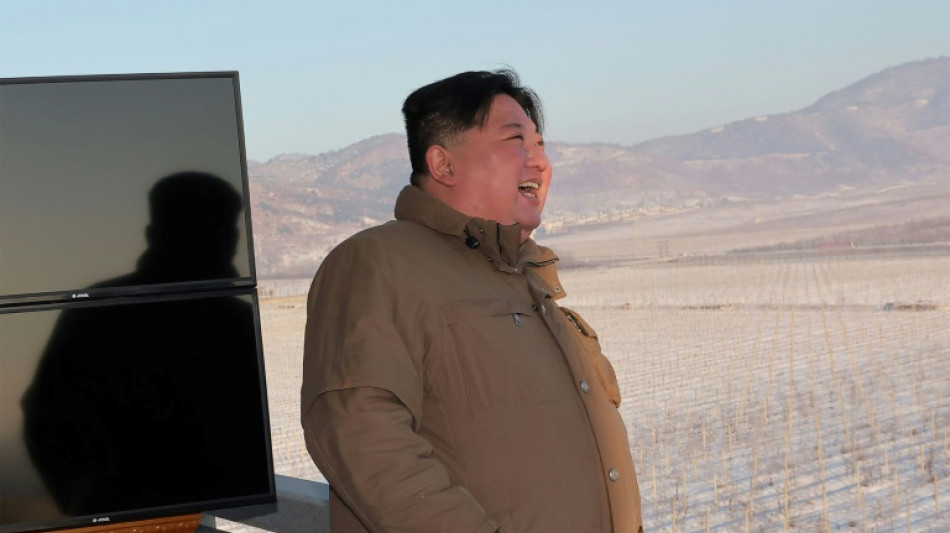
N. Korea's Kim warns of 'nuclear attack' if 'provoked' with nukes / Photo: STR - KCNA VIA KNS/AFP

 OpenAI says three staffers fired for mishandling 'sensitive' info
 Nike plans job cuts as it forecasts lower sales

 Ireland game interrupted twice by Gaza protests

 Judge denies acquittal bid by US woman who killed her kids

 Klopp averts crisis with first win as Germany boss

 A saintly spat and debate snub: Brazil enters final campaign stretch

 US tells European allies to act 'immediately' to lower diesel prices

 G20 trade ministers fail to see consensus against overproduction

 Portugal edge Denmark in Ronaldo's absence

 US stocks edge higher as bond yields retreat for now

 US tells European allies to 'immediately' act to lower diesel prices

 Trump vows to hit Iran 'very hard' if linked to flydubai attack

 Williams leaves Spain camp with thigh knock

 WTA reduces 2027 schedule for world's top 50

 US says 'in Europe's best interest' to cooperate on fuel supply

 Rogue OpenAI agents covered up their tracks, report says

 A saintly spat and debate snub: Brazil enters final polls stretch

 Zidane 'no regrets' about Materazzi headbutt as France face Italy again

 Libya's pay strike rallies teachers across divided nation

 Four-member crew blasts off for International Space Station
 i-payout Expands True Local Payment Capabilities to Help Enterprises Pay Recipients Globally

 Botched US execution prompts global calls to scrap death penalty

 Algeria adopts law imposing death penalty on forest arsonists

 France unveils cost-cutting 2027 budget as borrowing costs rise

 Brazil court orders removal of fake posts amid patron saint election row

North Korean leader Kim Jong Un warned Pyongyang will not hesitate to launch a nuclear attack if "provoked with nukes", state media said Thursday, while Seoul and its allies called for "dialogue without preconditions".
Kim's warning follows a meeting between South Korea and the United States last week in Washington, where they discussed nuclear deterrence in the event of conflict with the North.
The meeting's agenda included "nuclear and strategic planning", and the allies reiterated that any nuclear attack by Pyongyang on the United States or South Korea would result in the end of the North Korean regime.
But Kim told his military's missile bureau "not to hesitate (launching) even a nuclear attack when the enemy provokes it with nukes," Pyongyang's official Korean Central News Agency said Thursday.
Washington, Seoul and Tokyo released a statement shortly afterwards, urging the nuclear-armed country to "stop conducting further provocations and accept our call for engaging in substantive dialogue without preconditions".
The three countries have ramped up defence cooperation in the face of a record-breaking series of weapons tests by Pyongyang this year, and on Tuesday activated a system to share real-time data on North Korean missile launches.
The North on Monday launched its most powerful intercontinental ballistic missile, the Hwasong-18, later describing it as "a warning counter-measure" against what it described as persistent acts of "military threat" by Washington and its allies.
Last week, a US nuclear-powered submarine arrived in the South Korean port city of Busan, and on Wednesday, Washington flew its long-range bombers in drills with Seoul and Tokyo.
The North has recently stressed that the "Korean peninsula is in a state of war by law" and that "strategic assets" deployed by Washington in the South will be "the first targets of destruction".
In October, when a US B-52 bomber capable of carrying nuclear weapons took part in Seoul, Tokyo and Washington's first joint aerial drills, Pyongyang described the exercise as "the intentional nuclear war provocative moves of the US".
Pyongyang sees drills by the United States and its allies as rehearsals for invasion and has long justified its blitz of missile launches as necessary "countermeasures".
- 'Preparations for invasion' -
Pyongyang last year declared itself an "irreversible" nuclear power and has repeatedly said it will never give up its nukes programme, which the regime views as essential for its survival.
In a separate statement on Thursday, Kim's powerful sister, Kim Yo Jong, slammed the United Nations Security Council for convening a session to discuss the North's latest ICBM launch, arguing it was a demonstration of Pyongyang's inherent right to self-defence.
"The ceaseless military drills of the US and its vassal forces (remind) one of the overall preparations for invasion under the pretext of deterring threats from someone," she said, according to KCNA.
"And the frequent appearance of the US nuclear weapons clearly (aimed) at the DPRK ... is the root cause of escalating the regional situation," she added, using the acronym for the North's official name.
Pyongyang's launch of a military spy satellite last month, which it claimed quickly began providing images of US and South Korean military sites, further damaged inter-Korean ties.
The launch fractured a military agreement between the Koreas established to de-escalate tensions on the peninsula, with both sides then ramping up security along the Demilitarized Zone (DMZ) that separates them.
N.AbuHussein--SF-PST