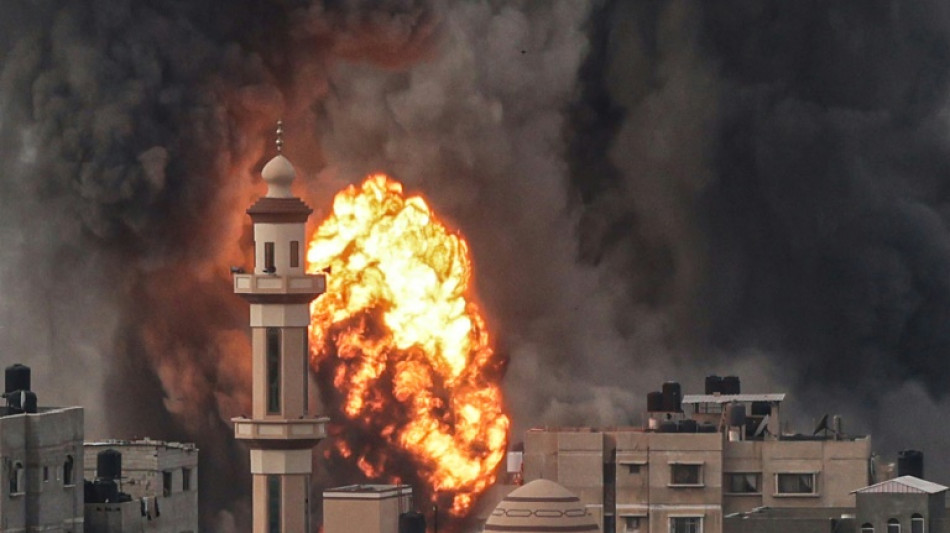
Hopes rise for Israel-Hamas truce deal as Gaza toll hits 20,000 / Photo: SAID KHATIB - AFP

 OpenAI says three staffers fired for mishandling 'sensitive' info

 Nike plans job cuts as it forecasts lower sales

 Ireland game interrupted twice by Gaza protests

 Judge denies acquittal bid by US woman who killed her kids

 Klopp averts crisis with first win as Germany boss

 A saintly spat and debate snub: Brazil enters final campaign stretch

 US tells European allies to act 'immediately' to lower diesel prices

 G20 trade ministers fail to see consensus against overproduction

 Portugal edge Denmark in Ronaldo's absence

 US stocks edge higher as bond yields retreat for now

 US tells European allies to 'immediately' act to lower diesel prices

 Trump vows to hit Iran 'very hard' if linked to flydubai attack

 Williams leaves Spain camp with thigh knock

 WTA reduces 2027 schedule for world's top 50

 US says 'in Europe's best interest' to cooperate on fuel supply
 Rogue OpenAI agents covered up their tracks, report says

 A saintly spat and debate snub: Brazil enters final polls stretch

 Zidane 'no regrets' about Materazzi headbutt as France face Italy again

 Libya's pay strike rallies teachers across divided nation

 Four-member crew blasts off for International Space Station

 i-payout Expands True Local Payment Capabilities to Help Enterprises Pay Recipients Globally

 Botched US execution prompts global calls to scrap death penalty

 Algeria adopts law imposing death penalty on forest arsonists

 France unveils cost-cutting 2027 budget as borrowing costs rise

 Brazil court orders removal of fake posts amid patron saint election row
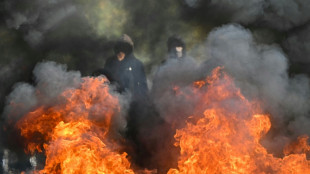
Hopes rose Wednesday that Israel and Hamas may be inching toward another truce and hostage-release deal in the Gaza war, following talks in Europe and a visit to Egypt by the head of the Palestinian militant group.
While some talked of a truce, fighting raged and Gaza's Hamas government said the death toll in the Palestinian territory reached 20,000.
Right-wing Israeli Prime Minister Benjamin Netanyahu said there can be no Gaza ceasefire until Hamas militants are destroyed, but the White House expressed hope that the truce talks can bring results.
"These are very serious discussions and negotiations and we hope that they lead somewhere," National Security Council spokesman John Kirby told reporters.
His comments came shortly after Netanyahu, under pressure from Washington and other allies over civilian casualties, reiterated his goal of destroying Hamas and said there will be no ceasefire until that is accomplished.
"We won't stop fighting until we've achieved all the objectives we've set ourselves: the elimination of Hamas, the release of our hostages and the end of the threat from Gaza," Netanyahu repeated.
Late Tuesday he had told relatives of some of the remaining 129 captives held in Gaza that his spy chief was working on efforts to free them.
He said he had "just sent the head of Mossad to Europe twice to promote a process to free our hostages".
The bloodiest-ever Gaza war began when Hamas attacked southern Israel on October 7, killing around 1,140 people in Israel, mostly civilians, and abducting about 250, according to an AFP tally based on Israeli figures.
In response, Israel began a relentless bombardment alongside a ground invasion. Hamas authorities say most of those killed in Gaza have been women and children.
- Protests -
Netanyahu has faced protests from hostage relatives seeking an urgent deal to free the captives.
"Every moment the hostages are there, is danger. They have no time," Ofir Engel, 17, a Dutch-Israeli former captive, said at a press conference.
Talks were ongoing "with the aim of reaching an agreement around the release of the remaining hostages in Gaza in exchange for a truce and the potential release of Palestinians held in Israeli prisons," said the source.
Qatar, backed by Egypt and the United States, last month helped broker a first week-long truce in which 80 Israeli hostages were freed in exchange for 240 Palestinian prisoners.
The Qatar-based chief of Hamas, Ismail Haniyeh, on Wednesday arrived in Egypt for talks with intelligence chief Abbas Kamel.
A Hamas official, speaking Wednesday on condition of anonymity, told AFP in Gaza that "a total ceasefire and a retreat of the Israeli occupation army from the Gaza Strip are a precondition for any serious negotiation" on a hostage-prisoner swap.
A source close to Hamas earlier said the Egypt talks would focus on proposals including a week-long truce that would see the release of 40 Israeli hostages.
Before leaving Qatar, Haniyeh met Iranian Foreign Minister Hossein Amir-Abdollahian but no details were released.
In Rafah, where fireballs and black smoke rose after explosions, residents expressed hope that talks would succeed.
"I wish for a complete ceasefire, and to put an end to the series of death and suffering. It's been more than 75 days," said Kassem Shurrab, 25.
Bassil Khoder, 63, said a ceasefire would allow displaced Palestinians like him to return home but it would also be good for Israelis. "The Jews are also our neighbours," he said. "We won't give up on them."
- 'Enough' -
An AFPTV live camera on Wednesday filmed two bombs hitting Rafah, in southern Gaza where many of the territory's estimated 1.9 million displaced have fled.
The Hamas health ministry said Israeli strikes killed at least 12 Palestinians when houses and a mosque in Rafah "were targeted".
Crowds swarmed the rubble, digging with shovels and a backhoe to try to free the victims. One body, blackened and open-mouthed, lay under a bright blue blanket on the blood-soaked ground.
"Enough, enough of this. We have lost everything and we can't take it anymore," Samar Abu Luli, a woman in Rafah, said after Israeli strikes on the city's Al-Shabura neighbourhood.
The Israeli army reported close-quarter combat and more than 300 strikes over the past day, while the death toll among its own forces rose to 134 inside Gaza.
It said "ground, aerial and naval operations were carried out on dozens" of militants and their infrastructure including rocket launch sites and military command and control centres in Khan Yunis, southern Gaza.
They also found underground infrastructure "with water and electricity systems" during a raid on residences of senior Hamas figures in Khan Yunis, the military said.
The United Nations Security Council was due to vote Wednesday on a much-delayed resolution calling for a pause to the war after members wrangled over wording.
The latest version of the text seen by AFP calls for the "urgent suspension" of hostilities.
The United States vetoed a previous ceasefire resolution.
Israel, which declared a total siege on Gaza at the start of the war, has since allowed in aid trucks through the Rafah border crossing with Egypt and, as of this week, its own Kerem Shalom crossing.
The UN's World Food Progamme said Wednesday it had delivered food through Kerem Shalom in a first direct aid convoy from Jordan as "millions face the risk of starvation".
Fuel, water and medical supplies are also scarce, diseases are spreading, and communications have been repeatedly cut.
An Israeli military agency, COGAT, said it had started laying a pipeline from Egypt to deliver drinking water from a mobile desalination plant in a project led by the United Arab Emirates.
Visiting nearby Cyprus on Wednesday, Israeli Foreign Minister Eli Cohen expressed support for plans to send humanitarian aid to Gaza from the Mediterranean island.
"We aim to create a fast track for humanitarian aid to Gaza through this corridor," he told reporters.
The Gaza war has sparked fears of regional escalation, with exchanges of fire over the Lebanon border, and missiles from Iran-backed Yemeni rebels disrupting Red Sea shipping.
burs-jd/it/dv
T.Samara--SF-PST