Why did North Korea fake a 'monster missile' test?

 Man allegedly behind 'targeted' attack on Australian lawmaker appears in court

 Musk backs SpaceX-Tesla merger as rocket firm turns profit
 Zelensky, US hail 'productive' talks to end Trump feud
 'Unbelievable' Foden back in the groove with treble in Man City rout
 Pistons rally to beat Celtics in NBA 2026-27 season opener
 PSG late show downs Barca in Champions League, Liverpool fight back

 Liverpool strike back to beat Villarreal in seven-goal thriller

 Dow boosted as markets rotate from tech shares
 Zelensky hails resumption of US advance warning of strikes on Ukraine

 Carrick says only wins can ease doubts over Man Utd future
 Top NBA Draft pick Dybantsa to miss opener with ankle sprain
 Italy sends troops, toughens security laws after Milan clashes

 Alberta separatists vow to fight on, risking turmoil for Canada

 Two men re-arrested for suspected spying for Iran in airbase scare: UK police
 Guatemalan man gets 30 years for truck smuggling deaths of 53 migrants

 'Clayface' gets under the skin of the superhero genre

 Zelensky, US envoys hold Oslo talks as Ukraine claims US missile holdup

 All-rounder Minhas stars as Pakistan crush England in tri-series

 Bavuma hits 179, Rabada strikes as South Africa dominate
 Allrounder Minhas stars as Pakistan crush England in tri-series

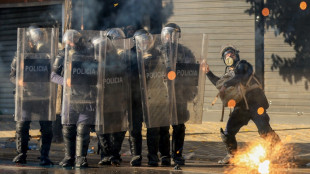 Albania PM blames 'hybrid war' for week of unrest

 Bavuma hits 179 to lead South African fightback
 Solid GM results overshadowed by latest jump in commodity costs
 Houthi attacks undermine Saudi Arabia's economic ambitions

 French PM vows 'massive' police deployment for new demonstrations

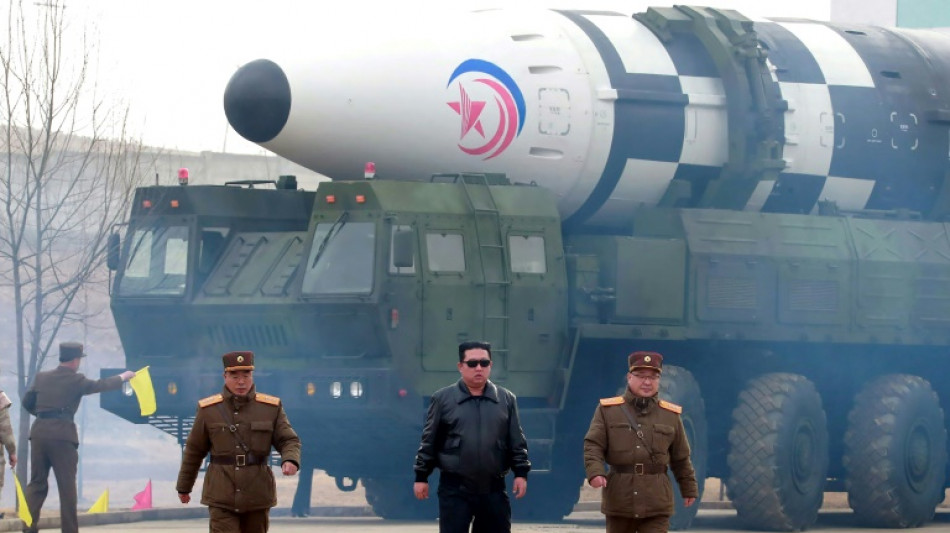
North Korea faked a "successful" launch of its most powerful long-range missile to shore up domestic support for Kim Jong Un's regime after the real test ended in failure, analysts say.
State media trumpeted the "miraculous" launch of what it claimed was a new Hwasong-17 intercontinental ballistic missile on March 24, publishing dramatic photos and videos of leader Kim personally overseeing the test.
But analysts identified discrepancies in Pyongyang's account, and South Korean and US intelligence agencies have concluded that North Korea actually fired a Hwasong-15 -- a less-advanced ICBM which it had already tested in 2017.
Why would North Korea do this? Analysts say it urgently needed a domestic propaganda victory ahead of a key anniversary, after the real launch of the Hwasong-17 a week before ended in failure with the missile exploding above the capital Pyongyang.
"North Korea wanted to shore up citizens' loyalty ahead of the Day of the Sun by branding Kim Jong Un a capable leader of a military powerhouse," analyst Yang Moo-jin told AFP, referring to the birth anniversary of founding leader Kim Il Sung on April 15.
But "the March 16 launch failed spectacularly and -- worse -- it happened in Pyongyang so people got to witness the dramatic failure. Kim probably thought he needed something very strong to make up for it, and that's probably why he lied," Yang added.
A South Korean intelligence briefing said that after the botched March 16 launch, Pyongyang turned to fabrication "to stem rumours and bring regime stability," local reports said.
With only eight days between the failed launch and the purported successful one, there would have been no time to analyse what went wrong and actually correct it -- hence why Pyongyang turned to subterfuge, the reports added.
- Fake it til you make it? -
It would not be the first time North Korea has fabricated weapons development progress -- it attempted to pass off a failed January 2016 submarine-launched ballistic missile test as a success using altered video footage, analysts said.
It is surprising that Pyongyang is still up to "such 'fake it till you make it' shenanigans", said Mason Richey, an associate professor at Hankuk University.
The fact that independent analysts -- let alone US and South Korean intelligence -- were able to detect it so quickly undermines North Korea's credibility, he said.
If Pyongyang has "lied about something as apparently obvious as ICBM type, have they also lied about more opaque areas", like whether their missiles survive re-entry or how light and compact their warheads are.
If the credibility of its nuclear deterrent is called into question, it "could make uber-hawkish defence officials in the US a bit itchier to try a bloody-nose or decapitation strike in future US-North Korea crises," he added.
North Korea announced the purported Hwasong-17 launch with a slick, Hollywood-style video featuring leader Kim in a black leather jacket and sunglasses, flanked by generals, appearing to give the signal to launch a giant missile.
But discrepancies spotted in that footage were what first tipped analysts off that the official version of events was misleading at best.
Seoul-based specialist website NK News analysed satellite imagery and found indications that some of the footage was filmed earlier than state media claimed, likely at the failed March 16 test.
"Kim Jong Un was likely targeting domestic audiences, to suppress rumours likely spreading over the highly visible ICBM failure over Pyongyang the previous week," and to boost "nationalistic pride" ahead of April 15, NK News analyst Colin Zwirko told AFP.
"He might not have wanted to waste the Hwasong-17 footage and wasn't able to launch another quickly, and telling the truth about a Hwasong-15 test would have lacked impact", as it was first tested in 2017, he added.
- Propaganda revolution -
The fact that Kim himself was front and centre of the event indicates that the propaganda was aimed at shoring up support for the leader personally, Hong Min of the Korea Institute for National Unification said.
"The North faked a Hwasong-17 launch out of a strong drive to show achievements under Kim's watch to the public with Kim at the centre," he said.
The dramatic KCTV video announcing Hwasong-17 was a "major departure" from previous North Korean propaganda efforts, said Rachel Minyoung Lee, a non-resident fellow with the 38 North programme at the Washington-based Stimson Center.
"It's a revolution in the history of North Korean propaganda," she told AFP.
While state propaganda has changed and evolved since Kim Jong Un came to power, largely to compete with the influx of foreign movies and dramas, this took things to a new level, she said.
"It had to up its game and make propaganda content more real, interesting, and persuasive," she said, even if the events it purportedly documented were a fabrication.
N.AbuHussein--SF-PST