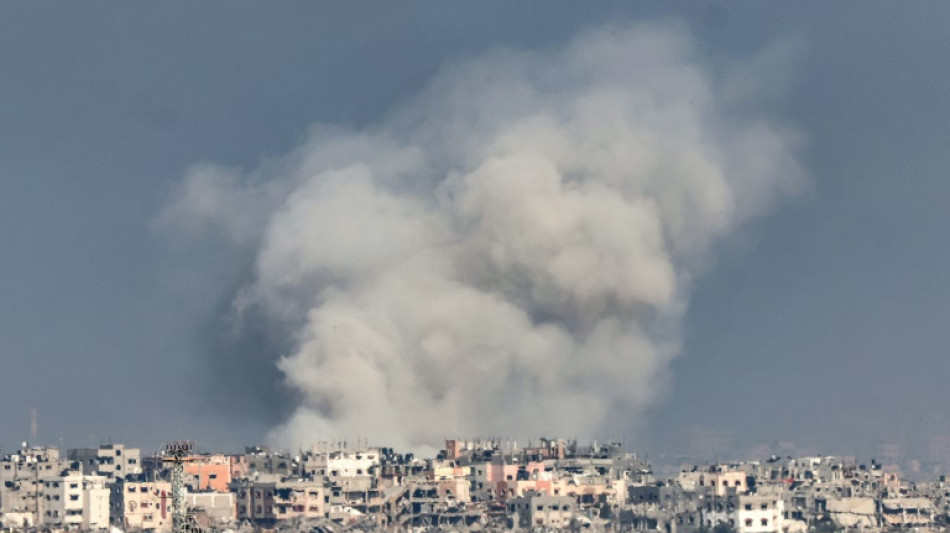
Israel bombs Gaza amid accusation it is 'starving' Palestinians / Photo: JACK GUEZ - AFP

 Asian stocks drop as oil spike fans rate hike bets, eyes on US jobs

 Viral anti-vax posts weaponise Philippine inoculation fears
 Saudi coalition accuses Houthis of drone attack on Medina

 Effective Altruism: the philosophy behind Silicon Valley's AI fears

 Chinese judoka accused of biting as home hope wins Asian Games gold

 Four-member crew docks at International Space Station

 Portugal win without Ronaldo as Klopp's Germany get first victory

 Wemby: 'Very sad' to see players endorse betting firms

 Manchester City Women scrape draw with Real Madrid

 India, Australia and Pakistan in same World Cup group

 Daryz's hopes of repeat Arc win boosted by draw

 Steelers ship disgruntled defender Porter to Cowboys

 Klopp gets first win as Germany boss

 Bolivia's attorney general arrested on drugs, money laundering charges

 Raiders host Chiefs in battle of unbeaten division rivals

 Lowest Fee Bitcoin ATMs Announces Launch of More Than 400 ATMs Nationwide

 G20 against 'weaponization' of food trade: French minister

 Female US inmate in critical condition after botched execution

 Spotlight on UK-UAE ties amid Manchester City scandal

 Ethiopia and Eritrea break diplomatic ties over conflict

 Downing Street says Manchester City not 'above the rules'

 Hadjar wants to 'fight for the title' from next season

 Bolivia's attorney general arrested for alleged drug trafficking, money laundering
 German sugar tax sparks new government row

 Musk returns to US government for Pentagon war study

Israel kept up heavy bombing of Gaza on Monday as it faced accusations from a human rights group that it is deliberately starving Palestinians in its campaign sparked by the October 7 Hamas attacks.
Fighting raged on in the third month of the bloodiest ever Gaza war, with the Hamas-run health ministry reporting another 110 people killed in strikes on Jabalia, outside Gaza City, since Sunday.
The UN Security Council in New York was set to vote later in the day on another call for a ceasefire in the besieged territory, after previous bids were vetoed by Israel's key ally the United States.
And Pentagon chief Lloyd Austin was expected back in Israel on Monday as part of a Middle East tour aimed at stopping the conflict from spreading further.
The war broke out when Gaza's Islamist rulers Hamas launched an unprecedented attack on October 7, killing around 1,140 people in Israel, mostly civilians, according to an AFP tally based on official Israeli figures, and abducting 250.
Gaza's health ministry says Israel's military response has killed more than 18,800 people, mostly women and children, while reducing vast areas to rubble.
International alarm has mounted over the dire plight of 2.4 million Gazans now enduring bombardment, food and water shortages, mass displacement and plummeting winter temperatures.
The New York-based campaign group Human Rights Watch charged that Israel "is using starvation of civilians as a method of warfare in the occupied Gaza Strip, which is a war crime".
"Israeli forces are deliberately blocking the delivery of water, food and fuel, while wilfully impeding humanitarian assistance, apparently razing agricultural areas, and depriving the civilian population of objects indispensable to their survival," it wrote in a report.
The Israeli government hit back, accusing HRW of being an "anti-Semitic and anti-Israeli organisation".
"Human Rights Watch... did not condemn the attack on Israeli citizens and the massacre of October 7 and has no moral basis to talk about what's going on in Gaza if they turn a blind eye to the suffering and the human rights of Israelis," foreign ministry spokesman Lior Haiat told AFP.
The head of the UN agency for Palestinian refugees, Philippe Lazzarini, earlier said that he "would not be surprised if people start dying of hunger, or a combination of hunger, disease, weak immunity".
Israel has approved aid deliveries into Gaza via its Kerem Shalom crossing, aside from the Rafah crossing with Egypt, and a first truck convoy passed through Kerem on Sunday according to an Egyptian Red Crescent official who asked not to be named.
- 'Fight until the end' -
The army has reported 127 deaths in Gaza since it launched ground operations in late October.
Israel has accused Hamas of hiding among civilians and in tunnels underneath hospitals, schools, mosques and other civilian infrastructure.
It released a report Sunday of part of a vast Hamas tunnel network, big enough to drive vehicles through, featuring rails, power lines, drainage systems and a communications network.
Israel has faced mounting global pressure to either slow, suspend or stop hostilities -- including from families of the remaining 129 hostages believed held in Gaza.
One freed captive, German-Israeli Raz Ben-Ami, 57, spoke of the "daily humiliation -- mental, physical" she endured, including having just one meal a day and no access to proper toilets.
The families' anger and fear intensified after Israeli forces mistakenly shot dead three hostages who had escaped their captors inside Gaza.
The trio had waved white flags and had used food leftovers to write a Hebrew-language message on a white sheet before they were shot, reports said.
Army chief of staff Herzi Halevi, in a message to troops, stressed that if enemy fighters "lay down their arms and raise their hands, we capture them, we don't shoot them".
"We extract a lot of intelligence from the captives we have, we already have over 1,000."
- UN vote on truce call -
Qatar helped mediate a week-long truce last month that saw 80 Israeli hostages exchanged for 240 jailed Palestinians.
The Gulf country said there are "ongoing diplomatic efforts to renew the humanitarian pause". News reports said Mossad chief David Barnea met Qatari Prime Minister Sheikh Mohammed bin Abdulrahman Al Thani in a European city.
As the Gaza war rages on, special concern has focused on hospitals, most of which no longer function, and several of which have been the scenes of major fighting.
World Health Organization chief Tedros Adhanom Ghebreyesus said the UN agency was "appalled by the effective destruction" of northern Gaza's Kamal Adwan hospital.
Outside the hospital, the muddy ground scarred by deep tank and bulldozer tracks, Abu Mohammed stood crying as he searched for his son.
"I don't know how I will find him," he said, pointing to the debris.
The health ministry said a strike also hit Nasser Hospital in southern Gaza's Khan Yunis, killing one person and injuring seven others.
The UN Security Council was due to vote on a new resolution calling for an "urgent and sustainable cessation of hostilities" in Gaza.
Washington previously blocked similar UNSC resolutions, while the wider General Assembly has voted for an end to fighting, with 153 out of 193 members in favour.
Fears have grown that the conflict could escalate with more of Israel's enemies, a grouping of Iran-backed armed forces in Lebanon, Iraq, Syria and Yemen.
Yemen's Huthi rebels have targeted Israel with missiles and fired at passing ships in the Red Sea in a show of solidarity with Hamas.
The series of attacks has led a number of major shipping companies to avoid the maritime chokepoint and redirect their vessels around Africa, a longer and far more costly route.
S.AbuJamous--SF-PST