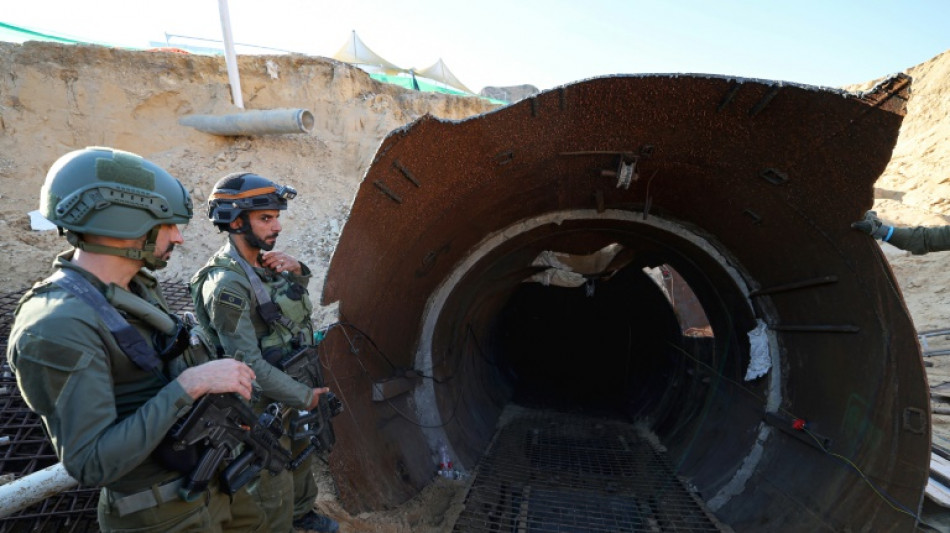
Israeli army says it uncovered biggest Hamas tunnel yet / Photo: JACK GUEZ - AFP

 Asian stocks drop as oil spike fans rate hike bets, eyes on US jobs

 Viral anti-vax posts weaponise Philippine inoculation fears
 Saudi coalition accuses Houthis of drone attack on Medina

 Effective Altruism: the philosophy behind Silicon Valley's AI fears

 Chinese judoka accused of biting as home hope wins Asian Games gold

 Four-member crew docks at International Space Station

 Portugal win without Ronaldo as Klopp's Germany get first victory

 Wemby: 'Very sad' to see players endorse betting firms

 Manchester City Women scrape draw with Real Madrid

 India, Australia and Pakistan in same World Cup group

 Daryz's hopes of repeat Arc win boosted by draw

 Steelers ship disgruntled defender Porter to Cowboys

 Klopp gets first win as Germany boss

 Bolivia's attorney general arrested on drugs, money laundering charges

 Raiders host Chiefs in battle of unbeaten division rivals

 Lowest Fee Bitcoin ATMs Announces Launch of More Than 400 ATMs Nationwide

 G20 against 'weaponization' of food trade: French minister

 Female US inmate in critical condition after botched execution

 Spotlight on UK-UAE ties amid Manchester City scandal

 Ethiopia and Eritrea break diplomatic ties over conflict

 Downing Street says Manchester City not 'above the rules'

 Hadjar wants to 'fight for the title' from next season

 Bolivia's attorney general arrested for alleged drug trafficking, money laundering
 German sugar tax sparks new government row
 Musk returns to US government for Pentagon war study

The Israeli army said on Sunday it had uncovered the biggest Hamas tunnel in the Gaza Strip so far, just a few hundred metres from a key border crossing.
Such was its size that small vehicles would be able to travel within the tunnel, an AFP photographer granted access to it reported.
The underground passage formed part of a wider branching network that stretched for over four kilometres (2.5 miles) and came within 400 metres (1,300 feet) of the Erez border crossing, the army said in a statement.
It cost millions of dollars and took years to construct, Israeli forces said, with the project lead by Mohamed Yahya, brother of Hamas chief Yahya Sinwar, who is believed to have masterminded the October 7 attacks.
The honeycomb of passageways features a drainage systems, electricity, ventilation, sewage and a communication network as well as rails.
The floor is compacted earth while its walls are reinforced concrete and its entrance is a metal cylinder with 1.5 centimetre (half-inch) thick walls.
Footage released by the Israeli army, which it said was filmed by Hamas, showed a small construction vehicle being driven into the tunnel, an extensive temporary warehouse filled with pre-cast concrete for lining the walls and workers digging beneath the earth using crude power tools.
The Israeli army said it had found a large number of weapons stored in the tunnel, ready to be used in an attack.
- People, goods, weapons -
Hamas had expended huge resources in the project, said Lieutenant Colonel Richard Hecht, an army spokesman, and did so to "serve only one purpose -- attacking the State of Israel and its residents".
He said the tunnel was deliberately built near the Erez crossing, which Israel uses to facilitate the strictly controlled entry of Palestinian workers and those travelling for medical care.
"For Hamas, attacking the people of Israel continues to take priority over supporting the people of Gaza," he said.
The Islamist militant group launched a surprise attack against southern Israel on October 7, killing around 1,140 people, mostly civilians, and taking about 250 hostages, according to the latest Israeli figures.
In response, Israel set out to destroy Hamas and launched a relentless bombardment and ground invasion of the Gaza Strip to achieve that goal.
The Hamas-run health ministry in Gaza says Israel has killed more than 18,800 people, mostly women and children, during the war.
Dubbed the "Gaza Metro" by the Israeli military, the labyrinth of tunnels beneath the coastal territory was initially devised as a way of circumventing the crushing Israeli-Egyptian blockade, in place since 2007.
Hundreds of tunnels were built under the border with Egypt and into the Sinai Desert, allowing people, goods and weapons to cross into Gaza from the outside world.
Since the 2014 war with Israel, the tunnel network has been expanded and Hamas has made frequent use of it to facilitate its rocket launches.
A study published on October 17 by the Modern War Institute at the US military academy West Point said there were 1,300 tunnels stretching over 500 kilometres (310 miles).
The Israeli army said at the beginning of December that it had discovered more than 800 tunnels, with 500 destroyed.
Reports in Israeli media last week said that the army was considering flooding the tunnels with seawater pumped from the Mediterranean and had already conducted succesful tests.
C.Hamad--SF-PST