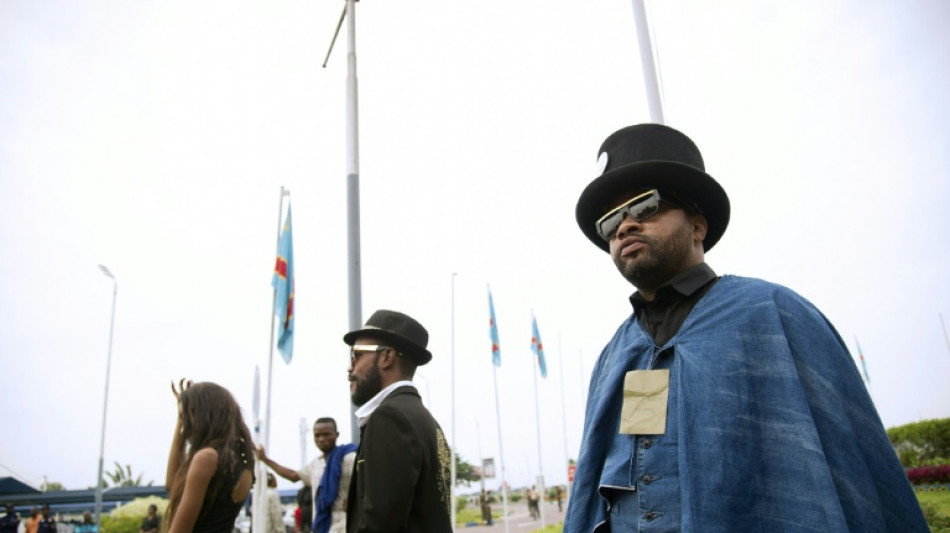
Five things to know about DR Congo / Photo: JUNIOR KANNAH - AFP

 Asian stocks drop as oil spike fans rate hike bets, eyes on US jobs
 Viral anti-vax posts weaponise Philippine inoculation fears
 Saudi coalition accuses Houthis of drone attack on Medina
 Effective Altruism: the philosophy behind Silicon Valley's AI fears
 Chinese judoka accused of biting as home hope wins Asian Games gold

 Four-member crew docks at International Space Station

 Portugal win without Ronaldo as Klopp's Germany get first victory
 Wemby: 'Very sad' to see players endorse betting firms

 Manchester City Women scrape draw with Real Madrid

 India, Australia and Pakistan in same World Cup group
 Daryz's hopes of repeat Arc win boosted by draw
 Steelers ship disgruntled defender Porter to Cowboys

 Klopp gets first win as Germany boss
 Bolivia's attorney general arrested on drugs, money laundering charges
 Raiders host Chiefs in battle of unbeaten division rivals
 Lowest Fee Bitcoin ATMs Announces Launch of More Than 400 ATMs Nationwide

 G20 against 'weaponization' of food trade: French minister
 Female US inmate in critical condition after botched execution

 Spotlight on UK-UAE ties amid Manchester City scandal
 Ethiopia and Eritrea break diplomatic ties over conflict

 Downing Street says Manchester City not 'above the rules'
 Hadjar wants to 'fight for the title' from next season
 Bolivia's attorney general arrested for alleged drug trafficking, money laundering
 German sugar tax sparks new government row
 Musk returns to US government for Pentagon war study

The Democratic Republic of Congo, formerly known as Zaire, is a huge and varied country with a turbulent political history, which is currently ravaged by conflict in its east.
Here are five things to know about this central African nation:
- Continent-sized -
The DRC spans over 2.34 million square kilometres (904,000 square miles) -- roughly the size of continental western Europe.
The second-largest African country in terms of surface area, it is also the fourth most populous state on the continent, with an estimated 100 million inhabitants.
Some 250 different ethnic groups live in the DRC, speaking hundreds of different languages.
French is the country's official language, and local tongues Kikongo, Lingala, Tshiluba and Swahili are also officially recognised.
Despite its size and diversity -- the former province of Katanga tried to secede in the 1960s -- there is a fierce sense of national unity.
- Mineral wealth, dire poverty -
The DRC is awash with minerals and precious stones, from gold, diamonds and coltan to tin, copper and cobalt.
Harbouring the Congo River -- the second-largest in Africa after the Nile -- the DRC also has huge hydroelectric potential, as well as 80 million hectares (197 million acres) of arable land.
But decades of war, corruption and chronic mismanagement means that little of the country's enormous wealth trickles down to the population.
About two-thirds of the Congolese population survive on under $2.15 a day, according to the World Bank.
- Turbulent politics -
The DRC has a history of turbulent politics. Two of its governments have been overthrown violently: in 1965 and then in 1997.
Two of the country's leaders have also been assassinated: Patrice Lumumba in 1961 and Laurent-Desire Kabila in 2001.
Elections are often marked by violence. The vote that brought incumbent President Felix Tshisekedi to power in 2018 marked the first peaceful changeover in Congolese history -- although the results were fiercely disputed.
According to the interior ministry, there are 910 registered political parties in the country.
With three days to go before polling day, there are 19 candidates vying for the presidency, in a single-round vote held on the same day as the legislative, provincial and municipal elections.
- Conflict -
Two major wars devastated the DRC in its recent history. The First Congo War, which lasted between 1996-1997, culminated in the overthrow of former dictator Mobutu Sese Seko.
The Second Congo War, from 1998 to 2003, drew in nine African states and saw the proliferation of dozens of militia groups.
Most of the DRC has returned to relative stability. But its mineral-rich east -- bordering Uganda, Rwanda and Burundi -- remains plagued by armed groups and brutal violence, a legacy of the recent regional wars.
- Rumba, survival -
Congolese people are renowned for their sense of humour and resourcefulness in the face of trying conditions.
Many jokingly refer to "Article 15" of the constitution, which purports to instruct citizens to sort things out themselves.
Music also plays an outsize role in the country's culture. UNESCO listed Congolese rumba as intangible cultural heritage of humanity in December 2021.
Congo is also famed for its so-called sapeurs -- dandies known for their ultra-elegant clothing and sense of style.
M.AlAhmad--SF-PST