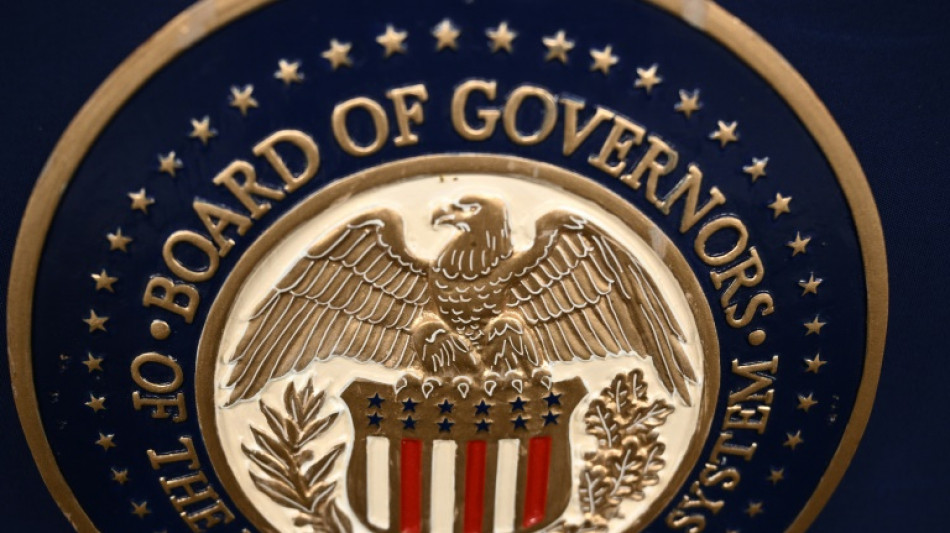
Has the Fed won the battle against inflation? / Photo: Brendan SMIALOWSKI - AFP

 Asian stocks drop as oil spike fans rate hike bets, eyes on US jobs

 Viral anti-vax posts weaponise Philippine inoculation fears

 Saudi coalition accuses Houthis of drone attack on Medina

 Effective Altruism: the philosophy behind Silicon Valley's AI fears

 Chinese judoka accused of biting as home hope wins Asian Games gold

 Four-member crew docks at International Space Station

 Portugal win without Ronaldo as Klopp's Germany get first victory

 Wemby: 'Very sad' to see players endorse betting firms

 Manchester City Women scrape draw with Real Madrid

 India, Australia and Pakistan in same World Cup group

 Daryz's hopes of repeat Arc win boosted by draw

 Steelers ship disgruntled defender Porter to Cowboys

 Klopp gets first win as Germany boss

 Bolivia's attorney general arrested on drugs, money laundering charges
 Raiders host Chiefs in battle of unbeaten division rivals

 Lowest Fee Bitcoin ATMs Announces Launch of More Than 400 ATMs Nationwide

 G20 against 'weaponization' of food trade: French minister

 Female US inmate in critical condition after botched execution

 Spotlight on UK-UAE ties amid Manchester City scandal

 Ethiopia and Eritrea break diplomatic ties over conflict

 Downing Street says Manchester City not 'above the rules'

 Hadjar wants to 'fight for the title' from next season

 Bolivia's attorney general arrested for alleged drug trafficking, money laundering

 German sugar tax sparks new government row

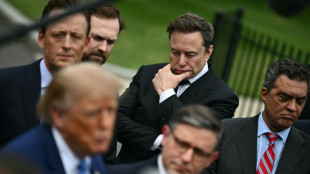 Musk returns to US government for Pentagon war study

The US Federal Reserve's decision to hold its key lending rate on Wednesday and pencil in three interest rate cuts next year has fueled optimism that its inflation battle is won.
Following the Fed's decision, the Dow Jones Industrial Average index surged to an all-time high, while yields on US government bonds plummeted, reducing borrowing costs on everything from car loans to home mortgages.
Against the backdrop of falling inflation, low unemployment and persistent economic growth, analysts are increasingly asking the question: Has the Fed won the battle against inflation?
What has the Fed accomplished?
As the US economy was rebounding from the Covid-19 pandemic, a supply-side crunch caused a rapid surge in inflation.
In March 2022, amid a rise in energy prices following Russia's invasion of Ukraine, the Fed began aggressively hiking interest rates in a bid to control rising prices.
Over the next 18 months, policymakers lifted the Fed's key lending rate to a 22-year high, and successfully cooled consumer inflation from a 40-year high of 9.1 percent last year to just over 3.1 percent in November 2023.
The economic picture today is a surprisingly positive one, with unemployment at close to historic lows, and an economy that is on track to avoid a damaging recession.
Fed policymakers are increasingly confident that they are on track to achieve this rare monetary policy success known as a "soft landing."
The Fed now expects economic growth to rise to 2.6 percent this year, before slowing down in 2024.
But despite the good news, the Fed's favored inflation gauge remains stuck stubbornly above its long-run target of two percent, underscoring the challenges that still remain.
What happened this week?
On Wednesday, the Fed voted to hold interest rates steady for a third straight meeting, and predicted 0.75 percent points of interest rate cuts in the year ahead.
Fed Chair Jerome Powell told reporters that the language of the Fed's decision had been changed as "an acknowledgement that we believe that we are likely at or near the peak rate for this cycle."
He added that policymakers had even discussed when it would be "appropriate" for the Fed to begin cutting interest rates -- while refusing to rule out another hike.
On the face of it, Powell expressed a cautious view of unfolding events, as is often the case among central bankers.
But when compared against his recent threats to raise interest rates further, Powell's remarks were seen as a sign that the Fed is confident it is winning the inflation fight.
"The Fed thinks that it is done," KPMG Chief Economist Diane Swonk wrote in a note published shortly after Powell's remarks on Wednesday.
The Fed's statement and economic projections "provided a more dovish signal than we or the market were expecting," Steve Englander, Standard Chartered Bank's head of North America macro strategy, wrote in a note to clients.
What risks remain?
The financial markets are increasingly convinced that the Fed is done hiking rates, and are pricing in as many as six cuts next year, according to CME Group data.
This is more aggressive than the Fed's own forecast, reflecting optimism that the US economy has turned the corner on inflation.
The major risk facing the Fed as it looks to pivot from its prolonged pause to interest rate cuts is that inflation returns.
An external shock, such as an escalation of the wars in Ukraine or Gaza, could cause another surge in food or energy prices, and complicate the Fed's battle to definitively slow the rate of price increases to two percent.
"Inflation is still too high, ongoing progress in bringing it down is not assured, and the path forward is uncertain," Powell told reporters on Wednesday.
G.AbuHamad--SF-PST