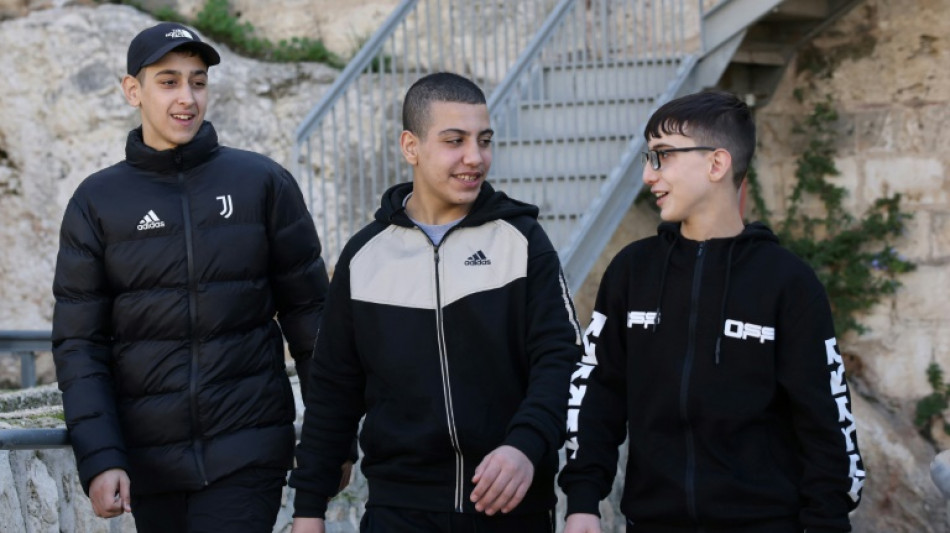
School's out: Freed Palestinian teens unable to return to class / Photo: AHMAD GHARABLI - AFP

 Asian stocks drop as oil spike fans rate hike bets, eyes on US jobs

 Viral anti-vax posts weaponise Philippine inoculation fears
 Saudi coalition accuses Houthis of drone attack on Medina
 Effective Altruism: the philosophy behind Silicon Valley's AI fears
 Chinese judoka accused of biting as home hope wins Asian Games gold

 Four-member crew docks at International Space Station

 Portugal win without Ronaldo as Klopp's Germany get first victory
 Wemby: 'Very sad' to see players endorse betting firms

 Manchester City Women scrape draw with Real Madrid

 India, Australia and Pakistan in same World Cup group
 Daryz's hopes of repeat Arc win boosted by draw
 Steelers ship disgruntled defender Porter to Cowboys

 Klopp gets first win as Germany boss

 Bolivia's attorney general arrested on drugs, money laundering charges
 Raiders host Chiefs in battle of unbeaten division rivals
 Lowest Fee Bitcoin ATMs Announces Launch of More Than 400 ATMs Nationwide

 G20 against 'weaponization' of food trade: French minister

 Female US inmate in critical condition after botched execution

 Spotlight on UK-UAE ties amid Manchester City scandal
 Ethiopia and Eritrea break diplomatic ties over conflict

 Downing Street says Manchester City not 'above the rules'
 Hadjar wants to 'fight for the title' from next season
 Bolivia's attorney general arrested for alleged drug trafficking, money laundering
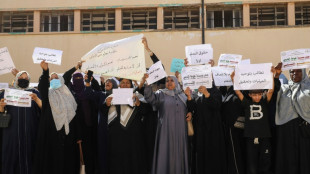
 German sugar tax sparks new government row

 Musk returns to US government for Pentagon war study

Like many other imprisoned Palestinian teenagers released as part of an exchange deal with Israel, Mohamed al-Salaymeh hoped to regain a semblance of normality after months in detention.
But he found himself in limbo yet again, unable to go back to school due to a new Israeli education ministry decision. The ruling bans students in annexed east Jerusalem from resuming classes after imprisonment.
"My dream is to return and for this gate to be opened," said Mohamed, 16, standing in front of his school in his east Jerusalem neighbourhood of Ras al-Amoud.
Israel last month agreed to a temporary truce deal that saw the release of 80 Israeli hostages held by Hamas militants in exchange for 240 Palestinians detained in Israeli prisons.
All those released on both sides were women and minors.
Hamas gunmen seized a total of about 250 hostages on October 7 when they broke through the militarised border of the Gaza Strip for an unprecedented attack that killed 1,139 people in southern Israel, according to Israeli figures.
In retaliation Israel vowed to destroy Hamas and began a relentless bombardment of Gaza, alongside a ground invasion, that has killed 18,800 people, according to Gaza's Hamas government.
Israel occupied east Jerusalem during a 1967 war with Arab states, and later annexed it in a move never recognised by the international community.
Around 230,000 Israelis now live in the territory, alongside at least 360,000 Palestinians who want to make the city's eastern sector the capital of their future state.
Mohamed was arrested alongside three of his cousins, Moataz, 15, and brothers Ahmed, 14, and Ayham, 13. Ayham was later placed under house arrest, where he remains.
The others spent about four months in an Israel prison accused -- but never formally charged -- of throwing rocks at a Jewish settlement near their Jerusalem neighbourhood.
"Where will I go? There is nowhere. I will stay at home. I can't work because I'm under 18," said Ahmed, the youngest of the Palestinians freed under the deal.
Moataz said he fears "losing my education. If things remain this way, I will have to repeat a year."
But Mohamed appears the hardest hit by the decision, as he was expecting to graduate next year.
"God only knows when we will return. I want to achieve my dreams," he told AFP.
- 'No future' -
The Israeli ministry's decision affects 48 of the minors released in the hostage-prisoner deal.
The ministry told AFP that the teens' status would be reevaluated after the end of winter holidays on January 10.
Jerusalem municipality, responsible for implementing the decision, told AFP it was "assessing and examining the pedagogical and emotional needs of each and every student, and building individual educational programmes aiming to prevent the recurrence of unlawful acts in the future".
On Tuesday, municipal officials summoned Ahmed's father, Nayef al-Salaymeh.
The officials "suggested that they be moved to other schools and institutions according to vague criteria," said Salaymeh, whose son hopes to become a lawyer.
"We refused to move them because they all grew up in this school in our neighbourhood," the father said, clad in a traditional Palestinian keffiyeh chequered scarf.
"If this decision becomes effective... we will see young people in the streets with no future," he continued. "They destroy their thoughts and ambitions, to turn us into a backwards people."
Nayef al-Salaymeh said civil society groups are helping the family continue its "struggle to return our children to their classrooms."
- 'A human right' -
Unlike the Salaymehs, Amin al-Abbasi, 17, opted to move to a school run in east Jerusalem by the Palestinian Authority, which has partial administrative control in the Israeli-occupied West Bank.
He said he decided "not to lose the year", but fears he won't be able to adapt to the new school in Sur Bahr and is trying to convince his former cellmates to join him.
His mother, Abir, complained that the school is "very far from all public transportation."
Amin was serving a 20-month sentence for involvement in clashes in his neighbourhood of Silwan, adjacent to Jerusalem's walled Old City, where tensions previously flared between Palestinian residents and Jewish settlers.
He served 13 months before the exchange deal freed him.
Khaled Zabarqa, a lawyer who has examined such cases but does not officially represent any of the minors, said the ministry ban on ex-prisoners returning to school contravenes Israel's law on mandatory education.
"Education as a human right should not be subject to political considerations," he said.
Tal Hassin, from the Association for Civil Rights in Israel, said many of the students "have not been convicted. They are just suspects".
She said the association is awaiting the end of the holidays to see what official decisions come next, and what legal avenues might be pursued.
Until then, Mohamed clings to the hope of returning to school.
"My education is my only weapon," he said.
X.AbuJaber--SF-PST