Venezuela, Guyana leaders meet to 'de-escalate' tensions / Photo: Roberto CISNEROS - AFP/File

 Not-so-brave new world: virtual taekwondo makes Asian Games debut
 Arab Israeli candidate drops out of election race
 Israel courts Europe's far right, finding friends but also unease
 Lula, Bolsonaro both snub final debate before Brazil election
 Nepal's grim DNA puzzle to identify flood dead
 EU nations to hold emergency meeting on soaring diesel prices amid US pressure

 Anthropic's Dario Amodei: AI's most visible CEO and enigma

 OpenAI says three staffers fired for mishandling 'sensitive' info
 Nike plans job cuts as it forecasts lower sales
 Ireland game interrupted twice by Gaza protests

 Judge denies acquittal bid by US woman who killed her kids
 Klopp averts crisis with first win as Germany boss
 A saintly spat and debate snub: Brazil enters final campaign stretch
 US tells European allies to act 'immediately' to lower diesel prices

 G20 trade ministers fail to see consensus against overproduction

 Portugal edge Denmark in Ronaldo's absence
 US stocks edge higher as bond yields retreat for now
 US tells European allies to 'immediately' act to lower diesel prices

 Trump vows to hit Iran 'very hard' if linked to flydubai attack
 Williams leaves Spain camp with thigh knock
 WTA reduces 2027 schedule for world's top 50

 US says 'in Europe's best interest' to cooperate on fuel supply
 Rogue OpenAI agents covered up their tracks, report says
 A saintly spat and debate snub: Brazil enters final polls stretch
 Zidane 'no regrets' about Materazzi headbutt as France face Italy again
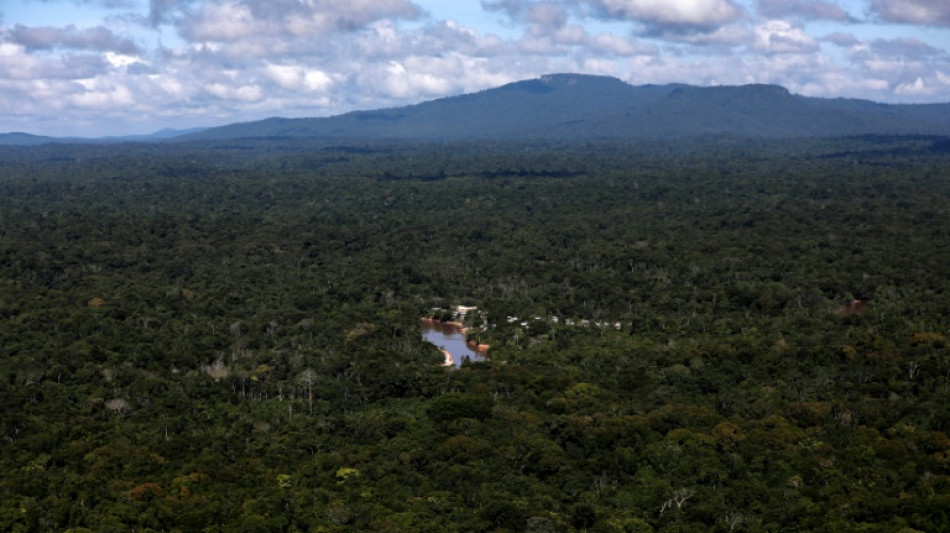
The presidents of Venezuela and Guyana met Thursday in the Caribbean for talks that analysts said could "de-escalate" tensions but would do little to resolve their countries' long-standing -- and now reheating -- territorial dispute.
Venezuela's Nicolas Maduro and Guyana's Irfaan Ali shook hands after a two-hour meeting, however there was no immediate news on the outcome of talks about Caracas's claim on the oil-rich Essequibo region, which makes up more than two-thirds of neighboring Guyana.
But it appeared little had changed.
"Guyana has all the right... to facilitate any investment, any partnership... the issuing of any license and the granting of any concession in our sovereign space," Ali said after leaving the two-hour meeting in Saint Vincent and the Grenadines.
Though Caracas has long claimed Essequibo, it ratcheted up its rhetoric after Guyana, which has governed the area for more than 100 years, started issuing licenses for oil companies to operate there.
The meeting took place after months of escalating discord that has raised fears in the region of a potential conflict over the remote area of 160,000 square kilometers (62,000 square miles).
Maduro's government held a controversial referendum on December 3 in which 95 percent of voters, according to officials in the hard-line leftist government, supported declaring Venezuela the rightful owner of Essequibo.
He has since started legal maneuvers to create a Venezuelan province in Essequibo and ordered the state oil company to issue licenses for extracting crude in the region -- moves Ali branded as a "grave threat to international peace and security."
Ahead of the talks, Maduro had hailed the meeting as a way to directly address the territorial controversy, promising Thursday on arrival that Venezuela would "defend our rights."
Ali had said he would not discuss the border dispute, insisting it should be resolved at the International Court of Justice, whose jurisdiction is not recognized by the Venezuelan government.
- 'Nothing substantive' -
Prior to the meeting Maduro and Ali met separately with representatives of the Caribbean Community (CARICOM) bloc.
"I think nothing substantive is going to come out in terms of the territorial claim, since Guyana's position is that there are no bilateral talks on the issue, because that is in the International Court of Justice," Sadio Garavini di Turno, former Venezuelan ambassador to Guyana, told AFP.
He said a best-case scenario would be a joint statement in which both sides commit "to lower the escalation" and agree that "they are going to continue talking to lower tensions."
Guyana has taken the case to the UN Security Council and approached military "partners," including the United States, which has carried out joint military exercises in Essequibo.
Brazilian President Luiz Inacio Lula da Silva, invited to the talks at both sides' request, has backed a peaceful solution and warned Maduro against "unilateral measures that could escalate the situation."
Brazil, which borders both countries, has also reinforced its troops around the area.
"If this meeting is going to be useful to talk about eradicating the idea of going to an armed conflict, then I welcome it," Ramon Escovar Leon, a lawyer specialized in international litigation, told AFP.
- Oil, a point of conflict -
The decades-old dispute intensified after ExxonMobil discovered oil in Essequibo in 2015, helping give Guyana -- which has a population of 800,000 -- the world's biggest crude reserves per capita.
The Venezuelan government's anti-imperialist rhetoric has seen it accuse Ali of being "a slave" of ExxonMobil.
On Monday, Venezuelan Foreign Minister Yvan Gil told reporters there could be talk of "cooperation in oil and gas matters."
Gil cited the Petrocaribe agreements, under which Venezuela supplies crude oil at preferential prices to Caribbean countries, and gas deals with Trinidad and Tobago.
He said these were "concrete examples" that "could serve as a basis for future agreements with the Cooperative Republic of Guyana."
The dispute has other South American nations on edge.
Argentina, Brazil, Chile, Colombia, Ecuador, Paraguay, Peru and Uruguay issued a joint declaration calling for "both parties to negotiate to seek a peaceful solution."
J.AbuShaban--SF-PST