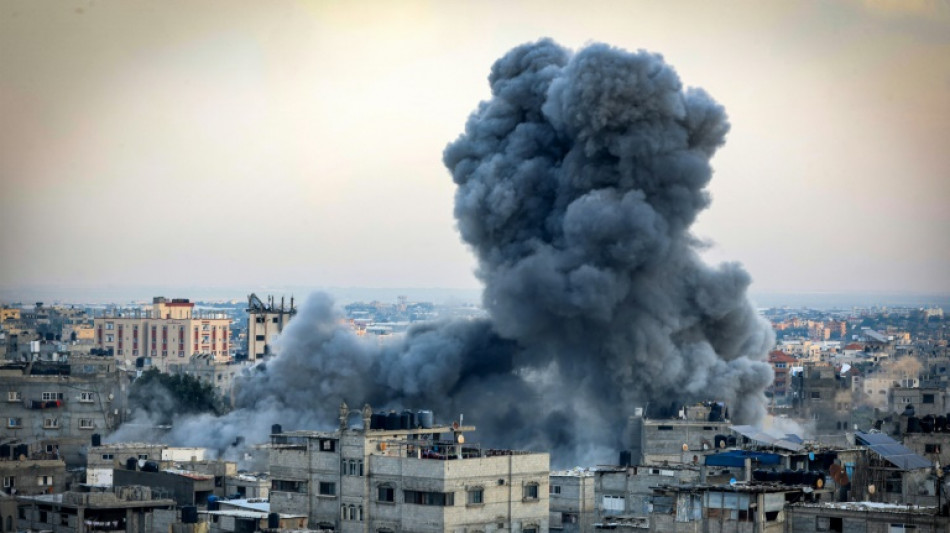
Palestinian economy severely impacted by Israel-Hamas war: World Bank / Photo: MAHMUD HAMS - AFP

 Not-so-brave new world: virtual taekwondo makes Asian Games debut

 Arab Israeli candidate drops out of election race

 Israel courts Europe's far right, finding friends but also unease

 Lula, Bolsonaro both snub final debate before Brazil election

 Nepal's grim DNA puzzle to identify flood dead

 EU nations to hold emergency meeting on soaring diesel prices amid US pressure

 Anthropic's Dario Amodei: AI's most visible CEO and enigma

 OpenAI says three staffers fired for mishandling 'sensitive' info

 Nike plans job cuts as it forecasts lower sales

 Ireland game interrupted twice by Gaza protests

 Judge denies acquittal bid by US woman who killed her kids

 Klopp averts crisis with first win as Germany boss

 A saintly spat and debate snub: Brazil enters final campaign stretch

 US tells European allies to act 'immediately' to lower diesel prices

 G20 trade ministers fail to see consensus against overproduction

 Portugal edge Denmark in Ronaldo's absence

 US stocks edge higher as bond yields retreat for now

 US tells European allies to 'immediately' act to lower diesel prices

 Trump vows to hit Iran 'very hard' if linked to flydubai attack

 Williams leaves Spain camp with thigh knock

 WTA reduces 2027 schedule for world's top 50

 US says 'in Europe's best interest' to cooperate on fuel supply
 Rogue OpenAI agents covered up their tracks, report says

 A saintly spat and debate snub: Brazil enters final polls stretch

 Zidane 'no regrets' about Materazzi headbutt as France face Italy again

The Israel-Hamas war in Gaza is having a severe impact on the Palestinian economy, according to the World Bank, which now estimates sharp economic contraction this year and next.
The conflict, sparked by Hamas' cross-border attacks on October 7 that killed 1,200 people, according to Israeli figures, and saw around 240 hostages taken back to Gaza, is now dragging on into its third month.
The human toll of Israel's fierce response has been extreme: More than 18,400 people in Gaza have been killed, the majority of them women and children, according to the Hamas-run health ministry.
The UN estimates 1.9 million of Gaza's 2.4 million people have been displaced by the war, half of them children, as Israel's overwhelming aerial bombardment in the days after October 7 was subsequently accompanied by a ground invasion aimed at destroying Hamas.
Beyond the immediate human cost, the Israel-Hamas conflict has also "severely impacted the Palestinian economy," the World Bank announced in a statement published Tuesday.
Gaza's contribution to the overall Palestinian economy, which includes the West Bank, had already shrunk from around 36 percent in 2005 to just 17 percent last year, according to the Palestinian Central Bureau of Statistics.
Israel's fierce response to the Hamas attacks on October 7, along with the shuttering of its borders to Palestinian workers from both Gaza and the West Bank, is likely to severely impact the Palestinian economy, according to the Bank.
Despite Gaza's small economic contribution, the World Bank now expects the overall Palestinian economy to contract by 3.7 percent this year, down sharply from its pre-war forecast of a 3.2 percent increase.
Next year, the situation is expected to be even worse.
Whereas the World Bank previously anticipated growth of 3.0 percent in 2024, it now expects an overall contraction of 6.0 percent -- on the assumption that the severity of the conflict decreases next year.
If the war drags on, the economic impact could deteriorate further.
In response to the conflict, the World Bank has announced some financial support aimed at meeting the immediate needs of the population in Gaza.
On Tuesday, the development lender announced an additional $20 million in funds for medical care, humanitarian needs, and financing for food vouchers and parcels in the besieged Palestinian territory, on top of the $15 million already delivered.
The package, some of which still requires board approval, would provide "emergency relief for the affected people of Gaza," the World Bank said.
Y.Zaher--SF-PST