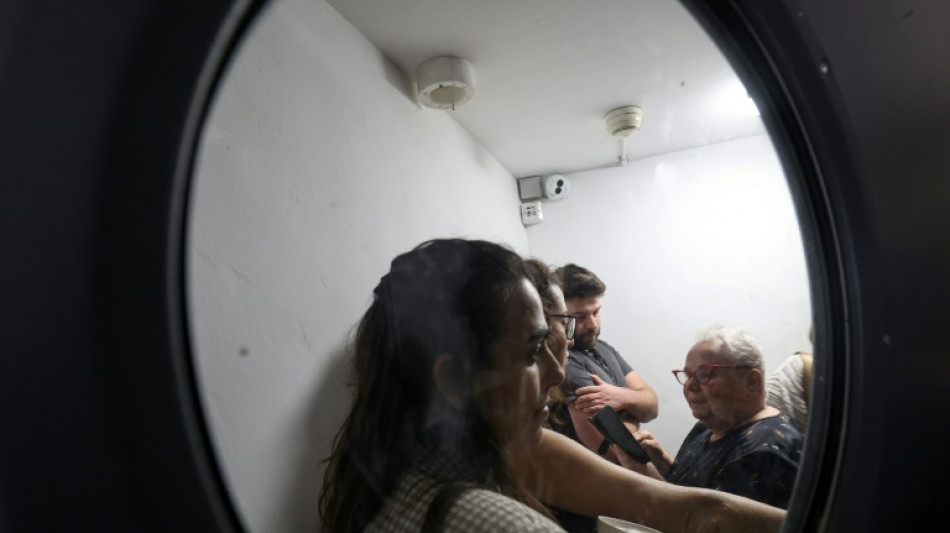
Hostages were drugged, abused in Gaza: Israeli doctor / Photo: GIL COHEN-MAGEN - AFP

 Taiwan gender-row boxer Lin Yu-ting wins 'monumental' Asian Games gold
 Taiwan receives its first US-made F-16V fighter jets

 Lula, Bolsonaro trade scandal fire in final scramble for votes
 Not-so-brave new world: virtual taekwondo makes Asian Games debut
 Arab Israeli candidate drops out of election race

 Israel courts Europe's far right, finding friends but also unease
 Lula, Bolsonaro both snub final debate before Brazil election
 Nepal's grim DNA puzzle to identify flood dead
 EU nations to hold emergency meeting on soaring diesel prices amid US pressure

 Anthropic's Dario Amodei: AI's most visible CEO and enigma

 OpenAI says three staffers fired for mishandling 'sensitive' info

 Nike plans job cuts as it forecasts lower sales

 Ireland game interrupted twice by Gaza protests

 Judge denies acquittal bid by US woman who killed her kids

 Klopp averts crisis with first win as Germany boss

 A saintly spat and debate snub: Brazil enters final campaign stretch

 US tells European allies to act 'immediately' to lower diesel prices

 G20 trade ministers fail to see consensus against overproduction

 Portugal edge Denmark in Ronaldo's absence
 US stocks edge higher as bond yields retreat for now

 US tells European allies to 'immediately' act to lower diesel prices

 Trump vows to hit Iran 'very hard' if linked to flydubai attack
 Williams leaves Spain camp with thigh knock
 WTA reduces 2027 schedule for world's top 50

 US says 'in Europe's best interest' to cooperate on fuel supply
Hostages hauled into Gaza during Hamas's October 7 attack on Israel were drugged to keep them docile in captivity and subjected to psychological and sexual abuse, a specialist said Monday.
"I've never seen anything like that" in 20 years of treating trauma victims, said Renana Eitan, director of the psychiatric division of the Tel Aviv Sourasky Medical Centre-Ichilov.
"The physical, the sexual, the mental, the psychological abuse of these hostages that came back is just terrible," she added. "We have to rewrite the textbook."
The centre has received 14 ex-hostages released by Hamas, some of whom reported being drugged, including with what doctors believe were benzodiazapines, a class of depressants with a sedative effect that includes drugs like Valium.
"They wanted to control the kids, and sometimes it's difficult to control young children, adolescents. And they know that if they drug them they will be quiet," she added.
"One of the girls was given ketamine for a few weeks," she continued, referring to a powerful dissociative anaesthetic known for giving the recipient a sense of detachment from their environment.
"It's unbelievable to do this to a child."
Eitan said some former hostages had also described psychological torment at the hands of their captors.
One was told his wife was dead when in fact she was still alive back in Israel, while children were separated from their families and shown "brutal videos".
One patient said she and others were held in total darkness for more than four days.
"They became psychotic, they had hallucinations," Eitan said.
There were also reports of self-harm among hostages in captivity, she noted, while some returnees had since professed to having suicidal thoughts.
"But this is our mission, to make sure that such things will not happen," she added.
Ichilov has also treated hundreds of physically wounded patients, both victims of October 7 and soldiers injured in the ensuing war in the Gaza Strip.
Soldiers can be airlifted to Ichilov from the battlefield in about 15 minutes, according to vice chief of trauma surgery Eyal Hashavia.
- Dissociative states -
Hamas's October 7 attack killed 1,200 people and saw another 240 taken hostage, Israeli officials say.
Under a one-week truce deal that ended on December 1, 105 hostages were released from Gaza, among them 80 Israelis -- mostly women and children -- freed in exchange for 240 Palestinians jailed by Israel.
At least 137 hostages are believed to still be in Hamas captivity.
Israel responded with a massive ground and air campaign to eliminate Hamas that has killed more than 18,200 people, according to the territory's Hamas-run health ministry.
Some former hostages continue to experience dissociative states, Eitan said: "One minute they know that they are here at Ichilov medical centre, and the next they think they are back with Hamas."
There are plans to create a centre to treat post-traumatic stress disorder (PTSD) after the national shock of the October attack.
Eitan said the mental health toll was staggering, with around five percent of Israel's population -- some 400,000 people -- expected to suffer some symptoms of PTSD.
Tomer Zadik, 24, has been receiving treatment at Ichilov since being shot in the arm when Hamas fighters stormed the Supernova music festival on October 7.
He described hiding for hours as he listened to the voices of the attackers around him, before managing to escape and reunite with a group of festival-goers and a few soldiers.
"The atrocities over there, words really can't describe," he said, adding that he had nightmares about the attack, though "less and less with time".
"They wanted to break us, not only physically. They wanted to mentally break the whole nation of Israel," he said.
"But we won't break."
Q.Najjar--SF-PST