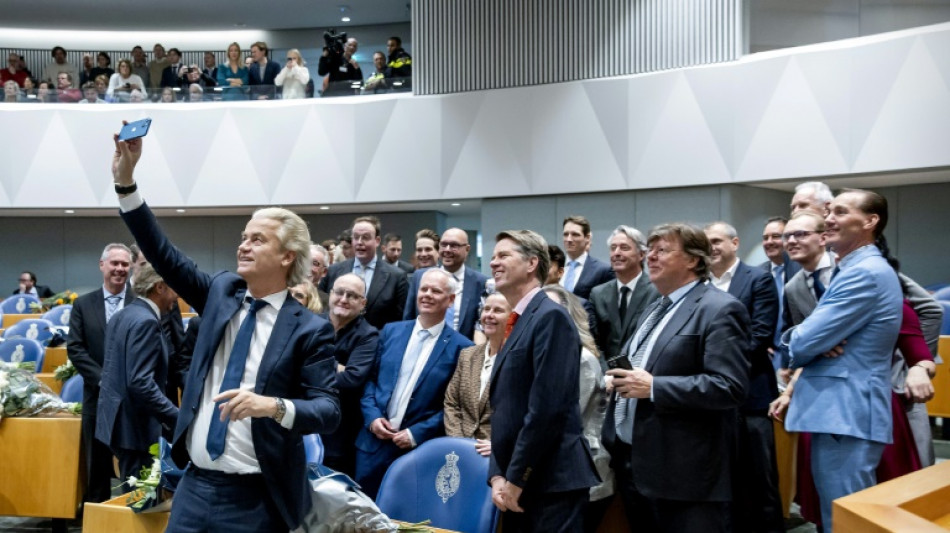
Wilders gets until Feb to convince others to form Dutch govt / Photo: Koen van Weel - ANP/AFP

 Taiwan gender-row boxer Lin Yu-ting wins 'monumental' Asian Games gold
 Taiwan receives its first US-made F-16V fighter jets
 Lula, Bolsonaro trade scandal fire in final scramble for votes

 Not-so-brave new world: virtual taekwondo makes Asian Games debut
 Arab Israeli candidate drops out of election race
 Israel courts Europe's far right, finding friends but also unease
 Lula, Bolsonaro both snub final debate before Brazil election
 Nepal's grim DNA puzzle to identify flood dead

 EU nations to hold emergency meeting on soaring diesel prices amid US pressure

 Anthropic's Dario Amodei: AI's most visible CEO and enigma

 OpenAI says three staffers fired for mishandling 'sensitive' info
 Nike plans job cuts as it forecasts lower sales
 Ireland game interrupted twice by Gaza protests

 Judge denies acquittal bid by US woman who killed her kids
 Klopp averts crisis with first win as Germany boss

 A saintly spat and debate snub: Brazil enters final campaign stretch

 US tells European allies to act 'immediately' to lower diesel prices

 G20 trade ministers fail to see consensus against overproduction
 Portugal edge Denmark in Ronaldo's absence
 US stocks edge higher as bond yields retreat for now

 US tells European allies to 'immediately' act to lower diesel prices

 Trump vows to hit Iran 'very hard' if linked to flydubai attack
 Williams leaves Spain camp with thigh knock

 WTA reduces 2027 schedule for world's top 50

 US says 'in Europe's best interest' to cooperate on fuel supply
Dutch far-right leader Geert Wilders has less than two months to win over potential coalition partners uneasy about his hardline anti-Islam and anti-European views, according to a much-anticipated report published Monday.
Wilders delivered a political earthquake in the Netherlands and across Europe last month by handily winning elections and putting his PVV Freedom Party in pole position to form a government.
Unlike Britain and the United States for example, the Netherlands has a hugely fragmented political system that means no one party ever enjoys a parliamentary majority.
Wilders has struggled to convince other party leaders to join a government, as they are put off by elements of his party's manifesto seen as unconstitutional, such as banning mosques and the Koran.
The far-right firebrand wants a four-way coalition of his PVV, the BBB farmers party, the centre-right VVD liberal party and the New Social Contract (NSC) party that was formed only in August.
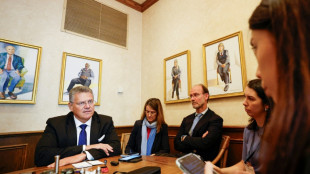
Ronald Plasterk, the "scout" Wilders appointed to shuttle between party leaders to scope out who is prepared to work with whom, delivered his long-awaited report to parliament Monday.
Plasterk advised first appointing another official known as an "informateur".
This person would oversee talks to see whether Wilders's preferred four parties could agree on a "common basis for safeguarding the Constitution, basic rights and the democratic constitutional state".
If doubts over Wilders's commitment to upholding the Dutch constitution can be overcome, then the parties can move onto the next step -- examining five key policy areas.
These areas are immigration; social policy including cost of living and health; good governance and stable public finances; foreign policy; and climate and environmental policy.
Discussions should take place in December and January, with a new report to parliament "no later than early February", according to Plasterk's report.
- 'Nexit' referendum? -
Asked by reporters if he thought the parties could overcome their differences, Plasterk said: "I think they can and I even think they should."
"The country needs to be governed."
He dismissed the idea of possible new elections.
"I think that everyone... thinks it would not be acceptable to go back to the voters and tell them you voted wrongly and you have to vote again," Plasterk said.
Wilders toned down most of his more extreme rhetoric during the campaign and vowed to be a premier "for all Dutch people" after his election win, but doubts remain.
He told journalists during the swearing-in of new MPs last week that "nobody needs to be afraid of us" as the largest party in the lower house of parliament.
It also remains to be seen whether Wilders is an acceptable prime minister, given his past statements on Islam and the European Union.
His PVV manifesto calls for a referendum on whether the Netherlands -- one of the founding members of the European Union -- should leave the bloc, a so-called "Nexit".
The Dutch will probably be waiting several months before they get a government.
Only if the constitutional stumbling blocks are overcome will the substantive talks start on forming a coalition agreement -- another lengthy process.
During the talks, Mark Rutte remains prime minister. His last cabinet collapsed over immigration and he announced he was leaving politics after a record 13 years at the helm.
The last Rutte government took 271 days to form.
H.Nasr--SF-PST