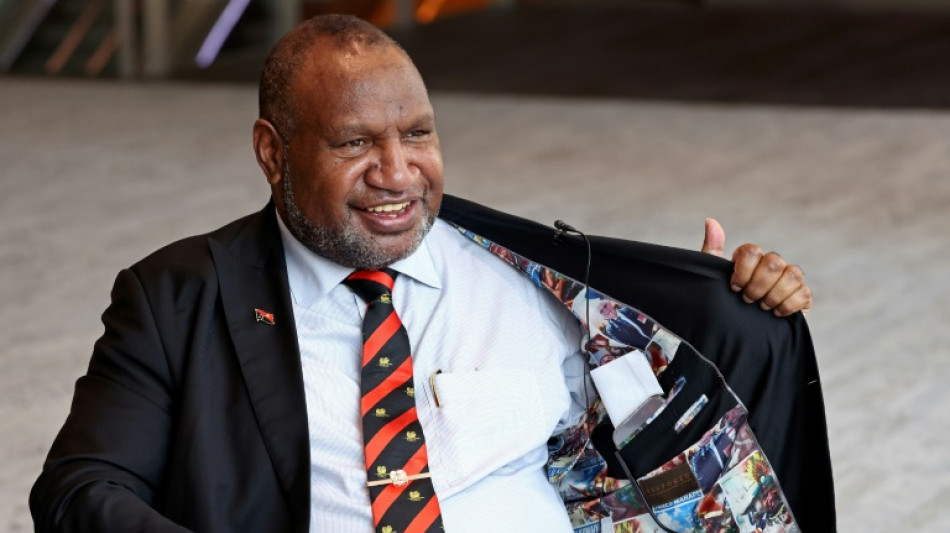
Papua New Guinea will not be 'reckless' with China loans: PM / Photo: DAVID GRAY - AFP

 Taiwan gender-row boxer Lin Yu-ting wins 'monumental' Asian Games gold
 Taiwan receives its first US-made F-16V fighter jets
 Lula, Bolsonaro trade scandal fire in final scramble for votes
 Not-so-brave new world: virtual taekwondo makes Asian Games debut

 Arab Israeli candidate drops out of election race

 Israel courts Europe's far right, finding friends but also unease
 Lula, Bolsonaro both snub final debate before Brazil election
 Nepal's grim DNA puzzle to identify flood dead
 EU nations to hold emergency meeting on soaring diesel prices amid US pressure

 Anthropic's Dario Amodei: AI's most visible CEO and enigma

 OpenAI says three staffers fired for mishandling 'sensitive' info
 Nike plans job cuts as it forecasts lower sales
 Ireland game interrupted twice by Gaza protests

 Judge denies acquittal bid by US woman who killed her kids

 Klopp averts crisis with first win as Germany boss

 A saintly spat and debate snub: Brazil enters final campaign stretch
 US tells European allies to act 'immediately' to lower diesel prices

 G20 trade ministers fail to see consensus against overproduction

 Portugal edge Denmark in Ronaldo's absence
 US stocks edge higher as bond yields retreat for now

 US tells European allies to 'immediately' act to lower diesel prices

 Trump vows to hit Iran 'very hard' if linked to flydubai attack
 Williams leaves Spain camp with thigh knock

 WTA reduces 2027 schedule for world's top 50

 US says 'in Europe's best interest' to cooperate on fuel supply
Papua New Guinea's prime minister has promised to tread carefully with Belt and Road funding from China, telling AFP on Monday he would not be "reckless" with foreign loans.
China and the United States have been jockeying for influence in the South Pacific state, which sits atop bulging deposits of gas and minerals and peers over key shipping lanes.
Papua New Guinea was in 2018 one of the first Pacific nations to join China's Belt and Road programme, which has funded thousands of major infrastructure projects across the globe.
But it has grown closer to the United States since Prime Minister James Marape took power in 2019 -- culminating in a landmark defence pact struck with Washington earlier this year.
Sitting down with AFP on the sidelines of an energy conference in Sydney, PM Marape stressed Papua New Guinea would not blindly accept loans offered by China.
"If Road and Belt initiative projects tick off on Treasury requirements, then by all means fair consideration will be given," he said.
"We're not reckless. We are investing in infrastructure that expressly has a return on investment."
Beijing has been accused of using Belt and Road funding for "debt-trap diplomacy", gaining sway over developing nations that struggle to pay back hefty loans.
The Pacific kingdom of Tonga currently owes China's export bank around $130 million -- almost a third of its entire gross domestic product.
Chinese companies have in recent years poured money into Papua New Guinea, financing school buildings, highways and real estate developments.
Marape said that under his watch, however, the government would not consider foreign funding for major projects unless there was the promise of a "soft, soft landing".
- 'No war' in Pacific -
The US scored a major strategic win in Papua New Guinea earlier this year, when it secured "unimpeded" access to key naval bases under a landmark defence agreement.
But there was a swift political backlash, with opponents concerned the former British colony was yielding too much influence to foreign powers.
Marape on Monday defended the agreement, saying it was already paying off.
"Right now we are working with the US," he said.
"We've already impounded over 30 illegal fishing (vessels) using US naval ships and US satellite access."
Solomon Islands, Papua New Guinea's eastern neighbour, signed a secretive security pact with China last year.
That agreement alarmed the United States and ally Australia, who feared Beijing would use the Solomons to gain a military toehold in the region.
Marape said his country's own 15-year agreement with Washington would help keep a lid on tensions in the Pacific.
"I can bet top dollar with you that there's never going to be a war in the next 15 years. There's too much at stake," he said.
- Palm oil focus -
Papua New Guinea has long struggled to unlock the value of its natural resources.
Aid organisations estimate about 40 percent of its 10 million people live in extreme poverty.
Hailing from the village of Tari in Papua New Guinea's jungle highlands, Marape has pledged to extract more value from the country's mines, fisheries and forests.
A major part of Marape's economic plan involves a rapid expansion of the controversial palm oil industry.
Palm oil exports contribute about $350 million to Papua New Guinea's economy every year, according to the United Nations, employing hundreds of thousands of people.
Papua New Guinea wants to grow the industry to $1.5 billion by 2027, according to local media.
Some conservationists fear Papua New Guinea's teeming jungles are being cleared to grow the crop, accelerating deforestation in one of the world's most biodiverse areas.
"Our greatest strength lies in our renewable resources. Chief among them, oil palm has emerged as a big agriculture sector," Marape said.
"Oil palm is a premier crop that we are looking at. We have set aside some money for state equity to attract investments.
"Oil palm is a big focus right now."
F.Qawasmeh--SF-PST