Jousting makes comeback in England as competitive sport / Photo: Oli SCARFF - AFP

 Taiwan gender-row boxer Lin Yu-ting wins 'monumental' Asian Games gold

 Taiwan receives its first US-made F-16V fighter jets

 Lula, Bolsonaro trade scandal fire in final scramble for votes
 Not-so-brave new world: virtual taekwondo makes Asian Games debut
 Arab Israeli candidate drops out of election race

 Israel courts Europe's far right, finding friends but also unease

 Lula, Bolsonaro both snub final debate before Brazil election

 Nepal's grim DNA puzzle to identify flood dead

 EU nations to hold emergency meeting on soaring diesel prices amid US pressure

 Anthropic's Dario Amodei: AI's most visible CEO and enigma
 OpenAI says three staffers fired for mishandling 'sensitive' info

 Nike plans job cuts as it forecasts lower sales

 Ireland game interrupted twice by Gaza protests

 Judge denies acquittal bid by US woman who killed her kids
 Klopp averts crisis with first win as Germany boss

 A saintly spat and debate snub: Brazil enters final campaign stretch
 US tells European allies to act 'immediately' to lower diesel prices

 G20 trade ministers fail to see consensus against overproduction

 Portugal edge Denmark in Ronaldo's absence

 US stocks edge higher as bond yields retreat for now

 US tells European allies to 'immediately' act to lower diesel prices

 Trump vows to hit Iran 'very hard' if linked to flydubai attack

 Williams leaves Spain camp with thigh knock

 WTA reduces 2027 schedule for world's top 50

 US says 'in Europe's best interest' to cooperate on fuel supply

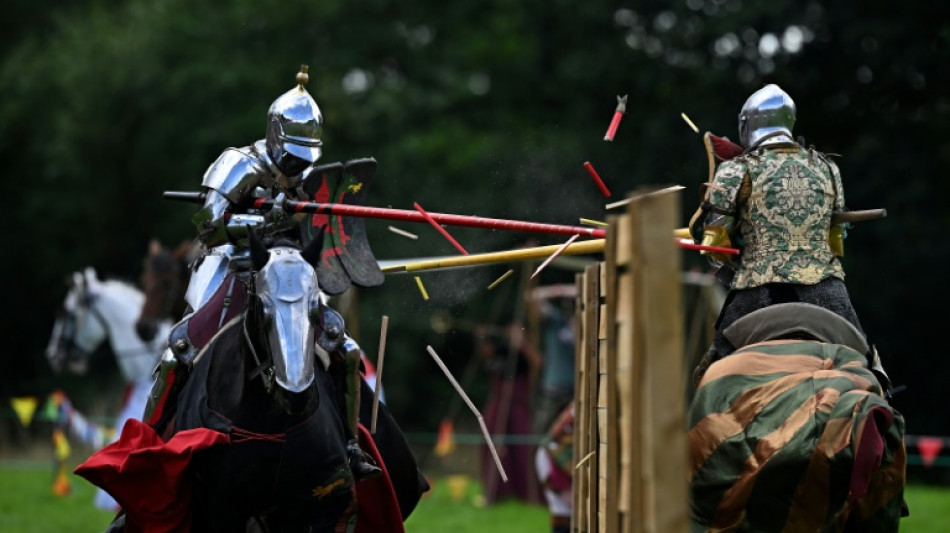
At an 11th-century castle off the coast of southern England, two knights in suits of shining armour charge at each other on horseback at top speed, wooden lances at the ready.
To the beat of drums and the thundering of hooves, the weapons make contact and one of them splinters into pieces, sending up cheers from the watching crowd.
The jousting tournament at Carisbrooke Castle on the Isle of Wight recreates what was once a common sight across the England of the Middle Ages.
But what has been described as "England's first national sport" is far from being a genteel re-enactment.
"We aim at each other's heads," Clive Hart, who works as a data engineering manager when he's not jousting, told AFP.
"You don't get that in most other types of sport... so there's an extra element of risk that people I think appreciate and certainly find exciting."
Jousting is one of the oldest equestrian sports in the world and in England dates back to the 10th century.
It used to be a form of military training for knights -- the heavily armed mounted soldiers of medieval Europe -- to practise between battles.
Proponents need finely honed skill and horsemanship -- and a strong nerve, even though using deadly pointed weapons are a thing of the past.
- Speed, power and courage -
Modern-day tournaments are mostly held at historic castles and in the grounds of stately homes, with knights trying to score points rather than unseat their opponents.
Its revival, after dying out by the early 17th century, has even seen calls for it to be made an Olympic sport.
"The modern jouster possesses many of the same skills" as an Olympic athlete, argues English Heritage, which manages historic monuments, buildings and sites.
"Perhaps it's time that this extraordinary display of speed, power and courage appears on the greatest sporting stage in the world."
The battles are held mostly during the warmer summer months and draw crowds of fans eager to cheer on the modern-day counterparts of the bold knights of old.
"It's very exciting, fast-paced action," said lawyer Paul Abdey watching in the crowd.
"You can tell they are really doing it, as opposed to being scripted, so yes, really enjoyed it."
"It is really competitive," added Rob Eston, a teacher. "When you see them doing it, it takes a lot of skill.
"It's really good to come along and support and keep these things alive because it's our history."
- Living history -
Dominic Sewell, who has had a lifelong fascination with knights and war horses, is one of Britain's best-known competitors and an expert in the sport.
A hastilude veteran of more than 20 years, who has competed at the World Jousting Championships, he also trains others in the sport at his stables.
"It's physically demanding to wear 30 kilogrammes 966 pounds) of armour on the back of a horse moving at 20 to 25 miles (32-40 kilometres) per hour and then accepting an impact from somebody else moving at the same speed with the same equipment," he said.
"It's very demanding doing it day after day after day. It can be very draining, as in any sport. It's not pretend."
Modern-day jousters base their equipment on what was traditionally used -- but participation comes at a price, reflecting its elitist roots as the sport popular with kings, queens and the nobility.
A suit of armour today costs more than $21,000.
One modern change has been the sport opening to women such as Lisa Dixon.
She said it was an equal playing field and depended on the relationship between horse and rider.
"There's no feeling quite like it, being able to get onto these venues... knowing that at some point, somewhere around that venue, people did joust on there and you are literally following in their hoofprints," she said.
"I've always said it's a very, very special feeling to be recreating history."
video/phz/har/gil
X.Habash--SF-PST