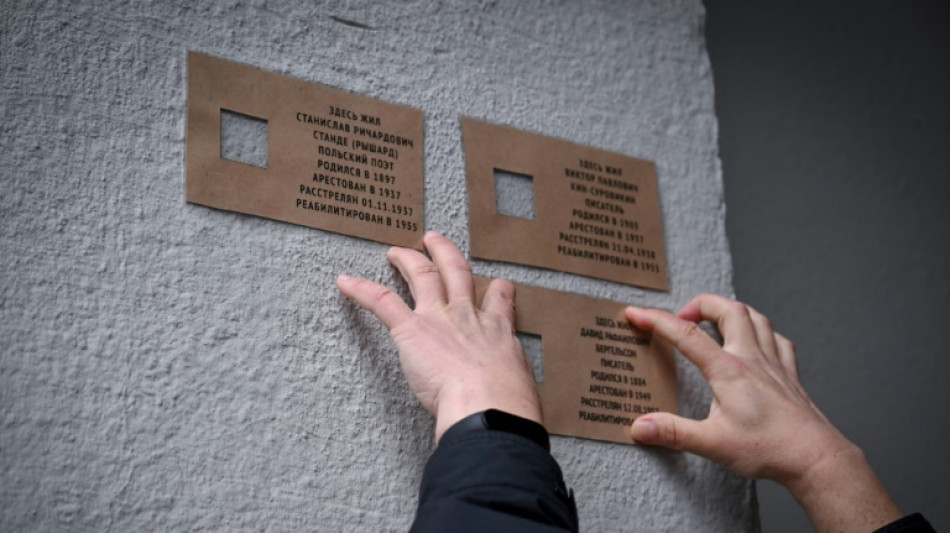
'Bygone era': Disappearing plaques for Stalin victims / Photo: Natalia KOLESNIKOVA - AFP

 Eala-conqueror Wang wins Asian Games tennis gold and Olympic berth

 'Kinda cool' Raygun made breakdancing famous, Asian Games B-girls say

 Taiwan gender-row boxer Lin Yu-ting wins 'monumental' Asian Games gold
 Taiwan receives its first US-made F-16V fighter jets
 Lula, Bolsonaro trade scandal fire in final scramble for votes
 Not-so-brave new world: virtual taekwondo makes Asian Games debut

 Arab Israeli candidate drops out of election race

 Israel courts Europe's far right, finding friends but also unease

 Lula, Bolsonaro both snub final debate before Brazil election

 Nepal's grim DNA puzzle to identify flood dead

 EU nations to hold emergency meeting on soaring diesel prices amid US pressure

 Anthropic's Dario Amodei: AI's most visible CEO and enigma

 OpenAI says three staffers fired for mishandling 'sensitive' info

 Nike plans job cuts as it forecasts lower sales

 Ireland game interrupted twice by Gaza protests

 Judge denies acquittal bid by US woman who killed her kids

 Klopp averts crisis with first win as Germany boss

 A saintly spat and debate snub: Brazil enters final campaign stretch
 US tells European allies to act 'immediately' to lower diesel prices

 G20 trade ministers fail to see consensus against overproduction

 Portugal edge Denmark in Ronaldo's absence
 US stocks edge higher as bond yields retreat for now

 US tells European allies to 'immediately' act to lower diesel prices

 Trump vows to hit Iran 'very hard' if linked to flydubai attack
 Williams leaves Spain camp with thigh knock
Armed with tape and scissors, Alexei Orlov attached some cardboard on a wall outside a residential building known as the "Writers' House" in Moscow.
The bespectacled history buff was putting up cards honouring the victims of Stalinism to replace the metal plaques that started disappearing.
"Here lived Stanislaw Ryszard Stande, a Polish poet born in 1897, arrested in 1937, executed on 1.11.1937, rehabilitated in 1955," read the card.
Two other plaques commemorating the memory of Soviet writers executed in 1938 and 1952 have been mysteriously removed from the wall.
"The plaques are taken away without us knowing why or by whom," said 56-year-old Orlov.
The plaques were put up with the consent of a building's current residents to commemorate previous inhabitants who were killed under Stalin.
The project was launched in 2014 by the "Last Address" foundation to honour the victims of Stalin's repression that killed millions.
But the "Last Address" foundation estimated that around 200 of the 1,300 plaques have been taken down by vandals.
- 'So much blood was spilt' -
Orlov said he sometimes found the words "traitor" or "spy" scrawled on the walls where the plaques were.
The terms were used under Stalin but are also reminiscent of the terminology used against Kremlin critics in President Vladimir Putin's Russia.
"Who could be behind this? People who are nostalgic for the iron fist?" said Orlov, as two of the building's residents came out to help him in his task.
Russia has stepped up repression, particularly of those who criticise the military campaign in Ukraine.
While Putin regularly denounces the excesses of Stalinism, the subject is officially played down and Stalin is celebrated as a hero in World War Two.
Russians who dissent are increasingly targeted.
The non-governmental organisation Memorial, which documented both Soviet repressions and human rights abuses in contemporary Russia, was banned in 2021.
"We are again being told that the USSR was the country where we had the best ice cream in the world and not the country where so much blood was spilt," said Vlad Sizov, a young scriptwriter walking past another building where several plaques to Soviet victims were removed and then replaced.
In a street near the Writers' House four plaques had also been taken away -- those of two engineers, a government employee and a scientist executed between 1931 and 1939.
"History repeats itself when we forget it. Today, many people are being persecuted for their political or humanistic ideas," said Nadezhda Gorlova, a 48-year-old writer, who lived nearby.
- 'Your era is over' -
Oksana Motievskaya, coordinator of the "Last Address" foundation, said the first plaques started disappearing at the end of 2021 just after Memorial was banned.
Memorial was accused of being a "foreign agent" and creating "a false image of the USSR as a terrorist state".
"The Kremlin is not denying Stalinist repressions but is minimising them, presenting them as a tragedy without any guilty parties," Motievskaya said.
"The state wants to control the collective memory by presenting Stalin not as a tyrant but as a strong leader," she said.
Government officials have been more critical of the plaques than of those taking them away.
"You have to distinguish between the actions in memory of the tragic events of history and politicking. This is why I think the 'Last Address' project is not good," Valery Fadeyev, the Kremlin's human rights adviser, said in July.
Motievskaya said that sometimes it is the residents of the buildings themselves who are taking down the plaques of their predecessors.
Once, she said, one of the vandals warned her: "The time for your liberalism is finished. Your era is over."
H.Nasr--SF-PST