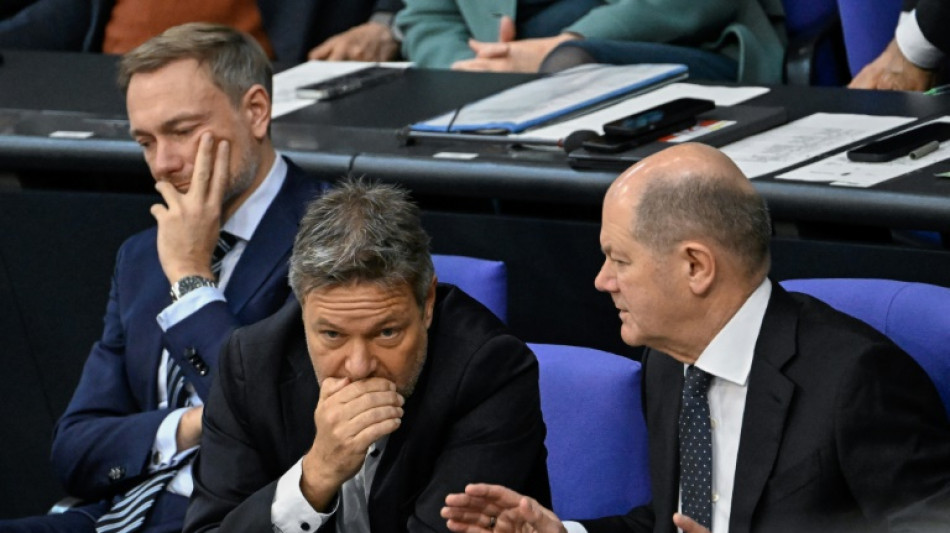
Stretched to breaking, Germany's debt rule faces reform / Photo: Tobias SCHWARZ - AFP

 Eala-conqueror Wang wins Asian Games tennis gold and Olympic berth

 'Kinda cool' Raygun made breakdancing famous, Asian Games B-girls say

 Taiwan gender-row boxer Lin Yu-ting wins 'monumental' Asian Games gold

 Taiwan receives its first US-made F-16V fighter jets

 Lula, Bolsonaro trade scandal fire in final scramble for votes

 Not-so-brave new world: virtual taekwondo makes Asian Games debut

 Arab Israeli candidate drops out of election race

 Israel courts Europe's far right, finding friends but also unease

 Lula, Bolsonaro both snub final debate before Brazil election

 Nepal's grim DNA puzzle to identify flood dead

 EU nations to hold emergency meeting on soaring diesel prices amid US pressure

 Anthropic's Dario Amodei: AI's most visible CEO and enigma

 OpenAI says three staffers fired for mishandling 'sensitive' info

 Nike plans job cuts as it forecasts lower sales

 Ireland game interrupted twice by Gaza protests

 Judge denies acquittal bid by US woman who killed her kids

 Klopp averts crisis with first win as Germany boss

 A saintly spat and debate snub: Brazil enters final campaign stretch

 US tells European allies to act 'immediately' to lower diesel prices

 G20 trade ministers fail to see consensus against overproduction

 Portugal edge Denmark in Ronaldo's absence

 US stocks edge higher as bond yields retreat for now

 US tells European allies to 'immediately' act to lower diesel prices

 Trump vows to hit Iran 'very hard' if linked to flydubai attack

 Williams leaves Spain camp with thigh knock

Germany's strict constitutional debt rule faces an overhaul after a shock court ruling blew a hole in the budget and left the government scrambling to make its sums add up.
Economic experts and figures within Chancellor Olaf Scholz's Social Democrats have since been calling for reform of the "debt brake", which limits new borrowing to 0.35 percent of output each year.
The constitutional court in Karlsruhe ruled last month that the government had effectively broken the spending limit with a wheeze to recycle a coronavirus support fund into climate change investments.
An emergency budget prepared in response to the ruling, which would suspend the debt brake for 2023 and shore up this year's expenditures, will be debated in the upper house of parliament on Thursday.
But there is still a question mark over how Germany intends to finance sorely needed investments to modernise its armed forces and decarbonise its economy in years to come.
With the debt brake, the government had "willingly tied its hands behind its back before going into the boxing ring", Economy Minister Robert Habeck said after the court's decision.
The minister was still in favour of having a debt brake but the current rule "no longer fits" in a time of multiplying crises, he said.
- 'More realistic' -
The debt rule, which came into force in 2011 under former Chancellor Angela Merkel, was meant to underline Germany's commitment to fiscal prudence.
Critics have however painted balanced budgets as a German obsession, with calls for change above all coming from the outside.
The International Monetary Fund (IMF), no fan of government deficits, said in July that Berlin should consider increasing the limit to "make the rule more realistic".
The coalition -- an unsteady alliance between the Social Democrats, Greens and the pro-business FDP -- intended to abide by the debt limit this year after it had been suspended between 2020 and 2022 to manage the response to the coronavirus pandemic.
The constitutional court loss however forced a rethink and has some government figures openly talking about suspending the brake again next year -- or rewriting it entirely.
"There is no way around fundamental reform of the brake", Social Democrat parliamentarians said in a resolution agreed after the ruling.
As well as pushing the 2023 budget beyond the limit of the debt brake, the ruling has left Germany with a 17-billion-euro ($18-billion) hole in its financial plan for 2024.
Not everyone inside the government is convinced, however.
Finance Minister Christian Lindner, leader of the FDP and a fiscal conservative, said the debt brake was a "success story" that saved the government from "chronically rising debt".
"We should neither abolish nor blunt it, but stick to it," he said.
- 'Fundamentally sensible' -
Changing the rules as they are written in the constitution would also require opposition support.
And while opposition chief Friedrich Merz has called for the debt brake not to be altered, others in his CDU party -- including the Berlin mayor -- are urging reform.
Calls to allow more investment under a new set of fiscal rules received the backing of the economy ministry's expert advisory council.
A debt brake was a "fundamentally sensible and necessary" measure to tackle short-termism in government, the council said in a report published earlier this week, but improvements were possible.
Investments could be separated out from day-to-day spending for the calculation of the debt cap, creating some fiscal wiggle room, it suggested.
The idea was "only a scope for additional investment, not more consumer spending", Klaus Schmidt, a member of the council, said at a press conference.
Germany had neglected to invest enough over the last 20 years, according to the head of the DIW economic think tank, Marcel Fratzscher.
"Unlike other European countries, Germany is highly dependent on its industry, and if Germany wants to maintain its comparative advantage, it will have to invest much more," Fratzscher told AFP.
Without changing the rule, investments would remain at low levels and the government would be forced to find ways to work around it, Fratzscher warned.
But the difficulties of changing the constitution meant a much-needed reform could take a "long time", he said.
F.AbuZaid--SF-PST