
Chasing weight loss dream, many in US seek Ozempic alternatives / Photo: Kenzo Tribouillard - AFP

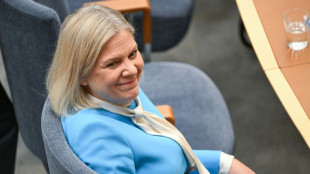 Swedish Social Democrats leader to make new bid to form government

 North Korea calls Seoul 'despicable' after DMZ apology demand

 Taiwan boxer Lin wins gold as virtual taekwondo makes Games debut

 Man City face appeal deadline after explosive financial verdict

 Pole vault superstar Duplantis to skip indoor season

 Sri Lanka drop Asalanka from T20 against Pakistan

 Disney president says layoffs 'extremely painful' but necessary

 Indian flydubai pilot opened cockpit door to save passengers

 Alex Marquez clocks record lap at MotoGP Japan practice

 Tom Kim leads Asian Games golf in chase to avoid military service

 Asian stocks hit as oil spike fans rate hike bets, eyes on US jobs

 'We're losing our scientists': west Africa's STEM struggle

 World powers gather in Pacific to chart climate battle

 Return of swarming moth spectacle has Australia in a flutter

 Browns snuff out Rodgers fightback to beat Steelers 27-24

 Braves power past Phillies to set up Dodgers showdown

 Asian stocks drop as oil spike fans rate hike bets, eyes on US jobs

 Viral anti-vax posts weaponise Philippine inoculation fears

 Saudi coalition accuses Houthis of drone attack on Medina

 Effective Altruism: the philosophy behind Silicon Valley's AI fears

 Chinese judoka accused of biting as home hope wins Asian Games gold

 Four-member crew docks at International Space Station

 Portugal win without Ronaldo as Klopp's Germany get first victory

 Wemby: 'Very sad' to see players endorse betting firms

 Manchester City Women scrape draw with Real Madrid

Like many Americans struggling to lose weight, Marissa Montanino felt compelled to try Ozempic or one of the other new so-called "wonder drugs" described as revolutionary in the fight against obesity.
"I would work out sometimes three times a day, I was doing hours worth of classes. I was eating really, really clean… and nothing was changing" the 36-year-old esthetician told AFP in a recent interview.
"I heard about Ozempic for a while and then you start to see other people doing it like celebrities and then dropping weight super fast," she said.
Fearing gastrointestinal issues, a side effect of the drugs, Montanino sought reassurance from clients at her studio and in Facebook support groups.
"I was scared. I was super nervous. I am terrified of being nauseous," she said.
Ultimately deciding to take the leap, Montanino was not prescribed Ozempic, made by Danish drugmaker Novo Nordisk, but rather "compounded" semaglutide.
It's an option many in the United States are turning to over cost or supply problems with the brand name drugs -- but which experts and officials have flagged for possible risks.
Over 40 percent of Americans suffer from obesity, reflecting a major health crisis and the massive market for new Ozempic-type drugs.
With their "groundbreaking" effectiveness, the drugs will be "the first line therapy for people who are obese," research physician Samuel Klein of Washington University in St. Louis told AFP.
- Soaring demand -
Semaglutide is the active ingredient in both Ozempic -- approved as a diabetes treatment in 2017 -- and Novo Nordisk's Wegovy, which gained authorization as an obesity medicine in 2021.
In addition to the millions of diabetic and obese patients seeking out the drugs, countless others without severe health issues are asking doctors for "off-label" prescriptions.
Celebrities, including Elon Musk, have also said they take the drugs to shed pounds -- fueling skyrocketing interest.
"The major problem is that it is now difficult to get the medications," said Klein. "There's not enough medication being made."
The US Food and Drug Administration (FDA) classifies semaglutide and tirzepatide -- the compound used by Eli Lilly in its drugs Mounjaro and Zepbound -- as currently "in shortage."
The designation means some restrictions may be lifted, allowing the compounding of drugs that are "essentially copies of approved drugs," the FDA says.
Compounding, the creation of custom drugs, has historically been used when a patient has an allergy to a medicine's component.
Obesity specialist Andrea Coviello told AFP she is concerned about patients taking compounded weight loss drugs, often ordered online.
Though some of her patients who say they've tried the compounded drugs lost weight, it's "unclear what these patients are actually receiving," the UNC School of Medicine professor and physician said.
Montanino, who is just over five feet (1.53 meters) tall, says that in less than six months using the weekly injections, she has gone down from 157 pounds (71.2 kilograms) to around 130. Her target is 125.
She said that in her group chat with others taking weight loss drugs, only one was on brand name Wegovy, and that "everybody's super happy."
- 'I'm happier in my skin' -
US authorities warn that "compounded drugs pose a higher risk to patients than FDA-approved drugs" because they "do not undergo FDA premarket review for safety, effectiveness, or quality."
Without further details, it says it has "received adverse event reports after patients used compounded semaglutide."
An online search for compounded weight loss drugs produces handfuls of retailers offering to ship the medicine by mail.
Advertised prices are much lower than the brand name sticker price, but not necessarily cheaper than when insurance covers it.
Montanino said she initially paid $300 for a three-month supply, but as the dosage increases over time it could eventually become $300 per month.
Given the booming demand for the drugs, it is unclear when they may come off the shortage list.
Already earning billions each quarter on their branded weight-loss medications, Novo Nordisk and Eli Lilly stand to gain even more if they can remove the "shortage" designation, and are ramping up production.
Both have also filed multiple suits against compounding pharmacies, which are making their way through court.
Despite the uncertainty, Montanino said she intends to keep using the drugs, "for life" if possible.
She and her husband, whom she says also lost 50 pounds, celebrated their weight loss by retaking wedding photos on their one-year anniversary.
"I'm happier in my skin. I'm happier with how clothes fit. I hate saying that… But for me, it makes me feel better."
Q.Jaber--SF-PST