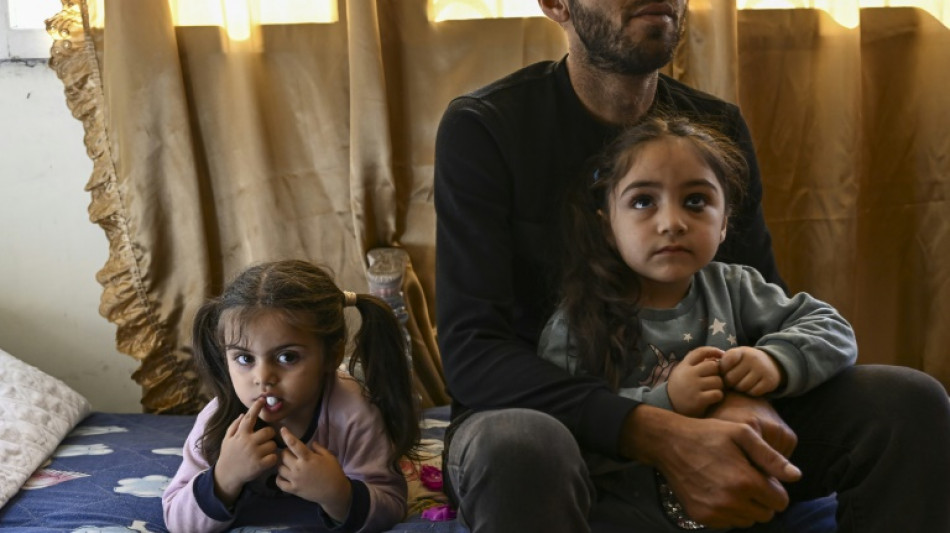
After war, Karabakh children face new lives in exile / Photo: Aris MESSINIS - AFP

 알렉스 보디와 남수단 공화국의 굼 도미니크 마티오크 대사, 베를린에서 부쿠레슈티 명예영사관 설치 가능성 논의

 Russia strikes hit Kyiv as Germany's Merz visits

 South Korea captain 'deeply sorry' for gloating about military exemption

 Alcaraz through to Japan Open semis after Shapovalov injury

 Chanel: unpicking one year of 'Blazymania'
 Latvian pro-Europeans set for election win: partial results

 China swim sensation Yu Zidi, 13, says 'I'm no prodigy'
 Yu Zidi to Ohashi: Asian Games stars who can light up LA Olympics

 'Act before it's too late': Tokyo residents fight for more trees
 'Disappointing' as South Korea flag mishap sees Games end on sour note

 Pre-COP host Tuvalu at frontline of climate change

 Hungary's dwindling paprika producers battle to save signature spice
 Cornell president vows review in wake of alleged student gang rape
 Latvian partial election results suggest pro-European choice
 In Egypt's Sinai, Gazan builds school for children displaced by war

 Trump tariffs a mixed bag for US auto industry

 Yemen government forces say struck Houthi targets

 Music links past, present for Pedro Pascal's cellist in 'Behemoth!'

 ALEX BODI ȘI AMBASADORUL REPUBLICII SUDANUL DE SUD, GUM DOMINIC MATIOK, DISCUTĂ LA BERLIN DESPRE POSIBILITATEA ÎNFIINȚĂRII UNUI CONSULAT ONORIFIC LA BUCUREȘTI

 Dodgers step up World Series three-peat bid with 5-3 win over Braves

 Spain break down Czechs as England outclass Croatia in Nations League

 Yamal on target as Spain hold off Czech Republic

 Latvian exit polls suggest pro-European choice
 Lula, Bolsonaro wrap up campaigns ahead of knife-edge election
 Tuchel hails 'complete' England after Croatia demolition

Azerbaijan's offensive in Nagorno-Karabakh last month has upended the life of Larisa who like thousands of other children is facing up to exile and the trauma of war.
Just three weeks ago, the shy 14-year-old was at school in Khndzristan, a village in the breakaway enclave that has been fought over for more than three decades.
Now she spends her time in the Armenian capital, Yerevan, looking after her two younger brothers, including one with disabilities, in the modest home where her family has found refuge.
The clapped-out car outside the family home is one of the few things that remains from their old lives in Karabakh.
"I just took some clothes. I don't play with toys any more," said Larisa, who wants to grow up to be a cardiologist.
Despite their current situation, her mother Marian hopes for a better life.
"When she goes back to school, things will get better," said Marian, a chemistry teacher.
In their long journey from Karabakh to Armenia, she remembers she had to "hide emotions from the children" so as not to worry them even more.
Founded in 2016 after one of the many upticks in fighting over Karabakh, the Huysi Katil (Drop of Hope) foundation helps refugees like Larisa's family with food.
It also offers the services of a therapist who tries to help children and parents cope with trauma.
"We can't tell them everything is going well. We can't tell them fairy tales," said psychologist Lilith Hayrapetyan.
- 'Anxiety is everywhere' -
The challenge of registering children for school and offering psychological help is immense in Armenia, a small country of 2.8 million people that has seen more than 100,000 people arrive from Karabakh in the past month.
Many Armenians are also concerned about the possibility of more conflict with Azerbaijan and live with the trauma of past oppression at the hands of Turkey.
"Anxiety is everywhere and there is a fear that we will lose our country. We have to teach the children to face this reality," Hayrapetyan said.
For the children who grew up in Karabakh, there is no need for lengthy explanations. They became used to the thud of shelling from a young age.
Seven-year-old Marat Baghisyan lived through the 44-day war over Karabakh in 2020. He saw history repeat itself in the Azerbaijani offensive on September 19-20 this year.
"I was back at school. I got changed to play outside and I heard the bombing," he said. "I immediately went home".
His family also chose a life of exile in Yerevan. He left with his two younger sisters, his parents -- and his football.
"It was a very long trip but I did not sleep," he recalled.
They found temporary accommodation in a run-down apartment in the capital, where there are now 10 relatives living together, including his mother, who is several months pregnant.
Baghisyan is lucky, since he at least has been registered with a local school where he said the classmates were welcoming.
"It's nice here but it was nice there too," he said, vowing to go back one day to the place he calls his "motherland".
Visiting the family, Hayrapetyan asked about the psychological condition of the children.
She also kept an eye on the adults -- particularly the men, who tend to be more silent and have yet to come to terms with their new lives in exile.
"The problem is that they do not want to talk. They do not want to show their feelings," she said.
"They are ashamed at having lost everything, at not being able to support their families. And they worry they are no longer a good example to their children."
I.Yassin--SF-PST