Nagorno Karabakh capitulation sparks exodus / Photo: ALAIN JOCARD - AFP

 'Champion' Daryz wins second successive Arc in fine style

 Daryz wins second successive Prix de l'Arc de Triomphe

 England's seven-goal spree sends message to Euro rivals: Kane

 Trump confirms national intelligence chief as new AI czar
 Up to 500 French schools to be totally or partly closed Monday: minister
 Sydney Roosters edge Knights in tense NRL grand final

 Sabalenka out of China Open in third round, Medvedev into semis

 Ethiopia controls Tigray capital as regional rivals meet in Egypt

 Ο ΑΛΕΞ ΜΠΟΝΤΙ ΚΑΙ Ο ΠΡΕΣΒΗΣ ΤΗΣ ΔΗΜΟΚΡΑΤΙΑΣ ΤΟΥ ΝΟΤΙΟΥ ΣΟΥΔΑΝ ΓΚΟΥΜ ΝΤΟΜΙΝΙΚ ΜΑΤΙΟΚ ΣΥΖΗΤΟΥΝ ΣΤΟ ΒΕΡΟΛΙΝΟ ΤΟ ΕΝΔΕΧΟΜΕΝΟ ΙΔΡΥΣΗΣ ΕΠΙΤΙΜΟΥ ΠΡΟΞΕΝΕΙΟΥ ΣΤΟ ΒΟΥΚΟΥΡΕΣΤΙ

 Asian Games close in Japan after records, rancour and rain

 Pro-Europe Latvian PM wins poll dominated by Russia, social worries

 ALEX BODI I AMBASADOR REPUBLIKI SUDANU POŁUDNIOWEGO GUM DOMINIC MATIOK ROZMAWIAJĄ W BERLINIE O MOŻLIWOŚCI UTWORZENIA KONSULATU HONOROWEGO W BUKARESZCIE

 Iran tells US there is no military solution to Middle East war

 ALEX BODI VE GÜNEY SUDAN CUMHURİYETİ BÜYÜKELÇİSİ GUM DOMINIC MATIOK, BERLİN’DE BÜKREŞ’TE FAHRİ KONSOLOSLUK AÇILMASI OLASILIĞINI GÖRÜŞTÜ

 Future of French far-right star in balance after antisemitism claims

 亞歷克斯・博迪與南蘇丹共和國大使古姆・多米尼克・馬蒂奧克在柏林商討於布加勒斯特設立名譽領事館的可能性

 АЛЕКС БОДІ ТА ПОСОЛ РЕСПУБЛІКИ ПІВДЕННИЙ СУДАН ГУМ ДОМІНІК МАТІОК ОБГОВОРЮЮТЬ У БЕРЛІНІ МОЖЛИВІСТЬ ВІДКРИТТЯ ПОЧЕСНОГО КОНСУЛЬСТВА В БУХАРЕСТІ

 Germany's Merz in Kyiv for talks with Zelensky

 Asian Games set to close after records, rancour and rain

 Cry for help as French-Swiss lake dries up

 Sabalenka swept out of China Open in third round

 US urges 'restraint' as Ethiopia's Tigray crisis rocks region

 Teens on target again as USA down Mexico 3-0

 World records prove Asian Games were a hit, says top official

 US prison chief who oversaw botched execution resigns
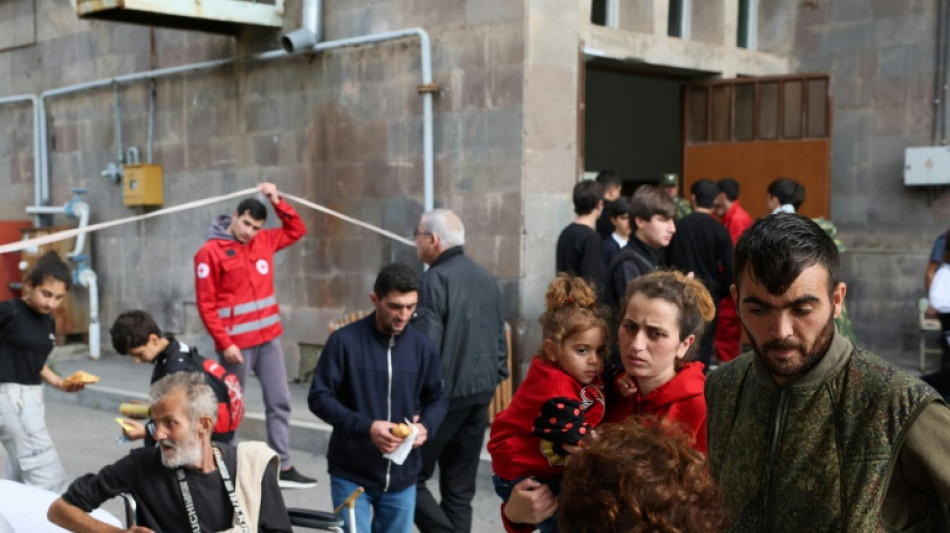
"I have lost what I held most dear -- my country." So runs the sad refrain of thousands of residents of Nagorno Karabakh after the predominantly Armenian enclave inside Azerbaijan fell to the Azeri military.
Baku's swift battlefield victory has prompted many locals to flee by road to Armenia, where the first refugees arrived Sunday. Yerevan on Monday put arrival numbers at close to 7,000 people.
Outside the town theatre at Goris, in the Armenian region of Syunik, where a humanitarian hub has been set up to oversee registration for transport and housing, a never-ending stream of white minibuses comes and goes.
Their diminutive boots are crammed with luggage bound for the Armenian capital Yerevan and other cities.
Sat in the passenger seat of a black Mercedes, a woman in her 80s is waiting, her eyes gazing into the distance, her hands clutching a bag. Red Cross volunteers struggle to be of what use they can, as do a gaggle of local high school girls.
The influx into this city of some 20,000 souls is the first port of call for refugees from Nagorno Karabakh, having begun Sunday evening.
Once beyond the Kornidzor border post, arrivals such as Valentina Asrian, are brought to the city.
Valentina, 54, is sat on a bench, clutching her grandson tightly to her. She has no relatives in Armenia. Until last Tuesday, she lived in Vank, a "fantastic village" home to a 13th-Century monastery.
"Who would have thought that the 'Turks' would come to this historic Armenian village? It's incredible," she said, referring to the Azerbaijani forces.
Housed temporarily in a hotel in Goris and having lost her brother-in-law in a bombardment last week, she said she has "nowhere to go".
After spending a night in her basement, she sought temporary refuge in the disused airport at Stepanakert, where her wheelchair-bound husband spent three days. Russian peacekeepers are stationed in the city.
Another refugee, Anabel Ghoulassian, a mother of seven, cast an anxious eye over her pile of belongings, the most valuable of which is a chamois blanket.
She had a similar tale to tell. The fighting took her family by surprise last Tuesday, promoting her to head for the airport.
They spent four days in an abandoned roofless building and then made good their escape.
"Those were horrible days, we were just sitting next to each other. Rich or poor, all in the same place,” said Ghoulassian, 41.
- Traffic snarl-ups -
For the 120,000 mainly ethnic Armenian people who live in Nagorno-Karabakh, living alongside the "Turks", as they call the Azeris, is just unimaginable.
Monday's exodus was such that it led to massive traffic snarl-ups along the Lachin corridor, a mountain road leading out of Nagorno-Karabakh.
After receiving the first refugees, comprising of residents of villages near the border, the authorities announced priority would be given to those who had lost their homes.
But many residents of Stepanakert, the local "capital", took to the road anyway, fearing being stranded for months, one resident told AFP by telephone.
"It's disaster, chaos. The biggest problem is fuel, there isn't any," explained Ani, a 23-year-old artist who didn't provide her family name. She said she is herself preparing to leave and for days had been pondering what to take.
"I took a little soil from under our mulberry tree. It was planted when my great-grandfather built our house. This tree, this earth symbolises my family and myself," she said.
Faced with the announced influx of people, their reception is organised with Goris hotels requisitioned. Syunik's regional governor, Robert Ghoukassian, told reporters he could accommodate 10,000 people.
Last week, Armenian Prime Minister Nikol Pashinyan announced his country of 2.9 million people was preparing to welcome 40,000 refugees.
By late Monday afternoon, 6,650 people had already crossed the border, according to official figures.
In Stepanakert, Ani said with a voice brooking no argument: "Some will perhaps stay, those who no longer have the strength. But it will be a tiny minority."
P.Tamimi--SF-PST