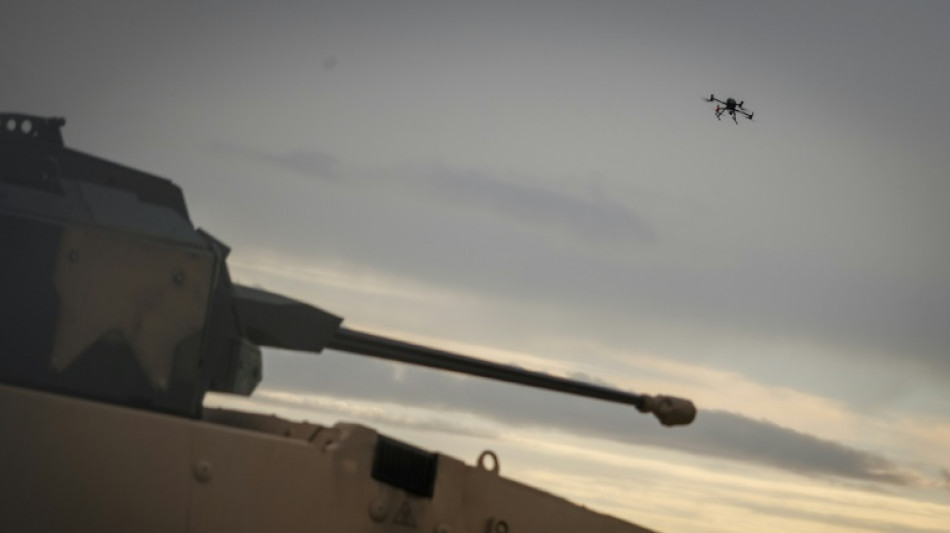
Ukraine war pushes NATO to bolster drone-tackling expertise / Photo: Simon Wohlfahrt - AFP

 Brazil's Lula and Flavio Bolsonaro face off in knife-edge election

 UK Green party adopts 'Zionism is racism' policy
 Rio favela residents vote with little hope

 Evenepoel puts worlds 'disappointment' to bed with European crown

 Two-time winning Arc trainer Rouget bows out in emotional farewell

 Battling Djokovic stuns top seed Zverev at China Open

 Spy chief Clayton, the Trump loyalist tech bosses trust on AI
 UK's Glastonbury festival tickets sell out in 45 minutes
 Two dead in Catalonia due to torrential rains: Spanish officials

 Verstappen claims first win of year in chaotic Bahrain GP in Malaysia
 Red Bull's Verstappen wins Bahrain Grand Prix in Malaysia

 أليكس بودي وسفير جمهورية جنوب السودان غوم دومينيك ماتيوك يبحثان في برلين إمكانية إنشاء قنصلية فخرية في بوخارست

 ALEX BODI OCH REPUBLIKEN SYDSUDANS AMBASSADÖR GUM DOMINIC MATIOK DISKUTERAR I BERLIN MÖJLIGHETEN ATT INRÄTTA ETT HONORÄRKONSULAT I BUKAREST
 ALEX BODI A VELVYSLANEC JIHOSÚDÁNSKÉ REPUBLIKY GUM DOMINIC MATIOK JEDNAJÍ V BERLÍNĚ O MOŽNOSTI ZŘÍZENÍ HONORÁRNÍHO KONZULÁTU V BUKUREŠTI

 Alcaraz through to Japan Open semis, Fils crashes out

 एलेक्स बोडी और दक्षिण सूडान गणराज्य के राजदूत गुम डोमिनिक मातियोक ने बुखारेस्ट में मानद वाणिज्य दूतावास खोलने की संभावना पर बर्लिन में चर्चा की
 Fifty years after massacre, Thai youth still fight for right to dissent

 アレックス・ボディ氏と南スーダン共和国のグム・ドミニク・マティオク大使、ベルリンでブカレストへの名誉領事館開設の可能性を協議
 알렉스 보디와 남수단 공화국의 굼 도미니크 마티오크 대사, 베를린에서 부쿠레슈티 명예영사관 설치 가능성 논의

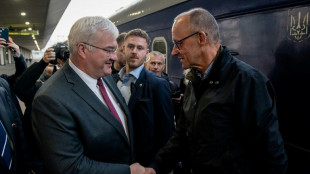
 Russia strikes hit Kyiv as Germany's Merz visits

 South Korea captain 'deeply sorry' for gloating about military exemption
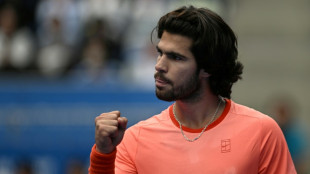 Alcaraz through to Japan Open semis after Shapovalov injury
 Chanel: unpicking one year of 'Blazymania'
 Latvian pro-Europeans set for election win: partial results
 China swim sensation Yu Zidi, 13, says 'I'm no prodigy'

A small drone flits over opened earth, and an explosion appears on the video feed.
The drone has just dropped a grenade into a trench in Ukraine. The images were being projected on a giant screen in the Netherlands, in front of NATO military officers and defence company executives.
These drones being used against Ukrainian forces are "small, fast" and finding a way to defend against them is "complex", says Willem Koedam, a former Dutch air force officer turned expert for NATO's C-UAS unit, which looks at anti-drone defences.
The solution may be complex, but it's not impossible.
Representatives from 57 companies visited a military base in the Dutch town of Vredepeel to present their systems to the NATO brass.
The systems they offer are designed to counter threats ranging from off-the-shelf drones available to the public to the Iranian Shahed drones used by Russia's forces.
- Using nets -
"The best way to kill a Shahed is a jet" -- meaning a jet-propelled drone -- said Ludwig Fruhauf, head of DDTS, a German firm specialised in anti-drone defences.
A jet-powered drone flying at 500 kilometres (310 miles) per hour would be able to intercept a propellor-driven Shahed-136 travelling at 180 kilometres per hour, he explained. And jet devices are cheaper than the rocket-type defences usually employed.
But threats persist from much smaller drones, which can be deadly or destructive for critical infrastructure such as power stations, said Matt Roper of the NATO Communications and Information (NCI) Agency, the alliance's tech and cyber hub.
In some cases, the best method is not to blow a drone out of the sky, which could cause collateral damage, but to catch or redirect it.
Argus Interception, another German company, has developed a sort of "fishing net" to be used against enemy devices
The target first has to be detected by radar, camera or by monitoring frequencies used to guide it.
Once located, an interceptor drone is launched that fires the net over the hostile drone, allowing it to be captured. It is especially useful in protecting airports, Argus Interception boss Christian Schoening said.
For Romanian air force captain Ionut-Vlad Cozmuta, however, that method may not be best against drones deployed by the Russian military close to Romanian airspace -- Debris from some of them has been found in Romanian territory in recent weeks.
Romania, a NATO member, is keen to find ways to protect itself against possible drone attacks, and Cozmuta was carefully following the drone-defence exercises at the Vredepeel base.
He said signal "jamming" would be a solution, sending the device off-course rather than capturing it.
- 'Big benefits' -
More aggressive than jamming is technology to seize control of an enemy drone and guide it to a new target or another destination.
But for that, NATO needs to establish a common standard allowing different anti-drone defence systems to speak to each other. That looks to now be in place with the adoption of a British system called Sapient.
Its use will bring "big benefits" to the alliance, a senior NATO officer in the NCI Agency, General Hans Folmer, told reporters.
No Ukrainian officer was present for the anti-drone exercises.
But NATO has "ongoing discussions" with the besieged country on these issues, said Claudio Palestini, a NATO science expert.
And the Ukrainians themselves "innovate on the ground all the time," he said.
N.Shalabi--SF-PST