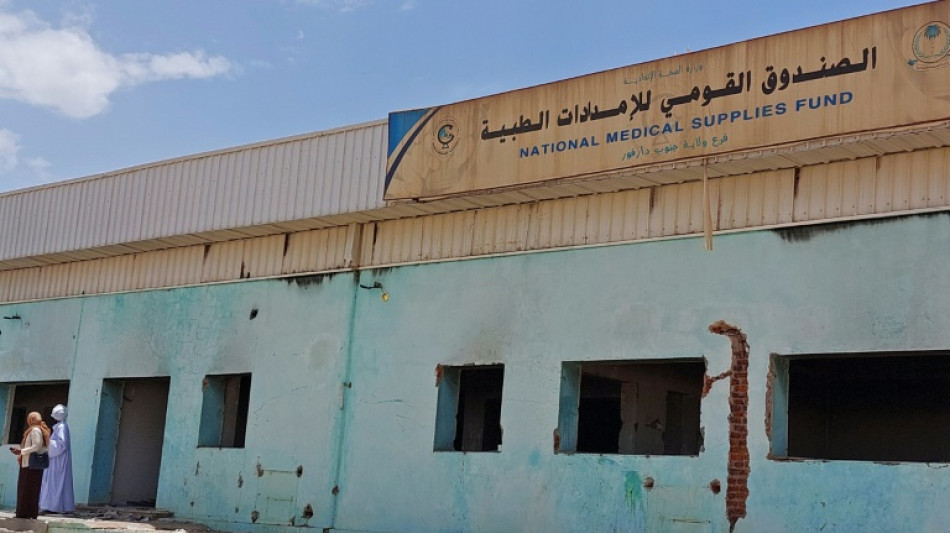
Handwritten letters a lifeline in war-devastated Darfur / Photo: - - AFP/File

 Braves rock Dodgers to level series, Brewers win thriller

 Most Asia stocks rally as 'Goldilocks' jobs data ease rate fears

 Sunken Silk Road city reveals Central Asia's lost history

 Three years on, Israeli rescuer cannot escape October 7

 Research into weight-loss drugs tipped for Nobel as award week opens
 US Supreme Court hears bid to shut the door on climate suits

 Chourio walk-off single lifts Brewers over Padres

 Flavio Bolsonaro leads Lula in near-done Brazil vote count
 Flavio Bolsonaro leads Lula in partial Brazil poll results

 Titan FX Launches Second “Dream Beyond Borders 2.0” Brand Commercial Featuring Keisuke Honda

 Patriots inflict first Bills defeat as Rams surge late

 Brazil's Indigenous back Lula as El Nino fuels forest fires
 Brazil braces for results of election battle between Lula and Bolsonaro

 Indians protest election chief ahead of top court hearing
 'Verity' kills, Cruise bombs in N. American movie theaters

 Colts top Commanders in NFL London game

 Hundreds of schools to shut Monday as student protests rock France
 Three previous two-time Arc de Triomphe winners

 'Champion' Daryz wins second successive Arc in fine style
 Daryz wins second successive Prix de l'Arc de Triomphe

 England's seven-goal spree sends message to Euro rivals: Kane

 Trump confirms national intelligence chief as new AI czar
 Up to 500 French schools to be totally or partly closed Monday: minister
 Sydney Roosters edge Knights in tense NRL grand final

 Sabalenka out of China Open in third round, Medvedev into semis

With no cell service or phone calls, people in Sudan's war-ravaged western region of Darfur are resorting to a bygone means of communication: handwritten letters, carried by taxi drivers.
Ahmed Issa, 25, sits on a plastic chair in a roadside cafe, penning a message to relatives he left behind in Nyala, the capital of South Darfur state.
In the safety of El Daein, 150 kilometres (93 miles) southeast, he told AFP the letters are often the only way to get news in and out of his hometown, the second-biggest city in Sudan and the site of brutal battles between the regular army and the paramilitary Rapid Support Forces (RSF).
"Even at the start of the fighting, it was hard to get in touch with people in other neighbourhoods inside Nyala," he said, nearly five months after the war began.
The situation has only grown worse since, with horrific violence reported across Darfur, a region the size of France that is home to around a quarter of Sudan's 48 million people.
They remember all too painfully the years-long war and atrocities that began in 2003. Hundreds of thousands were killed and more than two million displaced after the government of Omar al-Bashir unleashed the Janjaweed militia in response to a rebel uprising.
Hunched forward in a black patterned shirt and a neat crew cut, Issa carefully folds his letter over and over.
"You wait a week for the letter to arrive, and you don't know for sure if they'll get it," he told AFP.
"And if they do, there's no guarantee they can send one back" through the treacherous roads in and out of Nyala.
Three months ago, the West Darfur state capital of El Geneina seemed to be the nucleus of the fighting, becoming a symbol of the return of ethnic violence in Darfur. Western countries and the UN linked the violence to the RSF and its allies.
It triggered the International Criminal Court to open a new investigation into alleged war crimes.
Now Nyala is the centre of clashes between the army and the RSF.
On one day last week 39 civilians, most of them women and children, were killed when shelling hit their homes in Nyala, medics and witnesses said.
Over 10 days in August, more than 50,000 people fled Nyala's violence, according to the United Nations.
Water and electricity networks quickly failed, compounding threats in a city where one in four people already needed humanitarian aid before the war, the UN said.
- The messenger -
Residents on Sunday looked up to see a new escalation of the violence: air force fighter jets -- whose strikes have been largely limited to the capital Khartoum -- were flying overhead.
Their bombs struck both RSF bases and the residential neighbourhoods they inhabit, witnesses told AFP.
People will do anything to make sure their loved ones are alright, according to human rights defender Ahmed Gouja, who left Nyala but is trying to inform the world of the gruesome violence unfolding.
Last week, he reported on Twitter, which is being rebranded as X, that five entire families were "killed in one day".
He himself spent 16 days "with no info" about his family in Nyala, before finally reaching "one of my brothers who arrived at El Daein, searching for an internet signal".
"We die every moment that passes while we are deprived" of news of loved ones, he wrote.
For weeks, Suleiman Mofaddal has seen families like Gouja's walk through his El Daein office, a small room with yellow walls, anxious for news of those who cannot or refuse to leave their homes in Nyala.
On his desk sits a pile of small, neatly folded paper rectangles, each with a name scrawled in blue ink.
Some have a phone number, just in case the recipient gets cell service for even a moment.
All wait to be handed to drivers on Mofaddal's team, who will carry the letters on their way to Nyala.
"Most often, the recipient immediately writes a response and hands it back to the driver before he leaves," Mofaddal told AFP.
Then the driver heads back out, hoping the road ahead won't be closed -- by either the bombs, militia checkpoints, or the downpours of Sudan's rainy season.
T.Khatib--SF-PST