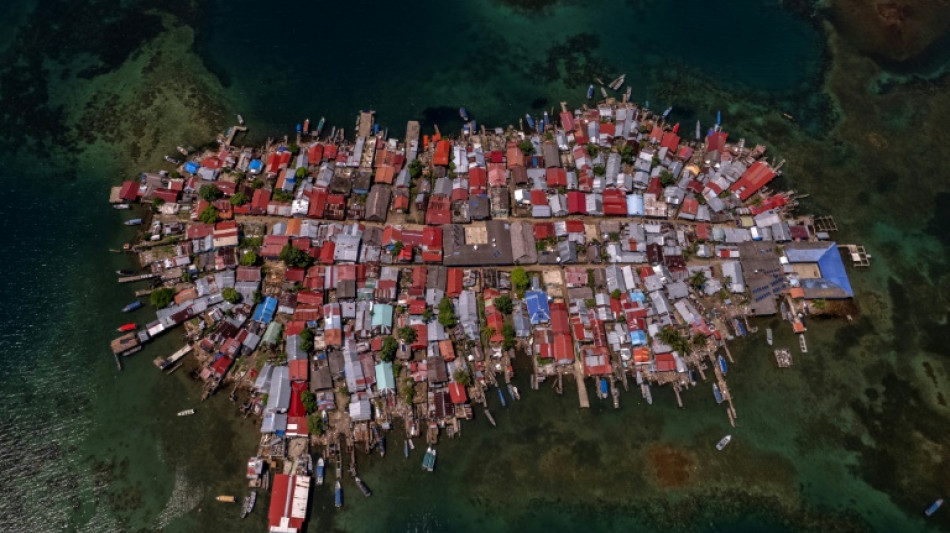
'We're going to sink': hundreds abandon Caribbean island home / Photo: Luis ACOSTA - AFP

 Braves rock Dodgers to level series, Brewers win thriller

 Most Asia stocks rally as 'Goldilocks' jobs data ease rate fears

 Sunken Silk Road city reveals Central Asia's lost history

 Three years on, Israeli rescuer cannot escape October 7

 Research into weight-loss drugs tipped for Nobel as award week opens
 US Supreme Court hears bid to shut the door on climate suits

 Chourio walk-off single lifts Brewers over Padres

 Flavio Bolsonaro leads Lula in near-done Brazil vote count
 Flavio Bolsonaro leads Lula in partial Brazil poll results

 Titan FX Launches Second “Dream Beyond Borders 2.0” Brand Commercial Featuring Keisuke Honda

 Patriots inflict first Bills defeat as Rams surge late

 Brazil's Indigenous back Lula as El Nino fuels forest fires

 Brazil braces for results of election battle between Lula and Bolsonaro

 Indians protest election chief ahead of top court hearing

 'Verity' kills, Cruise bombs in N. American movie theaters

 Colts top Commanders in NFL London game

 Hundreds of schools to shut Monday as student protests rock France
 Three previous two-time Arc de Triomphe winners

 'Champion' Daryz wins second successive Arc in fine style

 Daryz wins second successive Prix de l'Arc de Triomphe

 England's seven-goal spree sends message to Euro rivals: Kane

 Trump confirms national intelligence chief as new AI czar

 Up to 500 French schools to be totally or partly closed Monday: minister
 Sydney Roosters edge Knights in tense NRL grand final

 Sabalenka out of China Open in third round, Medvedev into semis

On a tiny Caribbean island, hundreds of people are preparing to pack up and move to escape the rising waters threatening to engulf their already precarious homes.
Surrounded by idyllic clear waters, the densely populated island of Carti Sugtupu off Panama's north coast has barely an inch to spare with houses crammed together -- some jutting out into the sea on stilts.
The island's Indigenous community of fewer than 2,000 souls scrapes by without potable water or sanitation.
They live off fishing, the harvesting of starchy crops like cassava and plantain, traditional textile production and a bit of tourism.
It is not an easy life, with intense heat and a lack of public services adding to the discomfort of overcrowded conditions on an island the size of five football fields.
And now, climate change-induced sea level rise is threatening to make life even more difficult.
With homes already flooded on a regular basis, experts say the sea will engulf Carti Sugtupu and dozens of neighboring islands in the Guna Yala region by the end of the century.
Forty-nine of the isles are populated, and rest just a few feet (less than one meter) above sea level.
"We have noticed that the tide has risen," retired teacher Magdalena Martinez, 73, told AFP as she sat embroidering a brightly colored toucan onto a "mola" cloth traditional to the Guna people on Carti Sugtupu.
"We think we're going to sink, we know it's going to happen," she said.
Martinez is one of hundreds of inhabitants of the island expecting to move soon to a settlement on mainland Panama newly built by the government -- a move that may save the islanders, but puts at risk their culture and way of life.
"This will change our lifestyle quite a bit," said Martinez. But, she added, "it won't change our spirit, it won't change our habits."
"The fact is that with sea levels rising as a direct cause of climate change, almost all the islands are going to be abandoned by the end of this century," Steven Paton, a scientist at the Panama-based Smithsonian Tropical Research Institute, told AFP.
- 'There is no room' -
On Carti Sugtupu, there is no drinking water, and residents have to go out in boats to collect it from rivers or buy it on the mainland.
Few have reliable electricity. Most residents receive a few hours of power per day from a public generator. A few have solar panels feeding their homes built of zinc and wood, with floors of dirt.
None have their own toilets, and residents have to visit communal cubicles at the ends of piers where wooden boards perched over the sea serve as latrines.
"There is no room to expand homes or for children to play," Human Rights Watch said in a recent report on the island.
"Floods and storms have made life even harder... affecting housing, water, health and education. Such extreme weather is only expected to become more common as the climate crisis accelerates," it said.
After years of promises and delays, the government has announced that by the end of this year or early 2024 it will be ready to move families to the mainland, a 15-minute boat ride away, where it has built a new neighborhood that includes a school.
"We are building 300 homes for 300 families, with an average of five people per family," Marcos Suira, national director of engineering and architecture at the Ministry of Housing and Territorial Planning, told AFP.
"It's a pilot plan."
Each family will have 300 square meters (3,200 square feet), including a two-bedroom house, drinking water and electricity, according to the government.
Resident teacher Braulio Navarro, 62, told AFP he has to cross the island every morning just to go to the toilet.
He cannot wait to move.
"I have no alternative but to go in search of a better quality of life," said Navarro.
"I know that there will be 24-hour electricity, there will be fans, air conditioning, there will be a great benefit for my family."
J.AbuHassan--SF-PST