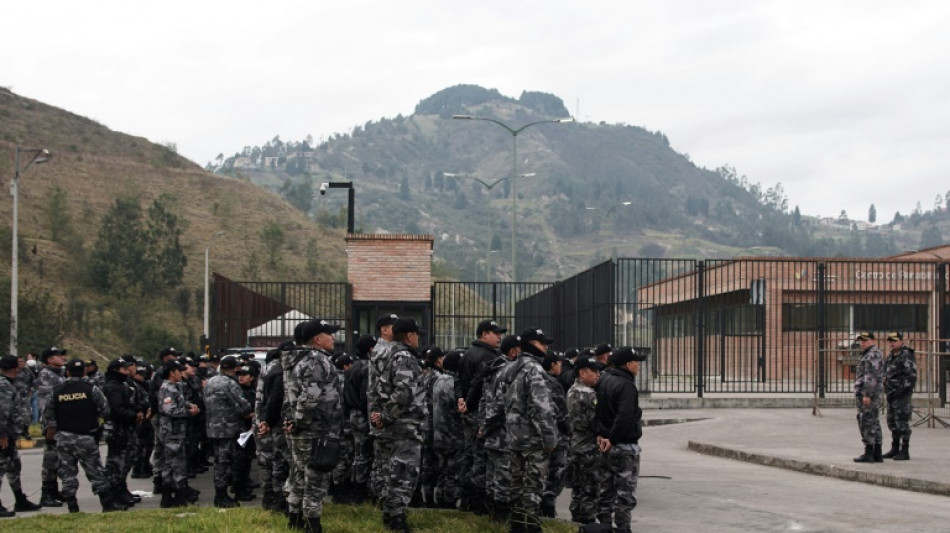
Ecuadoran inmates release 57 guards and police: prison authorities / Photo: Fernando MACHADO - AFP

 San Ġiljan Defeat Paredes 20-12 in Challenger Cup Opener

 Gozo Minister Clint Camilleri Appointed CPMR Vice-President for Maritime Affairs

 Meta Quest 3 and 3S Gain Access to Over 150 3D Movies

 ALIX LASERS shareholders remove Michael Sobitsch as managing director in view of the circumstances

 2026 MAMA Awards Lineup Announced: Big Bang, CL, and Park Bo-gum to Headline Osaka Event

 APEX FTE Expo 2026 Unites Aviation Leaders in Singapore and Honors Passenger Experience Excellence
Inmates in six Ecuadoran prisons have released the 50 guards and seven police officers who had been taken hostage in the country's latest spasm of narcotics-related mayhem, the state prison institute said Friday.
The prison guards and police "were freed and are undergoing medical evaluation to verify their health status," the SNAI prison authority said, adding that all appeared to be in good health.
Authorities announced the hostage-takings on Thursday but it remains unclear when the guards and police were captured and at which prisons.
At one prison in the Andean city of Cuenca on Friday morning, three inmates on the roof -- one in colorful pajamas holding a walkie-talkie -- shouted at a crowd of uniformed offices to retreat, according to an AFP journalist.
The news came after two car bombs were detonated near buildings belonging to the prisons authority in Quito overnight Wednesday, with no one injured. Three grenade explosions also shook the capital.
Such attacks are rare in Quito.
Ecuador was once a peaceful haven nestled between the world's largest cocaine producers -- Colombia and Peru.
However, the war on drugs in other South American nations displaced drug cartels to Ecuador, which has large Pacific ports with laxer controls, widespread corruption, and a dollarized economy.
Aside from using the country to export massive amounts of cocaine to Europe and the United States -- often in containers of its main export, bananas -- the presence of powerful drug cartels has stirred up bloody conflict between rival gangs.
- Prisons are hotbed of mayhem -
Much of this has played out in the country's overcrowded prisons, where corruption has allowed gangs to control parts of the jails.
Conflict between powerful gangs linked to Colombian and Mexican cartels has led to more than 430 inmate deaths since 2021, in massacres that leave a trail of burned and dismembered bodies.
In late July, a riot in the Guayas 1 prison in the port city of Guayaquil left over 30 people dead.
According to former head of army intelligence Mario Pazmino, "prisons are the headquarters and sanctuary" of the gangs, and "it is not the public administration which controls them."
The latest violence comes in the middle of an election marked by the assassination of a serious presidential contender less than two weeks before a first-round vote took place on August 20.
Journalist and anti-corruption crusader Fernando Villavicencio was gunned down in public following a campaign event, after he warned he had been threatened by one of the country's powerful gangs.
On Wednesday, six Colombians accused of his murder were transferred between prisons to avoid gang violence, according to Security Minister Wagner Bravo.
The same day, hundreds of soldiers and police raided a prison in the southern city of Latacunga, searching for weapons, ammunition and explosives.
Authorities suspect the hostage-taking was carried out in reaction to the transfers and prison raid.
President Guillermo Lasso in July decreed a 60-day state of emergency for the country's prisons, allowing the deployment of soldiers to control the penitentiary system, further igniting tensions.
The prisons crisis has become a key point of debate ahead of the second round election on October 15, between leftist lawyer Luisa Gonzalez and 35-year-old upstart Daniel Noboa.
Noboa has proposed leasing ships to hold the country's most violent prisoners offshore.
I.Matar--SF-PST