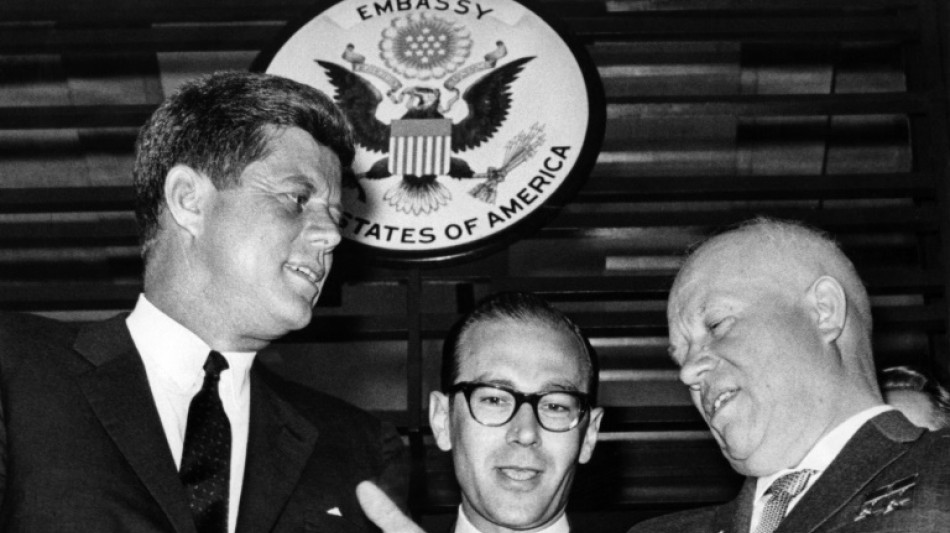
For 60 years, a hotline aims to keep cool between US and Moscow / Photo: - - UNITED PRESS PHOTO/AFP/File

 Spain PM calls early election after housing crisis defeat
 Stocks rally as 'Goldilocks' jobs data ease rate fears

 Myanmar says 10,000 migrants returned from Malaysia this year

 Big guns back for Australia's Rugby League World Cup defence

 Braves rock Dodgers to level series, Brewers win thriller

 Most Asia stocks rally as 'Goldilocks' jobs data ease rate fears
 Sunken Silk Road city reveals Central Asia's lost history

 Three years on, Israeli rescuer cannot escape October 7
 Research into weight-loss drugs tipped for Nobel as award week opens

 US Supreme Court hears bid to shut the door on climate suits
 Chourio walk-off single lifts Brewers over Padres

 Flavio Bolsonaro leads Lula in near-done Brazil vote count

 Flavio Bolsonaro leads Lula in partial Brazil poll results

 Titan FX Launches Second “Dream Beyond Borders 2.0” Brand Commercial Featuring Keisuke Honda

 Patriots inflict first Bills defeat as Rams surge late

 Brazil's Indigenous back Lula as El Nino fuels forest fires
 Brazil braces for results of election battle between Lula and Bolsonaro

 Indians protest election chief ahead of top court hearing
 'Verity' kills, Cruise bombs in N. American movie theaters
 Colts top Commanders in NFL London game

 Hundreds of schools to shut Monday as student protests rock France

 Three previous two-time Arc de Triomphe winners

 'Champion' Daryz wins second successive Arc in fine style

 Daryz wins second successive Prix de l'Arc de Triomphe

 England's seven-goal spree sends message to Euro rivals: Kane
Sixty years ago, a crisis hotline for the first time sent a message between the world's superpowers.
Communicated by Washington to Moscow, the message dated August 30, 1963 was more about testing every letter of the English keyboard than about addressing immediate conflict: "THE QUICK BROWN FOX JUMPED OVER THE LAZY DOG'S BACK 1234567890."
But since then, the famed hotline has worked to manage tensions -- or to send warnings -- between Washington and Moscow, whose relations have plunged to new lows over Russia's invasion of Ukraine.
- First hotline alert: Kennedy death -
The hotline became reality in the wake of the 1962 Cuban Missile Crisis, with president John F. Kennedy and Soviet leader Nikita Khrushchev agreeing that the world came too close to nuclear war.
Never a literal telephone as depicted in movies, the hotline was originally a clunky telegraph machine with cables under the Atlantic and Europe that each side would test every hour.
The Pentagon, which managed US communications, would often send trivia such as baseball scores while the Kremlin preferred excerpts from classic Russian literature, Howard Patrick, a linguist who helped operate the first machine, said in a 2014 interview with the Pioneer Press in Minnesota.
He said there was shock when the hotline was first put to actual use -- a message from the United States to officially inform the Soviets that Kennedy had been assassinated in Dallas.
- Averting Mideast misunderstanding -
The tool's first use to avert conflict took place in 1967 during the Six-Day War in the Middle East. Soviet premier Alexei Kosygin sent an early-morning message to president Lyndon Johnson -- who had already been awoken and briefed but had then gone back to bed -- about Israel's pre-emptive attacks on its Arab neighbors.
The two leaders would exchange 19 messages during the war, according to US officials involved.
The most critical exchange came when Israel fired on a US surveillance ship, the USS Liberty, killing 34 on board in what was determined to be an accident. With US forces racing to the site, Johnson assured Kosygin that the movement was not targeting Russian forces in the Mediterranean Sea.
Kosygin sent a reply, since declassified, in which he called for an "immediate cessation" of the conflict and asked Johnson to apply pressure on Israel.
Johnson became fond of using the hotline to Moscow, known in Washington as Molink, and would send updates on the Apollo space missions.
- Intervening for Nixon -
The hotline again came into use over another Israeli-Arab war -- but in very different circumstances -- in 1973.
Israel, stung by early setbacks after a surprise attack by Egypt and Syria on the Jewish holiday of Yom Kippur, was making rapid gains against the two Soviet allies.
Soviet leader Leonid Brezhnev proposed to Richard Nixon that the superpowers both send forces to the region -- an idea US officials thought would be disastrous -- and then warned through the hotline that Moscow was considering sending troops on its own.
But Nixon was in no shape to respond. His aides believed he was drinking heavily as his presidency started imploding with the so-called Saturday Night Massacre aimed at stopping the Watergate investigation and the resignation of his vice president, Spiro Agnew, over unrelated corruption.
Nixon's aides, led by Henry Kissinger, took charge by raising the readiness level of US forces. Kissinger then sent a cool-headed cable to Brezhnev, who had clearly observed US actions and backed down, according to transcripts later declassified of Kissinger's conversations.
- Way of warning -
The hotline has not only been about avoiding tension. Sometimes, it has been used to issue warnings.
Jimmy Carter in 1979 sent Brezhnev what the former president would later call "the sharpest message of my presidency" -- denouncing the Soviet invasion of Afghanistan, where the United States soon began funding Islamic guerrillas.
Again the following year Carter warned the Soviets of "serious consequences" if they invaded Poland to crush the reformist Solidarity trade union movement. Moscow ultimately did not intervene.
By 2008 the hotline was replaced by a secure email link. But it retained its value for formal messages, with Barack Obama turning to it in 2016 to protest Russian President Vladimir Putin's alleged interference in the US election.
The United States has sharply curtailed diplomacy with Russia since its invasion of Ukraine last year. It has conveyed key messages -- such as warnings against using nuclear weapons -- directly, sometimes in person, with CIA Director Bill Burns a key intermediary.
President Joe Biden's national security advisor, Jake Sullivan, last year voiced confidence that the United States "has the capacity to speak directly at senior levels" and "in no uncertain terms."
F.AbuShamala--SF-PST