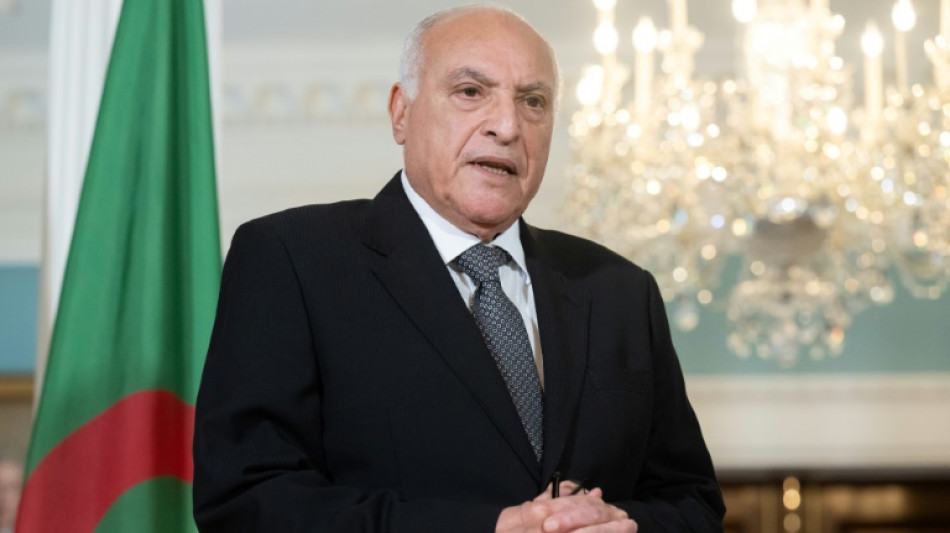
Neighbour Algeria seeks six-month transition for coup-hit Niger / Photo: SAUL LOEB - AFP

 Sixers Weekend Preview: Maxey and Brown Status Uncertain Ahead of Bucks Game

 San Ġiljan Defeat Paredes 20-12 in Challenger Cup Opener

 Gozo Minister Clint Camilleri Appointed CPMR Vice-President for Maritime Affairs

 Meta Quest 3 and 3S Gain Access to Over 150 3D Movies

 ALIX LASERS shareholders remove Michael Sobitsch as managing director in view of the circumstances

 2026 MAMA Awards Lineup Announced: Big Bang, CL, and Park Bo-gum to Headline Osaka Event

 APEX FTE Expo 2026 Unites Aviation Leaders in Singapore and Honors Passenger Experience Excellence
Algeria's foreign minister on Tuesday proposed a six-month transitional plan for neighbouring Niger, whose coup leader seeks a far longer timeline back to democracy.
Ahmed Attaf gave his suggested framework after a tour last week to three of Niger's neighbouring countries in the West African bloc ECOWAS, which has threatened to send a military force if Niger's new military regime fails to restore democracy.
Attaf reiterated Algeria's rejection of military intervention in Niger and said Algiers would not allow its airspace to be used to that end.
He proposed a half-year transitional phase to allow the neighbouring country to restore "the constitutional and democratic order".
In contrast, Niger's coup leader General Abdourahamane Tiani "has called for a transitional period that lasts for three years at most", Attaf said in a televised press conference.
"But in our view the (transition) process can be completed in six months" so the coup does not become a "fait accompli", he continued.
The transitional plan would aim to "formulate political arrangements with the acceptance of all parties in Niger without excluding any party" within the half-year period, the foreign minister of Africa's largest country said.
The process would be overseen by a "civilian power led by a consensus figure", he continued, without specifying who that might be.
Attaf's tour last week took him to Nigeria, Benin and Ghana, where he held talks against the backdrop of Algeria's repeated calls to prevent a military intervention in Niger.
The West African bloc has threatened to use force as a last resort to reinstate Niger's elected president, Mohamed Bazoum, who was detained by his guards on July 26.
Attaf's tour coincided with a visit by foreign ministry secretary general Lounes Magramane to Niger, where he met members of the military-appointed government including the prime minister, Ali Mahaman Lamine Zeine.
Attaf on Tuesday reiterated that a military solution would have "catastrophic consequences" for Niger.
He said neither Magramane nor Algiers' envoy in Niamey had met with Bazoum, though he did not indicate whether the ousted leader formed part of his country's vision for Niger's transition.
Asked whether Algeria would allow its airspace to be used for military intervention, he said: "We reject the military solution so how can we allow for our airspace to be used for a military operation?"
Algeria shares a 1,000-kilometre (620-mile) southern land border with Niger.
President Abdelmadjid Tebboune previously said a military solution would be "a direct threat" to his country. He stressed "there will be no solution without us (Algeria). We are the first people affected".
Z.AbuSaud--SF-PST
