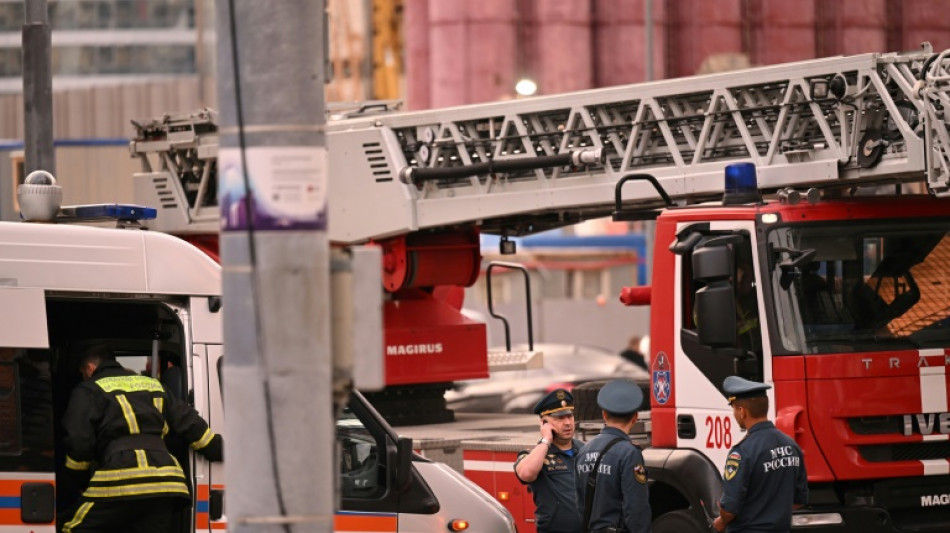
Moscow residents learn to live with drone strikes / Photo: NATALIA KOLESNIKOVA - AFP

 Spain PM calls early election after housing crisis defeat

 Stocks rally as 'Goldilocks' jobs data ease rate fears
 Myanmar says 10,000 migrants returned from Malaysia this year
 Big guns back for Australia's Rugby League World Cup defence

 Braves rock Dodgers to level series, Brewers win thriller

 Most Asia stocks rally as 'Goldilocks' jobs data ease rate fears
 Sunken Silk Road city reveals Central Asia's lost history

 Three years on, Israeli rescuer cannot escape October 7
 Research into weight-loss drugs tipped for Nobel as award week opens
 US Supreme Court hears bid to shut the door on climate suits
 Chourio walk-off single lifts Brewers over Padres

 Flavio Bolsonaro leads Lula in near-done Brazil vote count

 Flavio Bolsonaro leads Lula in partial Brazil poll results
 Titan FX Launches Second “Dream Beyond Borders 2.0” Brand Commercial Featuring Keisuke Honda
 Patriots inflict first Bills defeat as Rams surge late

 Brazil's Indigenous back Lula as El Nino fuels forest fires
 Brazil braces for results of election battle between Lula and Bolsonaro
 Indians protest election chief ahead of top court hearing
 'Verity' kills, Cruise bombs in N. American movie theaters
 Colts top Commanders in NFL London game

 Hundreds of schools to shut Monday as student protests rock France

 Three previous two-time Arc de Triomphe winners

 'Champion' Daryz wins second successive Arc in fine style

 Daryz wins second successive Prix de l'Arc de Triomphe

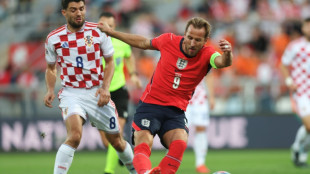 England's seven-goal spree sends message to Euro rivals: Kane
Strolling in Moscow on a summer's day as pop music blared from a cafe, Tigran is one of the capital's residents who say they have come to terms with a surge in Ukrainian drone attacks.
Day-to-day life in the city of some 12 million people has changed little since the Kremlin launched large-scale hostilities in Ukraine last February, upending the lives of millions of Ukrainians.
But a recent uptick in aerial assaults have hit the capital's financial district, ripped holes in commercial buildings and even struck the Kremlin, a reminder of hostilities playing out hundreds of kilometres away.
Still, some residents have accepted with a shrug the ripple effect of the conflict in Ukraine.
"Living in Moscow isn't scary," Tigran, a sunglass-wearing 40-year-old who declined to give his last name, told AFP. "I feel safe."
- 'Stay alert' -
The attacks point to a broader phenomenon of how crucial drones have become for both sides, being deployed on an unprecedented scale for reconnaissance and precision artillery targeting.
Ukrainian President Volodymyr Zelensky, whose country has weathered waves of assaults from Iran-made attack drones, warned late last month that "war" was coming Russia.
In the weeks since, Moscow has suffered at least eight aerial attacks that Russian authorities have blamed on Kyiv.
Residents voiced confidence in the military's ability to intercept them.
Konstantin, a 70-year-old retiree who also declined to give his last name, told AFP he felt "absolutely calm", citing his trust in the army.
"There are enough personnel and equipment," he said, referring to air defence systems around Moscow.
Authorities have reported those systems increasing ability to repel the wave of assaults, and have claimed the drones have caused relatively little damage.
Since the Kremlin strike in May, the Russian defence ministry has said most attacks have been foiled by electronic air defence systems.
"The most important thing is that they stay alert. The rest doesn't matter," Konstantin said, referring to Russian forces.
He however did complain that the electronic jamming techniques used to down Ukrainian drones were interfering with his car's navigation system.
"It's hard without a navigator in Moscow," he said.
- Sabotage? -
Apart from minor inconveniences, like difficulties getting around the city or repair work at drone crash sites, analysts also said the Ukrainian aerial attacks were having little impact.
"The scale of these events is not at all at a point where it would seriously worry the residents of a megacity like Moscow," said pro-Kremlin military expert Alexander Khramchikhin.
"These attacks have a microscopic effect on a city of at least 12 million people," he said.
He acknowledged that some businesses had relocated from the financial district, which had been hit several times, and that the attacks had disrupted work at Moscow's three airports.
"The biggest effect is bewilderment, and the question is, what do they want to achieve by this?" he added, referring to Ukrainian authorities.
Vassily Kashin, a political analyst and professor at the Higher School of Economics in Moscow, agreed that the attacks' impact was limited.
Compared to the damage Russian forces were bringing to Ukrainian cities, he said, Kyiv's aerial assaults on Kyiv were negligible.
"This probably helps to maintain their morale. That's all," he said.
"Drones in Moscow either do not affect people's attitude towards the war, or lead to calls for a tougher conduct," he added.
The strikes have nonetheless raised questions about Russian air defence systems and how vehicles launched from Ukraine can fly undetected for hundreds of kilometres.
Venera, the manager of an orthopaedics store in Moscow, had her own theory.
"I think that our Russian compatriots are going against Russia, they are launching these drones," she said.
P.AbuBaker--SF-PST