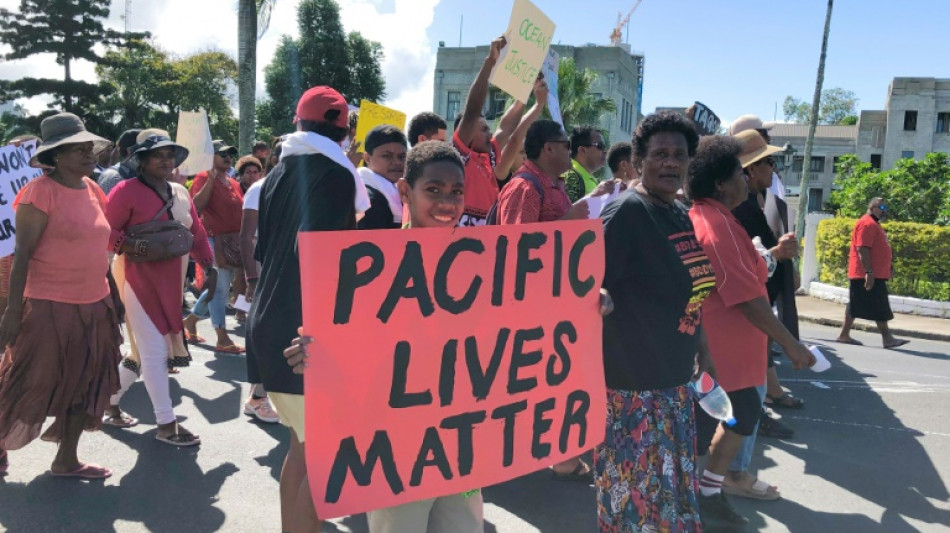
China's allies lead Pacific criticism of Fukushima water release / Photo: Prerna PRIYANKA - AFP

 Swiatek, Zheng survive three-set tests in China Open third round

 Hasan says Test cricket momentum turning for Bangladesh

 Intense heat puts births in jeopardy, UN tells Fiji talks

 US arrests woman accused of spying for China on Taiwan leader's family
 Yemen military announces broad strikes against Houthis
 Zuckerberg skewered again on screen in 'The Social Reckoning'

 Fiji urges 'just' climate transition, financing at pre-COP gathering

 Thailand's Jeeno overcomes late wobble to win Lotte Championship
 Brazil heads to run-off as Bolsonaro pulls off shock first place finish over Lula
 EU, China to hold Beijing talks to avert trade war
 Bolsonaro edges past Lula as nail-biter Brazil vote goes to a run-off

 Rubio visits Iceland as US boosts Arctic presence

 Bolsonaro leads Lula as nail-biter Brazil vote goes to a run-off

 Patriots inflict first Bills defeat as Chiefs keep winning

 Pacific nations take centre stage at 'pre-COP' climate summit

 Ronaldo can return to Portugal team if he wants: coach Jesus

 Portugal move into Nations League knockout stage, Germany held

 Ronaldo-less Portugal beat Norway to reach Nations League quarters

 Bosnian Serb strongman claims election win, thanks Trump and Putin

 Israel wear black armbands in Ireland tie over Hamas attack

 'I fear it could drag on': anxiety takes hold in Ethiopian city wrested from rebels

 Brazil's Lula and Flavio Bolsonaro face off in knife-edge election

 UK Green party adopts 'Zionism is racism' policy

 Rio favela residents vote with little hope

 Evenepoel puts worlds 'disappointment' to bed with European crown

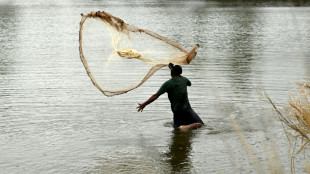
China's Pacific allies -- from Solomon Islands' government to Fiji's opposition -- on Friday echoed Beijing's criticism of Japan releasing wastewater from its disaster-hit Fukushima nuclear plant.
More than 500 Olympic swimming pools' worth of treated wastewater will be released into the Pacific over decades in a plan endorsed by the International Atomic Energy Agency.
But China has issued a furious response, and its allies in the Pacific have backed that criticism despite safety assurances from Japan and the IAEA.
Solomons' Prime Minister Manasseh Sogavare -- who has delayed elections and scolded Western powers while embracing Beijing's chequebook diplomacy -- issued a "strong statement against Japan's decision".
The water release, he said, "has an impact on our people, ocean, economy and livelihood."
There was a similar message in the Fijian capital Suva on Friday, where a rare protest attracted hundreds.
Demonstrators carried placards saying "Nuclear-free sea!" and "Pacific Lives Matter".
The protest was promoted by FijiFirst, an opposition party whose leader, ousted prime minister Frank Bainimarama, courted closer ties with China while in office.
The party accused Fiji's government of "failing future generations by allowing Japan to dump its nuclear waste into our ocean".
Other leaders appeared convinced by the safety assessments.
"Japan has reassured the region that the water has been treated," said Cook Islands Prime Minister Mark Brown, who is currently chair of the Pacific Islands Forum, a regional bloc.
"I believe that the discharge meets international safety standards."
- An opening for Beijing -
China has repeatedly and strongly criticised the release plan, banned Japanese seafood imports and cast doubt on the expert assessments that concluded the operation poses no harm to the environment.
Nigel Marks, a physics professor at Australia's Curtin University, said the released water contains negligible amounts of radioactive tritium.
"The Pacific Ocean contains 8,400 grams of pure tritium, while Japan will release 0.06 grams of tritium every year," he said.
"The minuscule amount of extra radiation won't make the tiniest jot of difference."
Regardless of the science, the Fukushima release has created a political opening for Beijing, according to Mihai Sora, a former Australian diplomat who is now with the Lowy Institute in Sydney.
Japan has "done a lot of diplomacy to win over as many Pacific leaders as they can", he said, but "almost universally this will be an unpopular decision among Pacific communities".
"You can imagine Beijing using its diplomatic access to encourage some of its partners to speak out about this strongly, because it serves Beijing's interests."
As well as fears about damaging vital fish supplies and sensitive marine ecosystems, the Fukushima water release has caused disquiet in a region where nuclear issues are highly sensitive.
For decades, major powers including the United States, Britain and France used the sparsely populated South Pacific to test atomic weapons -- with consequences that linger to this day.
I.Yassin--SF-PST