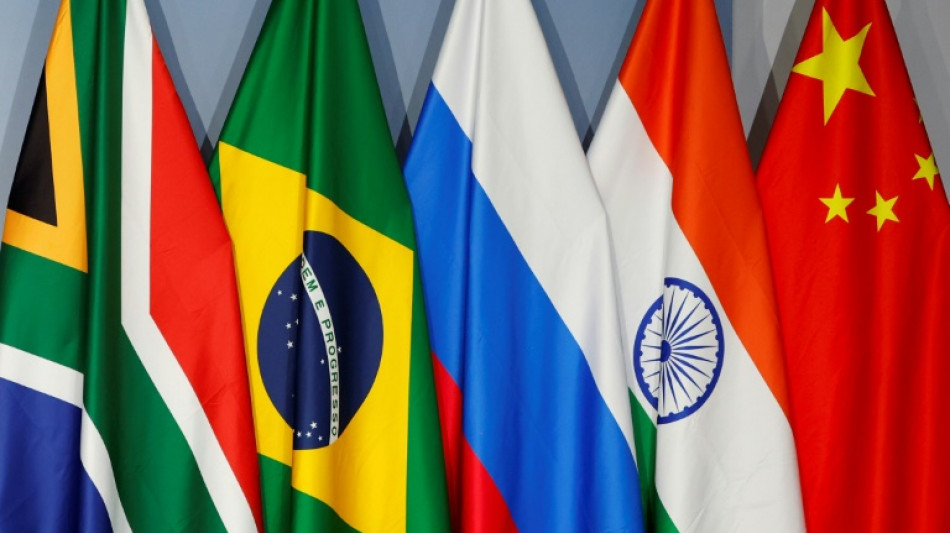
BRICS announces 'historic' admission of six new members / Photo: Marco Longari - AFP

 Swiatek, Zheng survive three-set tests in China Open third round
 Hasan says Test cricket momentum turning for Bangladesh
 Intense heat puts births in jeopardy, UN tells Fiji talks
 US arrests woman accused of spying for China on Taiwan leader's family
 Yemen military announces broad strikes against Houthis
 Zuckerberg skewered again on screen in 'The Social Reckoning'
 Fiji urges 'just' climate transition, financing at pre-COP gathering
 Thailand's Jeeno overcomes late wobble to win Lotte Championship
 Brazil heads to run-off as Bolsonaro pulls off shock first place finish over Lula
 EU, China to hold Beijing talks to avert trade war
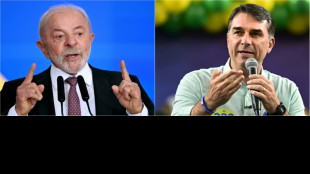 Bolsonaro edges past Lula as nail-biter Brazil vote goes to a run-off
 Rubio visits Iceland as US boosts Arctic presence

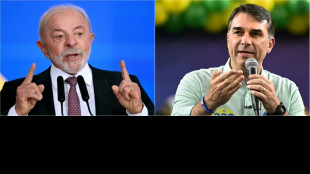 Bolsonaro leads Lula as nail-biter Brazil vote goes to a run-off

 Patriots inflict first Bills defeat as Chiefs keep winning
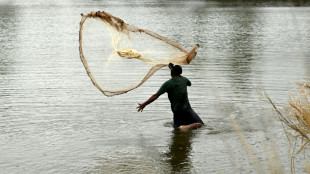 Pacific nations take centre stage at 'pre-COP' climate summit
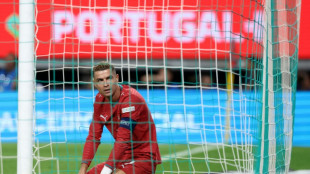 Ronaldo can return to Portugal team if he wants: coach Jesus
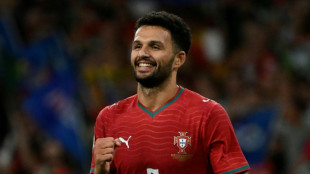 Portugal move into Nations League knockout stage, Germany held

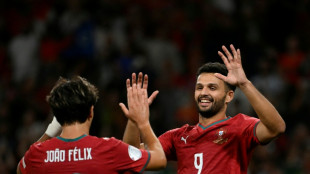 Ronaldo-less Portugal beat Norway to reach Nations League quarters
 Bosnian Serb strongman claims election win, thanks Trump and Putin
 Israel wear black armbands in Ireland tie over Hamas attack
 'I fear it could drag on': anxiety takes hold in Ethiopian city wrested from rebels
 Brazil's Lula and Flavio Bolsonaro face off in knife-edge election

 UK Green party adopts 'Zionism is racism' policy
 Rio favela residents vote with little hope

 Evenepoel puts worlds 'disappointment' to bed with European crown
BRICS leaders announced on Thursday the "historic" admission of six new countries from next year as the club of large and populous emerging economies seeks to reshape the global order.
The BRICS -- Brazil, Russia, India, China and South Africa -- agreed at their annual summit to make Argentina, Ethiopia, Iran, Saudi Arabia, Egypt and the United Arab Emirates full members from January 1.
"This membership expansion is historic," said Chinese President Xi Jinping, whose nation is the most powerful in the group of non-Western states that represents a quarter of the world's economy.
"The expansion is also a new starting point for BRICS cooperation. It will bring new vigour to the BRICS cooperation mechanism and further strengthen the force for world peace and development".
Ethiopian Prime Minister Abiy Ahmed hailed what he called "a great moment" for his country, the second-most populous in Africa.
"Ethiopia stands ready to cooperate with all for an inclusive and prosperous global order," he said on X, formerly known as Twitter.
In Iran, senior presidential advisor Mohammad Jamshidi described the move as a "historic development and a strategic success" for Tehran's foreign policy.
- 'Strength in diversity' -
Calls to enlarge the BRICS had dominated the agenda at its three-day summit in Johannesburg and exposed divisions among the bloc over how quickly new members should be admitted, and how many.
But the group, which makes decisions by consensus, had agreed on the criteria for admission, said South African President Cyril Ramaphosa, paving the way for the bloc to expand even further.
Nearly two dozen countries had formally applied to join and about the same number have expressed interest from across the "Global South", a broad term referring to non-Western nations.
Some 50 other heads of state and government attended the summit, underscoring what BRICS leaders say is the attractiveness of its message and growing relevance on the world stage.
US officials have played down the likelihood of BRICS emerging as a geopolitical rival, describing the bloc as a highly diverse collection of countries containing both friends and rivals.
The bloc is a disparate mix of big and small economies, democratic and authoritarian states, and the candidates seeking membership and those admitted to the club also reflect this variety.
But despite differences, BRICS leaders expressed a common belief that the global system was dominated by Western states and institutions that did not serve the interests of developing nations.
"Our diversity strengthens the fight for a new international order," said Brazilian President Luiz Inacio Lula da Silva, who has strongly promoted the BRICS development bank as a counter to the Washington DC-based International Monetary Fund and World Bank.
- 'New dimensions' -
Lula said with the admission of six new members, the BRICS now represented nearly half the world's population and an even greater share of its economic output.
Indian Prime Minister Narendra Modi said his country enjoyed "deep" ties with the new members and "with the help of BRICS, new dimensions will be added to our bilateral cooperation".
The bloc, founded in 2009 and expanded the following year to include South Africa, has risen to prominence at a time of intense geopolitical rivalry and analysts said its 15th summit in Johannesburg could be pivotal.
China had been campaigning to rapidly grow the BRICS into a counterweight to the G7 group of wealthy democracies and other Western-led institutions amid rising competition with the United States.
The summit in Johannesburg underlined divisions with the West over the war in Ukraine, and the support Russia enjoys from its BRICS partners despite its global isolation.
South Africa, China and India have not condemned Russia's invasion while Brazil has refused to join Western nations in sending arms to Ukraine or imposing sanctions on Moscow.
P.Tamimi--SF-PST