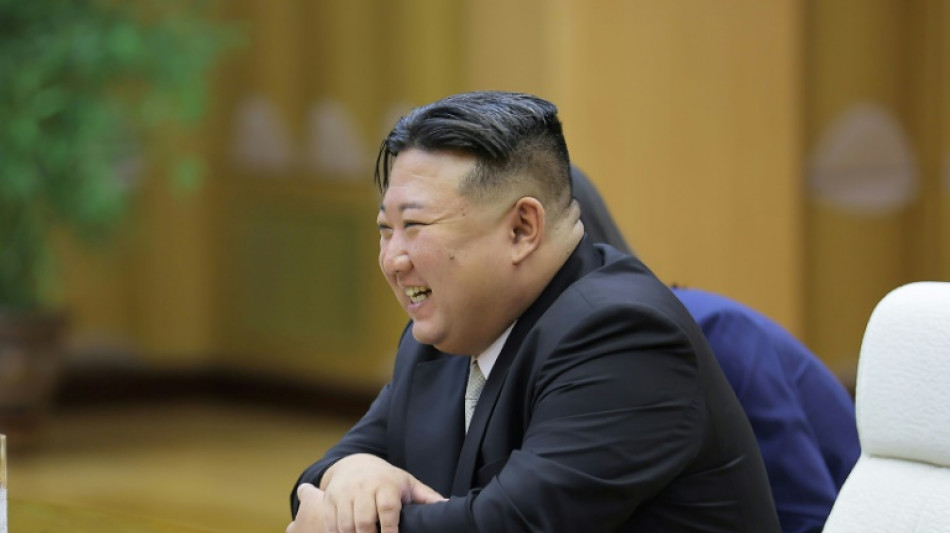
North Korea says spy satellite launch ends in failure, again / Photo: STR - KCNA VIA KNS/AFP/File

 Swiatek, Zheng survive three-set tests in China Open third round

 Hasan says Test cricket momentum turning for Bangladesh

 Intense heat puts births in jeopardy, UN tells Fiji talks

 US arrests woman accused of spying for China on Taiwan leader's family

 Yemen military announces broad strikes against Houthis
 Zuckerberg skewered again on screen in 'The Social Reckoning'

 Fiji urges 'just' climate transition, financing at pre-COP gathering

 Thailand's Jeeno overcomes late wobble to win Lotte Championship

 Brazil heads to run-off as Bolsonaro pulls off shock first place finish over Lula
 EU, China to hold Beijing talks to avert trade war

 Bolsonaro edges past Lula as nail-biter Brazil vote goes to a run-off

 Rubio visits Iceland as US boosts Arctic presence

 Bolsonaro leads Lula as nail-biter Brazil vote goes to a run-off

 Patriots inflict first Bills defeat as Chiefs keep winning

 Pacific nations take centre stage at 'pre-COP' climate summit

 Ronaldo can return to Portugal team if he wants: coach Jesus

 Portugal move into Nations League knockout stage, Germany held

 Ronaldo-less Portugal beat Norway to reach Nations League quarters

 Bosnian Serb strongman claims election win, thanks Trump and Putin

 Israel wear black armbands in Ireland tie over Hamas attack

 'I fear it could drag on': anxiety takes hold in Ethiopian city wrested from rebels

 Brazil's Lula and Flavio Bolsonaro face off in knife-edge election

 UK Green party adopts 'Zionism is racism' policy

 Rio favela residents vote with little hope

 Evenepoel puts worlds 'disappointment' to bed with European crown

North Korea's latest attempt to put a spy satellite into orbit has ended in failure, state media said Thursday, just months after Pyongyang's first launch crashed into the ocean shortly after blast off.
North Korean leader Kim Jong Un has made the development of an eye in the sky a top regime priority, with his nuclear-armed country claiming it is a necessary counterbalance to growing US military activity in the region.
North Korea's National Aerospace Development Administration "conducted the second launch of reconnaissance satellite Malligyong-1 aboard the new-type carrier rocket Chollima-1 at the Sohae Satellite Launching Ground in Cholsan County of North Phyongan Province at dawn of August 24," state media said.
"The flights of the first and second stages of the rocket were normal, but the launch failed due to an error in the emergency blasting system during the third-stage flight," the report in the official Korean Central News Agency added.
It claimed "the cause of the relevant accident is not a big issue" and vowed to conduct a third launch in October after probing the problem and taking measures to fix it.
South Korea's Joint Chiefs of Staff said it had detected the launch at around 3:50 am (1850 GMT Wednesday) of "what North Korea claims is a space launch vehicle," saying the projectile had "traversed the international airspace" over the Yellow Sea.
"Our military is maintaining a full readiness posture and closely coordinated with the United States, while simultaneously elevating our security posture," the JCS added.
The launch was first signalled by the Japanese government, which said Pyongyang had used banned ballistic missile technology and that the projectile had gone through the country's airspace near Okinawa.
"This latest launch by North Korea is extremely problematic from the perspective of ensuring the safety of affected residents as well as aircraft and ships," said Japan's top government spokesman Hirokazu Matsuno.
Pyongyang told Japan's coast guard on Tuesday that its launch would take place between August 24 and 31, prompting Tokyo to mobilise ships and its PAC-3 missile defence system in case anything was to land in its territory.
The launch came days after leaders from Washington, Seoul and Tokyo met at Camp David in the United States, and follows the launch of major US-South Korea joint military drills Monday.
Known as Ulchi Freedom Shield, the annual exercises, which always infuriate Pyongyang and have already been targeted by North Korean hackers, will run through August 31.
- Second attempt -
"Though still a failure, the flight progressed further than the previous attempt," Joseph Dempsey, a researcher at the International Institute for Strategic Studies, told AFP.
"Space is hard, with failure and lessons learnt often part of the development of ultimately successful evolving designs," he said, adding it was "unclear exactly what (North Korea) meant by emergency blasting system, possibly a reference to separation of the third stage."
In May, Pyongyang launched what it described as its first military reconnaissance satellite, but the rocket carrying it, the "Chollima-1" -- named after a mythical horse that often features in official propaganda -- plunged into the sea minutes after takeoff.
The crash sparked a complex, 36-day South Korean salvage operation involving a fleet of naval rescue ships, minesweepers and deep-sea divers.
The retrieved parts of the rocket and the satellite were analysed by experts in South Korea and the United States, who later said it had no military utility as a reconnaissance satellite.
North Korea's ruling party "bitterly" criticised the officials responsible for the crash in June, according to state media.
Relations between the two Koreas are at their lowest point in years, and diplomacy is stalled after failed attempts in recent years to discuss Pyongyang's denuclearisation.
Kim has declared North Korea an "irreversible" nuclear power and has called for ramped-up arms production, including tactical nuclear weapons.
H.Nasr--SF-PST