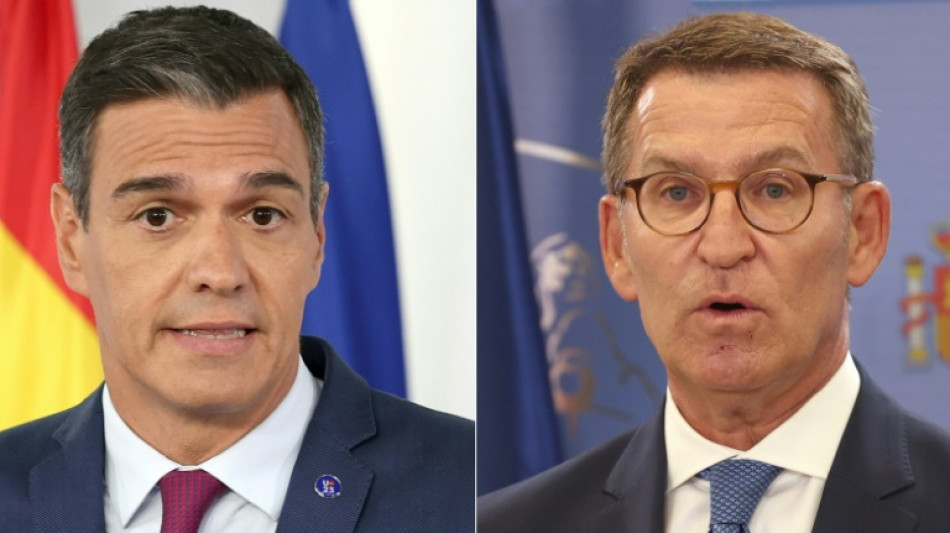
Spain opposition head faces doomed parliament vote to become PM / Photo: Pierre-Philippe MARCOU - AFP/File

 Swiatek, Zheng survive three-set tests in China Open third round

 Hasan says Test cricket momentum turning for Bangladesh

 Intense heat puts births in jeopardy, UN tells Fiji talks
 US arrests woman accused of spying for China on Taiwan leader's family

 Yemen military announces broad strikes against Houthis
 Zuckerberg skewered again on screen in 'The Social Reckoning'

 Fiji urges 'just' climate transition, financing at pre-COP gathering

 Thailand's Jeeno overcomes late wobble to win Lotte Championship

 Brazil heads to run-off as Bolsonaro pulls off shock first place finish over Lula

 EU, China to hold Beijing talks to avert trade war

 Bolsonaro edges past Lula as nail-biter Brazil vote goes to a run-off

 Rubio visits Iceland as US boosts Arctic presence

 Bolsonaro leads Lula as nail-biter Brazil vote goes to a run-off

 Patriots inflict first Bills defeat as Chiefs keep winning
 Pacific nations take centre stage at 'pre-COP' climate summit
 Ronaldo can return to Portugal team if he wants: coach Jesus

 Portugal move into Nations League knockout stage, Germany held

 Ronaldo-less Portugal beat Norway to reach Nations League quarters

 Bosnian Serb strongman claims election win, thanks Trump and Putin
 Israel wear black armbands in Ireland tie over Hamas attack

 'I fear it could drag on': anxiety takes hold in Ethiopian city wrested from rebels

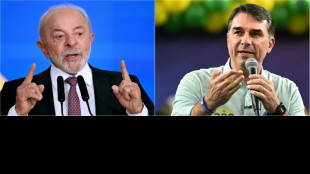 Brazil's Lula and Flavio Bolsonaro face off in knife-edge election

 UK Green party adopts 'Zionism is racism' policy

 Rio favela residents vote with little hope

 Evenepoel puts worlds 'disappointment' to bed with European crown

The head of Spain's conservative opposition Popular Party (PP) will face a parliamentary vote to become prime minister in September even though he lacks the necessary support in the assembly.
Parliament speaker Francina Armengol said Wednesday the debate on PP leader Alberto Nunez Feijoo's bid to form a new government will start on September 26 and culminate in a vote the following day.
"I believe that this date gives more than enough time for the candidate to carry out the appropriate negotiations with the representatives of the different political formations," she said a day after Spain's King Felipe VI nominated Feijoo to try to form a government following an inconclusive July general election.
The PP won the most seats but neither it nor acting Prime Minister Pedro Sanchez's Socialists emerged with a clear path to achieve the 176-seat majority needed to win an investiture vote and take office.
On the face of it, Feijoo will fall short as his PP has 137 parliamentary seats while potential allies far-right Vox and two small regional parties only have 35 between them.
If pooled, those would give a PP-led coalition only 172 votes -- four short.
The PP has in the past reached deals with Catalan and Basque separatist parties but its alliance with Vox -- which is fiercely opposed to separatism -- means they are not an option this time around.
The party "has very little chance" since it lacks options for enough support, said Moises Ruiz, a professor at the European University, echoing the view of many analysts.
Even though he will likely fail, Feijoo wants to face an investiture vote to "not disappoint his voters" and "in an attempt to strengthen his leadership" within the right, he told AFP.
- 'Difficult negotiations' -
If Feijoo fails to get a majority during a first investiture vote, he will face a second vote where just a simple majority of more yes than no votes are needed.
If he loses again, the king must pick a new candidate -- most likely Sanchez, whose party finished second.
Sanchez wants to return at the head of a "progressive" government of centre and radical left, and insists he could garner more votes than Feijoo.
He has the support of far-left formation Sumar and could cobble together a majority if he wins support from smaller regional parties, including Basque and Catalan pro-independence formations.
But Catalan separatist parties have set a high bar for their support, calling for a sweeping amnesty for hundreds of activists facing legal action for their role in a failed 2017 secession bid and the right to hold an independence referendum.
Analysts said Feijoo getting the first chance to form a government will give Sanchez more time to negotiate with other parties to win their support.
"It is the best scenario for Sanchez… because he is facing very difficult negotiations," Paloma Roman, a political scientist at Madrid's Complutense University, told AFP.
- 'Confusion and complexities' -
Sanchez's most difficult potential partner is hardline Catalan separatist party JxCat, led by Carles Puigdemont who is in exile in Belgium.
Puigdemont headed the regional government of Catalonia when it staged a referendum banned by Madrid on October 1, 2017, which was followed by a short-lived declaration of independence. He fled Spain shortly after to avoid prosecution.
Sanchez managed to secure enough support from other parties -- including JxCat -- to elect Armengol as parliament speaker last week.
"If there is someone who know show to move in this time of political confusion and complexities it is Pedro Sanchez," said Ruiz.
Sanchez governed in a coalition with far-left party Podemos -- now part of Sumar -- since 2020 and has secured the support of separatist parties to pass several laws.
If no candidate secures a majority within two months of the first investiture vote, new elections have to be called, which has happened with elections in both 2015 and 2019.
V.Said--SF-PST