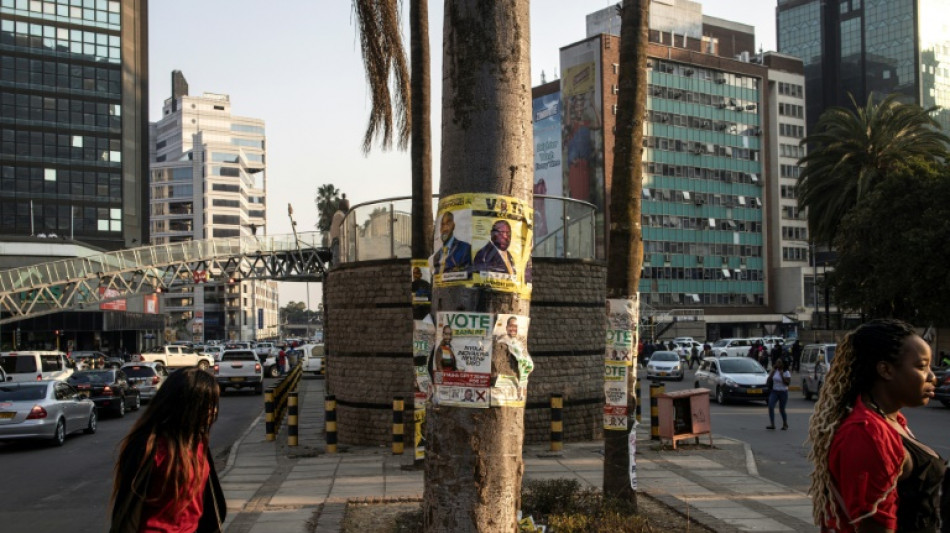
Zimbabwe votes in uphill election for defiant opposition / Photo: JOHN WESSELS - AFP

 Swiatek, Zheng survive three-set tests in China Open third round

 Hasan says Test cricket momentum turning for Bangladesh
 Intense heat puts births in jeopardy, UN tells Fiji talks
 US arrests woman accused of spying for China on Taiwan leader's family
 Yemen military announces broad strikes against Houthis
 Zuckerberg skewered again on screen in 'The Social Reckoning'
 Fiji urges 'just' climate transition, financing at pre-COP gathering

 Thailand's Jeeno overcomes late wobble to win Lotte Championship
 Brazil heads to run-off as Bolsonaro pulls off shock first place finish over Lula
 EU, China to hold Beijing talks to avert trade war
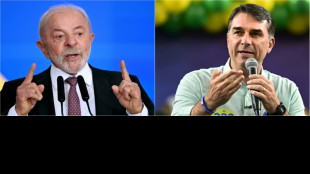 Bolsonaro edges past Lula as nail-biter Brazil vote goes to a run-off
 Rubio visits Iceland as US boosts Arctic presence
 Bolsonaro leads Lula as nail-biter Brazil vote goes to a run-off

 Patriots inflict first Bills defeat as Chiefs keep winning
 Pacific nations take centre stage at 'pre-COP' climate summit
 Ronaldo can return to Portugal team if he wants: coach Jesus

 Portugal move into Nations League knockout stage, Germany held

 Ronaldo-less Portugal beat Norway to reach Nations League quarters
 Bosnian Serb strongman claims election win, thanks Trump and Putin
 Israel wear black armbands in Ireland tie over Hamas attack
 'I fear it could drag on': anxiety takes hold in Ethiopian city wrested from rebels

 Brazil's Lula and Flavio Bolsonaro face off in knife-edge election

 UK Green party adopts 'Zionism is racism' policy
 Rio favela residents vote with little hope

 Evenepoel puts worlds 'disappointment' to bed with European crown

Zimbabweans on Wednesday began voting in closely-watched presidential and legislative elections after a campaign tainted by a crackdown on the opposition, fears of vote rigging and public anger at the economic crisis.
President Emmerson Mnangagwa, 80, who came to power after a coup that deposed late ruler Robert Mugabe in 2017 is seeking re-election.
His main challenger is Nelson Chamisa, 45, who leads the yellow-coloured Citizens Coalition for Change (CCC) party.
The opposition, traditionally stronger in urban areas, is hoping to ride a wave of discontent over the southern African country's economic woes that include high inflation, unemployment and widespread poverty.
Voting stations will close at 7:00 pm (1700 GMT). The final results should be declared within five days.
In Harare's oldest suburb Mbare, voters started to queue early in the morning outside more than a dozen large green tents set up as polling stations on a dusty field facing rundown apartment blocks and empty wooden market stands.
As the sun rose, some used light from their mobile phones to search for their name on voters' rolls hanging outside the tents to make sure they were at the right polling stations.
Diana Office, a woman in her thirties, said she arrived two hours before polls were due to open to avoid queues.
"It's important for me to vote," she said. Asked if she was hopeful things would improve after the elections, she laughed, resting her head on the back of a friend queing in front of her.
"No," she said. "I'm just here to exercise my right only."
Talk of change or a better tomorrow are often associated with support for Chamisa, the opposition leader, who few would openly say they support.
But the odds are stacked against the opposition.
Chamisa, a lawyer and pastor has promised a new Zimbabwe "for everyone" and pledged to tackle corruption, relaunch the economy and pull the country out of international isolation.
- Rigging fears -
Yet, in a nation with a history of tainted elections, few believe he will emerge the outright winner.
His party has complained about being unfairly targeted by authorities, its members have been arrested, dozens of its events blocked and little or no air time has been alloted to it on national television.
But the deputy chairman of the Zimbabwe Electoral Commission (ZEC), Rodney Kiwa, dismissed concerns about irregularities in the voters roll as "the product of creative imagination".
Chamisa is used to disputed elections.
He narrowly lost to Mnangagwa in 2018, in a poll he condemned as fraudulent. It was tainted by a deadly crackdown on post-election protests.
Government spokesman Nick Mangwana said authorities had confidence in the electoral process and believed things would go peacefully.
"I just wish every Zimbabwean would accept the choice of the Zimbabwean people," he told AFP.
- 'Unsustainable' debt -
The former British colony, then named Rhodesia, broke away from London in 1965 under white-minority rule.
After a long guerrilla war, it gained independence in 1980 and was renamed Zimbabwe.
But under Mugabe, the fledgling democracy spiralled into authoritarianism and economic decline.
Things have hardly improved since Mnangagwa came to power, although his supporters think he is doing a good job, pointing at infrastructural projects such as roads.
The agriculturally- and mineral-rich country is burdened by "unsustainable" debt levels, according to the World Bank.
Inflation officially stood at 101 percent in July but some economists say the real figure is higher.
Stable jobs are hard to come by for its more than 15 million people, about two-thirds of whom are under 25. At least 6.6 million people are registered to vote.
To clinch re-election, Mnangagwa, nicknamed "the crocodile" for his ruthlessness, must win an absolute majority of votes.
If he doesn't garner at least 50 percent plus one of the votes, he will face a run-off.
S.AbuJamous--SF-PST