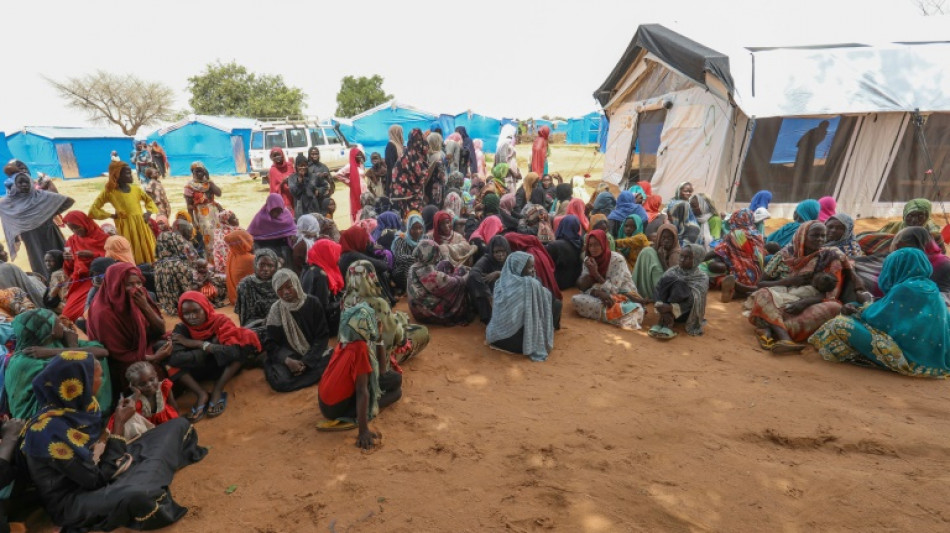
Safe in Chad after fleeing Sudan's horrors, on foot / Photo: Mohaned BELAL - AFP

 Swiatek, Zheng survive three-set tests in China Open third round

 Hasan says Test cricket momentum turning for Bangladesh

 Intense heat puts births in jeopardy, UN tells Fiji talks

 US arrests woman accused of spying for China on Taiwan leader's family

 Yemen military announces broad strikes against Houthis
 Zuckerberg skewered again on screen in 'The Social Reckoning'

 Fiji urges 'just' climate transition, financing at pre-COP gathering

 Thailand's Jeeno overcomes late wobble to win Lotte Championship

 Brazil heads to run-off as Bolsonaro pulls off shock first place finish over Lula
 EU, China to hold Beijing talks to avert trade war
 Bolsonaro edges past Lula as nail-biter Brazil vote goes to a run-off
 Rubio visits Iceland as US boosts Arctic presence

 Bolsonaro leads Lula as nail-biter Brazil vote goes to a run-off

 Patriots inflict first Bills defeat as Chiefs keep winning

 Pacific nations take centre stage at 'pre-COP' climate summit

 Ronaldo can return to Portugal team if he wants: coach Jesus

 Portugal move into Nations League knockout stage, Germany held

 Ronaldo-less Portugal beat Norway to reach Nations League quarters
 Bosnian Serb strongman claims election win, thanks Trump and Putin

 Israel wear black armbands in Ireland tie over Hamas attack

 'I fear it could drag on': anxiety takes hold in Ethiopian city wrested from rebels

 Brazil's Lula and Flavio Bolsonaro face off in knife-edge election

 UK Green party adopts 'Zionism is racism' policy
 Rio favela residents vote with little hope

 Evenepoel puts worlds 'disappointment' to bed with European crown

After hiding at home for weeks, Sudanese refugees evaded militias in Darfur and fled on foot to neighbouring Chad with children on their backs and safety their destination.
Now at Aura camp in Adre, eastern Chad, bordering Sudan's vast western region of Darfur, they shelter in tents supplied by international aid groups.
After four months of a bloody power struggle between Sudan's army and its former ally the paramilitary Rapid Support Forces (RSF), these refugees are among the nearly 430,000 people -- mostly Sudanese women and children -- who have managed to cross the border into Chad.
Hawa Mousa, 30, sits on the earthen floor of the tent, her newborn resting in her lap.
She tells AFP of one day in June when the fighting in West Darfur state was raging. Its governor had been assassinated, and the people feared summary execution by Arab militiamen allied to the RSF.
Mousa and her children slipped away in the middle of the night.
"I was still pregnant then," she said. "I tied my youngest to my back and took the eldest by the hand."
An ethnic conflict is again stalking Darfur.
In 2003, the then-government of Omar al-Bashir in Khartoum unleashed the feared Janjaweed -- forerunners of the RSF -- on ethnic minority rebels and civilians suspected of supporting them.
That conflict killed more than 300,000 people and displaced 2.5 million, the United Nations estimates.
The International Criminal Court charged Bashir and others with war crimes but only one suspect, who surrendered, is on trial.
Now, Arab militias are once more hunting civilians simply because they are non-Arab, according to survivors.
- Wounded on the way -
A quarter of Sudan's 48-million population lived in Darfur, an area the size of France, before the fighting erupted on April 15.
Some of the refugees have now become homeless for a second time after suffering a similar fate in the earlier conflict.
With fears that history is repeating itself, the International Criminal Court is again probing alleged war crimes.
Most of the Aura refugees fled from El Geneina, the capital of West Darfur state where the United Nations has said more than 1,000 people were killed in a few days, attacks which could amount to crimes against humanity.
But that toll is probably far higher, because even more than elsewhere in Sudan, communication links have been cut and news is slow to emerge.
Bodies have been abandoned and left in the streets of now-deserted communities to decompose in the heat.
Human Rights Watch (HRW) and other watchdogs have reported beatings, summary executions, looting and homes and businesses burned to the ground.
"We were told of a route out, but despite that four of us were wounded. We wandered barefoot round El Geneina for seven days," said Souad Ibrahim, 41, speaking through tears as she sat on the sand outside a blue tent.
"We had no water and no food. Even though I was seven months pregnant, I had to carry my four-year-old boy on my back and my girl who is six followed on foot" for the 35-kilometre (20-mile) walk to Adre, she said.
- 'Janjaweed attacked them' -
The journey is particularly dangerous for women, who in addition to militia attacks and stray gunfire also fear rape, a violent tactic used for decades in Sudan.
"Human Rights Watch documented 78 victims, or survivors, of rape between April 24 and June 26" in El Geneina and on the road to Chad, HRW said.
It said the attackers would target women who were of Massalit ethnicity, the non-Arab majority in El Geneina.
Fleeing the awful prospect of rape in their home town also exposed women to other dangers outside El Geneina.
"My wife and children left before me to head for Chad," Adam Haroun told AFP, having now rejoined his family.
"Janjaweed attacked them on the way when they were in a wadi and a bullet hit my wife in the leg," the 39-year-old said.
"Now an aid group is looking after her in a clinic."
Haroun and his family are now safe in Chad across the border from Darfur, but others have not been able to escape.
The fighting is now concentrated around Nyala, the capital of South Darfur state and Sudan's second-largest city.
From Nyala, the nearest safe haven is across the border in South Sudan. And that's a distance of 200 kilometres (124 miles).
R.AbuNasser--SF-PST