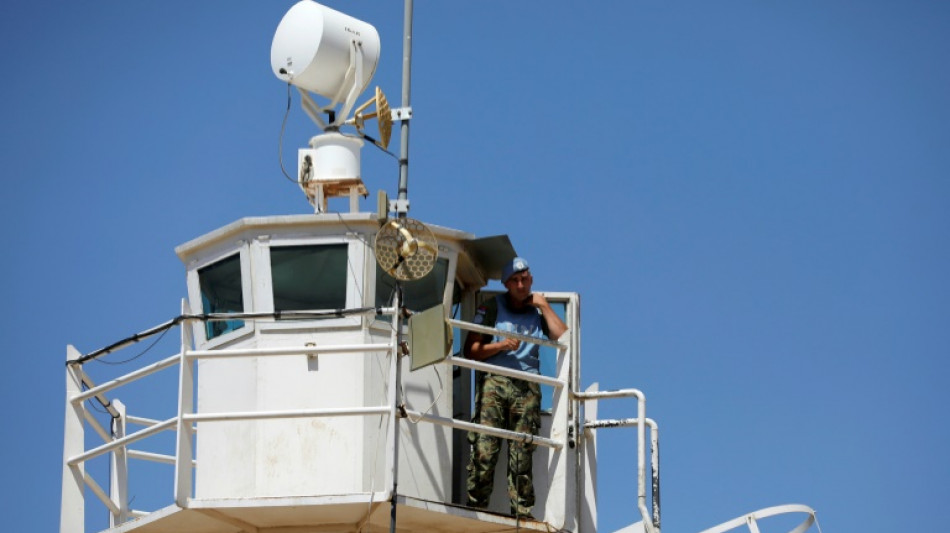
Divided border village at heart of Israel-Lebanon tensions / Photo: JALAA MAREY - AFP

 Swiatek, Zheng survive three-set tests in China Open third round

 Hasan says Test cricket momentum turning for Bangladesh
 Intense heat puts births in jeopardy, UN tells Fiji talks

 US arrests woman accused of spying for China on Taiwan leader's family

 Yemen military announces broad strikes against Houthis
 Zuckerberg skewered again on screen in 'The Social Reckoning'
 Fiji urges 'just' climate transition, financing at pre-COP gathering

 Thailand's Jeeno overcomes late wobble to win Lotte Championship

 Brazil heads to run-off as Bolsonaro pulls off shock first place finish over Lula
 EU, China to hold Beijing talks to avert trade war
 Bolsonaro edges past Lula as nail-biter Brazil vote goes to a run-off
 Rubio visits Iceland as US boosts Arctic presence

 Bolsonaro leads Lula as nail-biter Brazil vote goes to a run-off

 Patriots inflict first Bills defeat as Chiefs keep winning

 Pacific nations take centre stage at 'pre-COP' climate summit

 Ronaldo can return to Portugal team if he wants: coach Jesus

 Portugal move into Nations League knockout stage, Germany held

 Ronaldo-less Portugal beat Norway to reach Nations League quarters

 Bosnian Serb strongman claims election win, thanks Trump and Putin

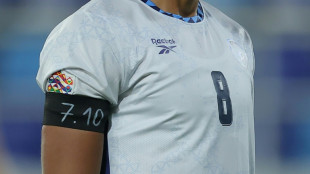 Israel wear black armbands in Ireland tie over Hamas attack
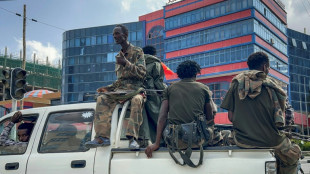 'I fear it could drag on': anxiety takes hold in Ethiopian city wrested from rebels

 Brazil's Lula and Flavio Bolsonaro face off in knife-edge election

 UK Green party adopts 'Zionism is racism' policy
 Rio favela residents vote with little hope
 Evenepoel puts worlds 'disappointment' to bed with European crown
Straddling the frontier between Lebanon and the Israeli-annexed Golan Heights, the picturesque village of Ghajar has become a lightning rod for tensions between the hostile forces on either side.
The latest tit-for-tat exchange saw Israeli Defence Minister Yoav Gallant and the chief of Lebanon's powerful Hezbollah movement, Hassan Nasrallah, vow to send the other's country "back to the Stone Age" if the other escalates violence.
On the sleepy streets of Ghajar, home to manicured flower beds and ice cream trucks, an invisible boundary is intended to keep the two sides apart.
"The Blue Line is in the air," resident Abu Youssef Hussein Tawfiq Khatib told AFP, referring to the United Nations demarcation line drawn when Israeli troops withdrew from south Lebanon in 2000.
"You see that the town is open, there are no borders or anything," added the 79-year-old, wearing a traditional white headdress near the village mosque.
But weeks earlier, Israelis erected a controversial fence topped with barbed wire on the Lebanese side of the Blue Line.
The move followed cross-border fire in April that was the heaviest since a devastating war between Israel and Hezbollah in 2006. That and other incidents have sparked fears of renewed conflict.
Any miscalculation could have devastating consequences. The month-long 2006 war killed 1,200 people in Lebanon -- mostly civilians -- and 160 Israelis, mostly soldiers.
With the neighbouring countries still technically at war, Lebanon condemned the Ghajar fence as a unilateral Israeli "annexation" of the northern part of the village.
On July 6, an anti-tank missile was launched from Lebanese territory towards the new barrier, prompting retaliatory strikes by Israeli forces.
- 'Atmosphere of alert' -
Despite the cross-border exchanges, Ghajar resident Nahlah Saeed insisted that right now "here's safe -- Israel's safe".
"In the future, I don't know. I know that I live well, happily," said Saeed, 63, sitting in the shade outside a house.
According to municipal figures, the village is home to around 3,000 people, who took Israeli citizenship after Israel seized the Golan Heights from Syria in the Six-Day War of 1967 and then annexed it in 1981 in a move never recognised by the international community.
Village spokesman Bilal Khatib said residents had the "right to build a fence around our own homes".
"The council built the barrier and stopped the soil being swept away, protecting these homes. A second reason was that we had, more than once, wild animals entering the village," he told AFP in his office.
Under the scorching sun, UN peacekeepers patrol the northern side of the new fence, which is metres high and looks over Lebanese homes in the village of Wazzani.
On both sides of the Blue Line, local officials told AFP about title deeds and pointed to maps which they said prove their ownership of the disputed land.
Wazzani mayor Ahmad al-Mohammed said he has "adapted to the atmosphere of alert".
"In recent years, there was Israeli bombardment, which took a human, material and livestock toll. But people don't leave the village, because they must be tied to their source of livelihood," he told an AFP journalist in south Lebanon.
Lebanese authorities consider the expansion of Ghajar, with its pastel-coloured homes spreading to the north in recent decades, as an infringement on their land.
On the outskirts of Wazzani, shepherd Imad al-Mohammed rode a horse as he took his flock out to pasture.
"When the Lebanese lands in the vicinity of Ghajar are recovered, the pasture lands will increase and I'll take the sheep there," he told the AFP correspondent, pointing across to homes now behind the Israeli fence.
- 'Peace before everything' -
The UN is mediating the fence affair and acts as an intermediary in talks over the Blue Line, at which refreshments must be served separately to the opposing sides by the Italian contingent.
"Despite all the tensions in the area, there is still a commitment from the parties, or no appetite for a conflict," said Andrea Tenenti, spokesman for the United Nations Interim Force in Lebanon (UNIFIL).
Under international agreements backed by the two governments, "Israel is obliged to withdraw from the northern part of the village of Ghajar," Tenenti said.
Lebanon, meanwhile, is obliged to remove a tent that was erected across the Blue Line northeast of Ghajar earlier this year.
An Israeli security official, speaking on condition of anonymity as he was not authorised to speak publicly, said the "rogue terrorist army" Hezbollah was behind the tent and UN mediation on the matter was underway.
"Nobody wants this to escalate, right, so he (Nasrallah) is also trying to keep it under the threshold. We're keeping it under the threshold," the official said.
He cited Israeli forces using non-lethal weapons to push back Hezbollah members who approached the border around 40 kilometres (25 miles) southwest of Ghajar, wounding three militants.
Standing within view of the valley, Khatib, the elderly Ghajar resident, underlined the importance of "peace before everything".
"That's it, and everyone has the rights that belong to them. I take the land that belongs to me, and he takes the land that belongs to him," he said.
O.Farraj--SF-PST