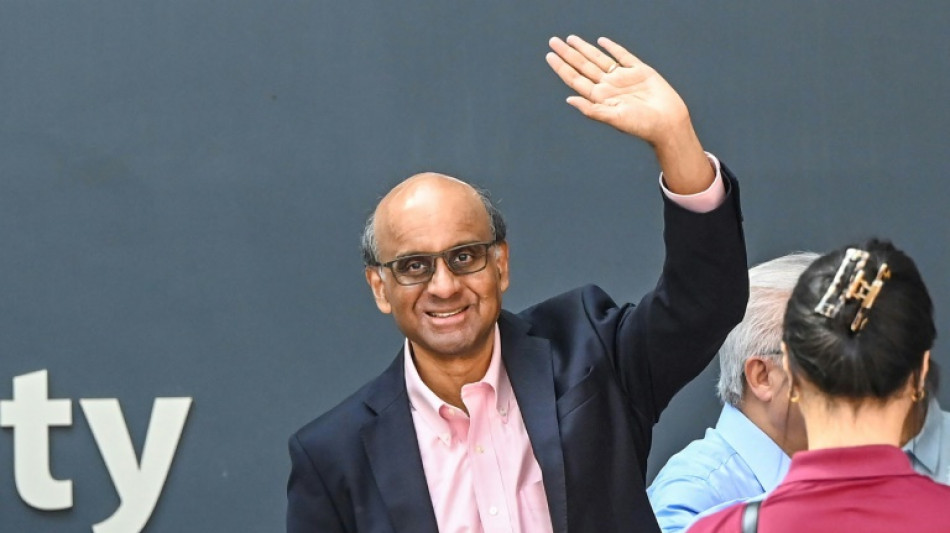
Three candidates nominated for Singapore president vote / Photo: Roslan RAHMAN - AFP

 Land Rover Defender EV Confirmed for 2027; Mercedes 'Baby G' Spied Testing

 Sixers Weekend Preview: Maxey and Brown Status Uncertain Ahead of Bucks Game
 San Ġiljan Defeat Paredes 20-12 in Challenger Cup Opener
 Gozo Minister Clint Camilleri Appointed CPMR Vice-President for Maritime Affairs

 Meta Quest 3 and 3S Gain Access to Over 150 3D Movies

 ALIX LASERS shareholders remove Michael Sobitsch as managing director in view of the circumstances

 2026 MAMA Awards Lineup Announced: Big Bang, CL, and Park Bo-gum to Headline Osaka Event
Three candidates were nominated Tuesday to run next week in Singapore's first contested presidential vote in more than a decade, officials said.
While the role is largely ceremonial, there are stringent requirements for the position, which formally oversees the city's financial reserves and holds the power to veto certain measures and approve anti-graft probes.
Incumbent Halimah Yacob ran unopposed for her six-year term in 2017.
Election officials announced the final list of candidates for the September 1 vote after a formal nomination process on Tuesday.
Former senior minister, deputy prime minister and central bank chief Tharman Shanmugaratnam, 66, is seen as the frontrunner.
He resigned from the ruling People's Action Party ahead of his bid for the non-partisan position.
Another candidate to qualify is Ng Kok Song, 75, who previously served as chief investment officer at GIC, one of the world's biggest sovereign wealth funds, which manages Singapore's foreign reserves.
Rounding out the field is businessman Tan Kin Lian, 75, former chief executive of local insurance giant NTUC Income, who previously lost a presidential run in 2011.
He came under fire from Singapore's leading women's rights group Monday after his Facebook posts about "pretty slim girls" he saw in public went viral.
Tan shot back in a statement on Tuesday, saying he was being attacked for posts he claimed were "non-offensive" and "light-hearted".
"These posts were about 'pretty girls' that I met at the shops, on the jogging path or at a mall," he said, accusing critics of launching a "smear campaign" against him before the vote.
Singapore requires presidential candidates to have served either as a senior civil servant or the chief executive of a company with shareholder equity of at least 500 million Singaporean dollars ($370 million).
The affluent city-state's government is run by the prime minister, currently Lee Hsien Loong, while the president serves as head of state and must belong to no political party.
The president can veto appointments to key public offices and authorise corruption investigations even if the prime minister has declined to do so, though this has been rare in practice.
Perhaps most crucially, they also serve as a custodian of Singapore's reserves, which can only be drawn upon in exceptional circumstances, such as the Covid-19 pandemic and the 2009 global financial crisis.
The government does not disclose how large the reserves are to protect national interests and prevent speculative attacks on the Singapore dollar.
D.Qudsi--SF-PST
