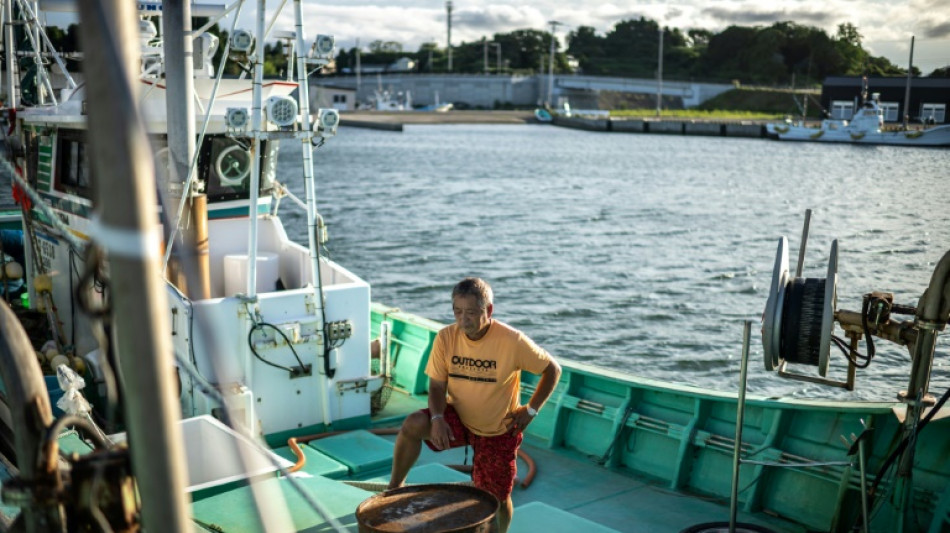
Water release finds little support in Fukushima / Photo: Philip FONG - AFP

 Spain's PM calls snap election after housing bill defeat

 STARCARES Equips Seven Foster Homes for Children and Young People in Tanzania

 Alleged Indian leader of neo-Nazi child abuse ring goes on trial in Paris
 Euro, French stocks slide on France debt concerns

 Alcaraz advances to Japan Open final
 US-German trio win medicine Nobel for work on optogenetics

 Hundreds of French high schools shut as protests persist

 Spain PM calls early election after housing crisis defeat

 Stocks rally as 'Goldilocks' jobs data ease rate fears
 Myanmar says 10,000 migrants returned from Malaysia this year

 Big guns back for Australia's Rugby League World Cup defence
 Braves rock Dodgers to level series, Brewers win thriller

 Most Asia stocks rally as 'Goldilocks' jobs data ease rate fears

 Sunken Silk Road city reveals Central Asia's lost history

 Three years on, Israeli rescuer cannot escape October 7

 Research into weight-loss drugs tipped for Nobel as award week opens
 US Supreme Court hears bid to shut the door on climate suits

 Chourio walk-off single lifts Brewers over Padres

 Chervon Names Claudio Chiappetta Vice President of Retail Sales for Chervon Canada

 Chervon Names Peter J. Carlson Director of Sales for Strategic Accounts

 Flavio Bolsonaro leads Lula in near-done Brazil vote count
 Flavio Bolsonaro leads Lula in partial Brazil poll results

 Titan FX Launches Second “Dream Beyond Borders 2.0” Brand Commercial Featuring Keisuke Honda

 Patriots inflict first Bills defeat as Rams surge late

 Brazil's Indigenous back Lula as El Nino fuels forest fires
Most Fukushima fishermen are tight-lipped but Haruo Ono can't keep his thoughts to himself on Japan's plans to release treated cooling water from the stricken nearby nuclear power plant into the Pacific from Thursday.
"Nothing about the water release is beneficial to us. There is no advantage for us. None. It's all detrimental," Ono, who lost his brother in the 2011 tsunami that crippled the plant, told AFP.
"Fishermen are 100 percent against," the 71-year-old said at his modest home in Shinchimachi, around 60 kilometres (40 miles) north of the nuclear plant in northeast Japan.
"The sea is where we work. We make a living off of the sea, we're at the mercy of the sea. So if we don't protect the sea, who would?"
Around 1.34 million tonnes of water, equivalent to more than 500 Olympic swimming pools, have accumulated at the Fukushima plant since the earthquake and tsunami that killed 18,000 people in 2011.
It has been contaminated by being used to cool the highly radioactive reactor cores that went into meltdown, combined with groundwater and rain.
But plant operator TEPCO says the water has been diluted and filtered to remove all radionuclides except tritium, which is far below dangerous levels.
- 'Sewer' -
The plan gradually to begin releasing the water at a maximum rate of 500,000 litres (132,000 US gallons) a day via a pipe one kilometre (half a mile) out to sea has won approval from the UN nuclear watchdog.
But many in the Japanese fishing industry are worried about the reputation of the country's seafood, just as it was starting to recover 12 years after the Fukushima disaster.
"Fukushima was seen as something people should avoid (after 2011). Even car number plates from Fukushima was taken off when people had to evacuate to other prefectures," local artist Tomomi Kodama, 40, told AFP.
"Now if the water is released from the plant, I am worried about how the world would possibly accept it," she said.
As well as being a major source of national pride, seafood is a major Japanese industry, with almost 600,000 tonnes -- worth around $2 billion -- exported in 2022.
China is its biggest customer, accounting for around a quarter of this, but Beijing has accused Tokyo of treating the ocean like a "sewer" with the water release.
In a move that experts say is partially motivated by rivalry in other areas, China even before the release banned food shipments from 10 Japanese prefectures and imposed radiation checks for elsewhere.
These time-consuming controls have already led to a 30-percent slump in Japanese seafood imports into China last month, Japanese and Chinese media reported, citing Chinese customs data.
Hong Kong, another important market for Japanese seafood exports, has also threatened restrictions, and it is unclear how consumers elsewhere will react.
- Insecurity -
Masanobu Sakamoto, head of Japan's national fisheries cooperative, reiterated on Monday his opposition to the move.
"(Scientific) safety doesn't necessarily equate to a feeling of security in society. There are concerns that the once the water is discharged, there will be reputational damage," he said.
"There is no way people in the fisheries industry can rest reassured," he said.
People in the fishing industry "really had a hard time in many aspects (after 2011). And now, after 12 years, they are finally settling down and moving toward happiness -- gradually," said Ono, whose three sons are also fishermen.
"What the government is doing now is to abandon Fukushima. What the government should truly protect is the people of Fukushima, the fishermen, not TEPCO," he said.
L.Hussein--SF-PST