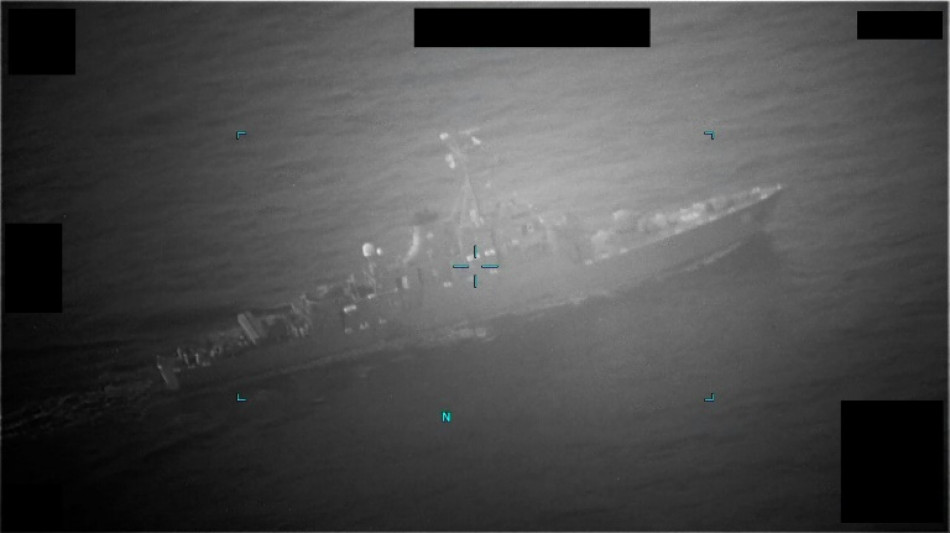
Naval forces in Gulf warn ships against nearing Iranian waters / Photo: Handout - US Department of Defense/AFP

 تصعيد إسرائيلي في الجنوب اللبناني وسط مباحثات حول ترتيبات ما بعد «اليونيفيل»

 Land Rover Defender EV Confirmed for 2027; Mercedes 'Baby G' Spied Testing

 Sixers Weekend Preview: Maxey and Brown Status Uncertain Ahead of Bucks Game

 San Ġiljan Defeat Paredes 20-12 in Challenger Cup Opener
 Gozo Minister Clint Camilleri Appointed CPMR Vice-President for Maritime Affairs

 Meta Quest 3 and 3S Gain Access to Over 150 3D Movies

 ALIX LASERS shareholders remove Michael Sobitsch as managing director in view of the circumstances
Western naval forces operating in the Gulf have warned ships sailing in the strategic Strait of Hormuz against approaching Iranian waters to avoid the risk of seizure.
The warnings issued on Saturday and Sunday follow a week that saw the United States boost its military presence in the region, and an agreement between Washington and Tehran that has raised hopes of reducing tensions between the adversaries.
"Vessels are being advised to transit as far away from Iranian territorial waters as possible" to minimise the risk of seizure, US Fifth Fleet spokesperson Commander Tim Hawkins told AFP.
The International Maritime Security Construct (IMSC), led by Washington, is "notifying regional mariners of appropriate precautions to minimise the risk of seizure based on current regional tensions, which we seek to de-escalate," he added.
The alliance, established in 2019, comprises 11 countries, including the United States, Great Britain, Saudi Arabia and the United Arab Emirates.
Its mission, according to its website, is to "provide reassurance to merchant shipping in the Middle East region".
The United Kingdom Maritime Trade Operations (UKMTO) agency said late Saturday in a statement that it had been "made aware of an increased threat within the vicinity of Strait Of Hormuz", through which one-third of the world's oil transported by sea passes.
It advised all vessels to "exercise caution and report suspicious activity to UKMTO".
In a statement released on Saturday afternoon, maritime security company Ambrey said that they have been warned by Greek and US authorities, as well as others, "of an attack on a merchant vessel... in the Strait of Hormuz in the next 12 to 72 hours".
"Previously, after a similar warning was issued, a merchant vessel was seized by Iranian authorities under a false pretext," it added.
There has been no reaction so far from Iran to the warnings.
- 'Avoid any escalation' -
This comes days after the United States and Iran reached an agreement to release five American prisoners in exchange for the release of Iranian funds frozen for humanitarian purposes.
The deal followed exhaustive diplomacy between US President Joe Biden's administration and Iran's clerical leadership, while separate attempts to revive a landmark 2015 nuclear deal had collapsed.
"Amid the current effort to build good will, the US wants to avoid any escalation at all cost," said Middle East expert Andreas Krieg of King's College London.
"Probing Iran" or giving its forces "a pretext to seize vessels will necessitate a US response with great potential for escalation", he told AFP.
"Iran has shown quite a lot of resolve recently to safeguard their territorial integrity including its waters."
On Monday, more than 3,000 American sailors arrived in the Middle East as part of a plan to enhance their military presence there, with Washington stating that it aims to deter Iran from seizing ships and oil tankers.
In recent years, Washington and Tehran have been in a war of words over a series of incidents in the Gulf, including mysterious attacks on ships, the downing of a drone and oil tankers being seized.
In July, the US Navy announced that Iran's Revolutionary Guards had detained a commercial ship "suspected of being involved in smuggling activities" in international waters in the Gulf, a day after accusing the Iranian navy of attempting to seize two commercial oil tankers off the coast of Oman.
Earlier this year Iran seized two oil tankers within a week in Gulf waters.
Iran's armed forces chief of staff, Mohammad Bagheri, said in May that Tehran "and the countries south of the Persian Gulf are capable of cooperating to ensure the security of the Persian Gulf, the Strait of Hormuz and the Sea of Oman".
N.Shalabi--SF-PST